Sligo
Dark Lies the IslandSligo is a setting where ordinary movement through town and countryside is repeatedly interrupted by natural danger and human violence. Its railway, streets, and Garavogue River anchor routines of punctual travel and care for wildlife, while the surrounding floodwaters and an assault expose how quickly familiar places can become threatening.
Setting and Routes
Sligo appears as a town connected to the high land of the south county by the railway. On his journey toward Sligo, Donie measures the train against its timetable, anxiously tracking delays and the time at each stop. The sequence carries him through Collooney, the last stop before town, and turns arrival into a personal test of order: reaching the station within the scheduled minute brings lightness to his step.
The town’s streets are also mapped through Donie’s habits. He normally looks at equipment in a mountaineering shop, greets a wood carver, and takes a shortcut through an arcade, counting paving slabs. These small landmarks make Sligo a known and navigable place, defined by repeated attention rather than grand views.
The Garavogue and Everyday Care
After arriving, Donie goes to the Garavogue River to check on the ducks. Where the river breaks before the bridge, its current can sweep young mallards away from their families. On earlier occasions, Donie has carefully descended the stone steps and crossed the rocks to return displaced ducklings to their broods; once, schoolgirls applauded his efforts. His routine gives the river a double character: it is a place of recurring danger for wildlife and of patient, practical care.
On the morning described, the water seems calm enough, but Donie keeps watch for the full half-hour. The attention he gives the river contrasts with his strict concern for the railway timetable: both routines depend on observing small changes before they become consequential.
Flood and Animal Signs
The wider Sligo region is affected by the rising waters of Killary. At the hotel, water enters after attempts to block doorways with old curtains fail, and the people shelter upstairs. From a landing window, the narrator sees seven sheep being carried in a rowing boat on the rough water. The animals remain calm in the scene, even as the flood transforms the surrounding landscape into a threat to human safety and ordinary movement.
Other animal appearances sharpen the sense of a world beyond human control. An otter enters a kitchen and, after being guided outside, heads toward higher ground rather than the shore where otters usually live. A black-backed gull is seen after apparently killing its mate, while the flood carries the sheep past the hotel. These episodes place animal behavior alongside human efforts to interpret an increasingly unstable environment, without making the animals’ actions reducible to human plans.
Violence and Disrupted Routine
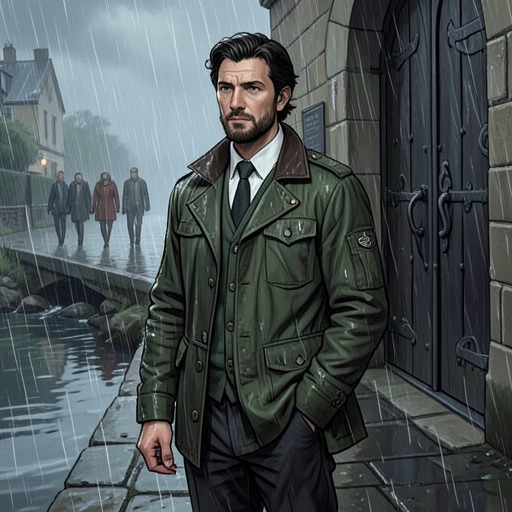
The Garavogue becomes the site of a sudden assault on Donie. A man first approaches him and then trips him, leaving him on the riverside path as bystanders fail to intervene. The encounter disrupts Donie’s relationship to the town more profoundly than a change of route: afterward he skips the mountaineering shop, does not greet the wood carver, and no longer counts the paving slabs on his usual shortcut.
The assault follows him back to the railway. He loses an hour trembling on the platform and misses the departure of the noon train; the journey’s familiar stations and routines no longer hold his attention as before. Sligo thus serves not only as a destination or landscape but as the setting where ordinary habits register the consequences of violence. Its roads, riverbanks, and transport links remain recognizable, yet their meaning changes with the safety of the people who move through them.