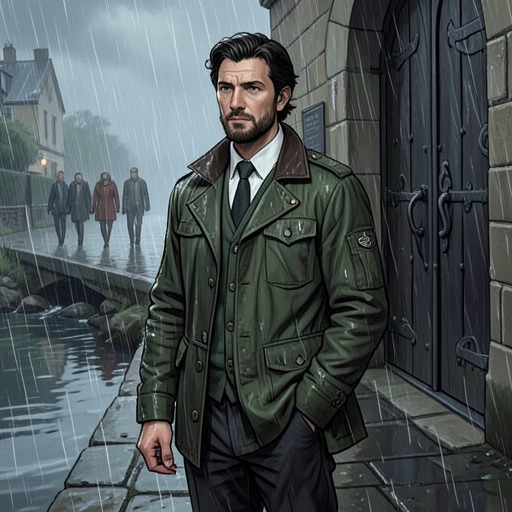
The Assault on Donie
Dark Lies the IslandThe Assault on Donie is an attack on Donie beside the Garavogue River that changes an ordinary journey into a day governed by fear. An unnamed man first makes Donie feel watched, then physically prevents him from leaving, threatens him, and knocks him down in public. The man’s final taunt follows Donie long after the encounter ends, displacing the small routines by which he ordinarily makes his way through Sligo and beyond.
The Encounter and Its Escalation
Donie has just finished his carefully specified packet of biscuits when a man sits beside him and addresses him. Donie recognizes the pressure of the man’s attention before looking up; the stranger has a thin, partly grown beard, pale eyes, and yellowish skin. The scene begins in the midst of an everyday pause, but the man’s presence quickly makes that familiar setting feel unsafe.
When Donie tries to rise, the man clamps a cold hand over his and holds it to the bench. Donie tells him to stop and says he has to go, but the man threatens to kick his ankles from under him if he stands. Donie’s voice shakes, and his attempt to leave has become an open confrontation in which the stranger controls whether he can move.
Donie identifies the man as resembling a hyena, a name prompted by the yellow spots on the back of the hand holding him. The comparison gives Donie a word for the threat he has been unable to place. The man laughs, keeps Donie’s hand pinned, and runs his thumb along it. Later, after Donie wrenches free and gets up, the man follows beside him, places a hand on his lower back, and whispers threats. Donie’s loud cry interrupts the words, but the man responds by trying to quiet him rather than withdrawing.
The Fall in Public
The man abruptly removes his hand, then strikes Donie in the lower back with an open palm and trips him. Donie falls onto the riverside path while people are nearby. No one steps forward to help; Donie understands that they take the scene for a fight between men behaving irrationally. The public setting therefore offers no protection: the presence of witnesses does not translate into intervention.
The assailant stands over Donie briefly, repeats the word hyena, and walks away. The repetition turns Donie’s own description of the man into the stranger’s parting taunt. The attacker leaves, but the encounter does not end for Donie when the man disappears; its aftermath occupies the rest of the day.
The Journey Afterward
Donie’s usual habits in Sligo fall away. He does not stop to look at the mountaineering equipment that normally holds his attention, greet the wood carver, or count the paving slabs along his shortcut through the arcade. Instead of providing continuity, these familiar places register what the assault has interrupted.
At the station, he loses an hour trembling on the platform. He boards the twelve o’clock train but misses its departure, then misses Collooney and the climb to Ballymote. The image of the man’s eyes continues to intrude, and the word hyena recurs as Donie passes through the landscape. He has no joke for the inspector, another small but telling departure from the ordinary pattern of his journey.
The same disruption continues through Boyle. Donie does not imagine the happy family he usually associates with a lost shack, and the word hyena accompanies him as he reaches Boyle station. A kind man notices his distress on Elphin Road and asks what is wrong. Donie does not stop to talk; he also bypasses Supervalu and its familiar bag of six doughnuts, going straight back to the terrace. The narrative marks the assault’s consequence through this sequence of omissions: places and pleasures remain available, but Donie cannot resume his customary engagement with them.
Significance
The assault is defined not only by the attacker’s actions but by the time they claim afterward. A brief encounter at a bench becomes the organizing fact of Donie’s passage through Sligo, the train route, and Boyle. The recurring word hyena links the moment of naming to the assailant’s farewell and then to Donie’s disrupted thoughts, showing how a phrase from the confrontation persists after the physical threat has passed.
The scene also contrasts Donie’s vulnerability with the people around him. On the riverside path, witnesses misread the violence as a quarrel and leave him without help; later, a passerby recognizes that something is wrong, but Donie cannot accept the invitation to speak. His withdrawal from routine, conversation, and food purchases gives the aftermath its shape without resolving it: he returns to the terrace, but the day’s ordinary pleasures have been eclipsed by the encounter.