The unnamed narrator and Evan the Head’s relationship
Dark Lies the IslandThe unnamed narrator and Evan the Head’s relationship is a movement from dangerous acquaintance to conditional refuge and captivity. Evan first appears as a calm, smiling contact in a rough Cork pub, but later offers the narrator shelter and food when he has nowhere else to go. The word friend carries a price: Evan’s help creates an expectation of reciprocal loyalty, and when the narrator does not submit to the household’s demands, that expectation turns into coercion. Their relationship makes hospitality inseparable from leverage.
An Acquaintance Formed in Cork
The narrator has known Evan for five years by the time he recalls their earlier connection. They first met at the Three Ones on Barrack Street in Cork, a pub associated with a rough clientele, drug dealing, feuds, and occasional shootings. The narrator says he was always nervous there; Evan, by contrast, seemed calm and smiling at the bar. That contrast establishes the attraction and danger of Evan’s company: he can appear composed in a setting where the narrator feels exposed.
The narrator’s first concrete transaction with Evan was a purchase of three sheets of acid at a good price. Evan also showed him passports issued under three different names. The narrator remembers being impressed when he was young, while acknowledging that later experience altered his perspective. Their acquaintance therefore begins with practical exchange and Evan’s display of an ability to move between identities, not with simple trust or friendship.
Evan’s charm also belongs to the narrator’s retrospective portrait of him. The narrator recalls that Evan was sometimes thought a charmer and that, when drunk, he spoke of Swansea as a kind of paradise, his accent growing stronger. Evan talked repeatedly about organizing an orgy and once recounted an event he and an old girlfriend had arranged in a Swansea graveyard. His interest in occult books followed that story; he told the narrator that he suspected him of being a white witch and insisted that magick should be spelled with an extra k. These recollections show Evan as a figure who made himself memorable through performance and eccentric claims, while the narrator’s account retains a distinction between the charm Evan projected and the threat that later emerged.
Refuge and the Price of Friendship
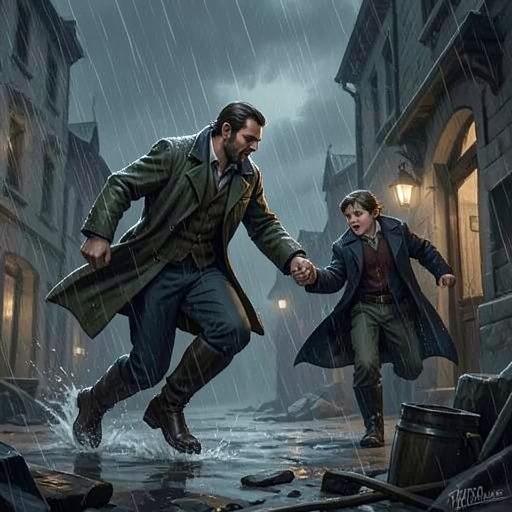
The relationship changes when the narrator reaches Gort in January. He arrives in the rain with little more than the clothes he is wearing, and Evan is waiting for him. Evan drives him in a Fiesta with no number plates to a farmhouse down a crooked lane between fields. During the journey he asks no questions, says that people sometimes simply need a place, and offers to help because the narrator is his friend. Yet the narrator hears something troubling in the way Evan softens that word: it seems to name the price of the offer. Evan also says that matters could be reversed one day, with the narrator helping him in return.
At the farmhouse, Evan explains that he has obtained rent allowance for the house on account of his children. He lives there with Suze, Elsie, and the children, and the narrator is brought into a household whose crowded, unruly life differs sharply from the empty rural setting outside. Evan’s offer is not merely a brief ride or a bed: it places the narrator inside a family arrangement where food, shelter, and the expectation of belonging are bound together.
The practical routine begins with care. Evan tells the narrator he can come inside in the evenings, where a pot of curried vegetables will be cooking. The narrator eats, watches television, and helps burn four-be-twos; afterward, he goes to Elsie in a back room. Elsie tells him she loves him on the third night. The account presents the narrator’s entry into the household as a series of ordinary provisions and repeated visits, but those routines also deepen his dependence on Evan’s home.
The narrator does not feel wholly at ease as this family-like arrangement takes shape. He continues to go out to the caravan at night to have space to himself, think about May-Anne, look at her photograph, and listen to the dogs. Elsie regards his withdrawal as snobbish and wants him to stay with her; Evan and Suze agree with her. The narrator identifies that pressure as the beginning of the trouble. His bond with Evan is thus tested not by a single dramatic break at first, but by a conflict over whether the narrator may preserve a private life within the shelter Evan has provided.
From Pressure to Captivity
As winter lengthens and February arrives, the pressure becomes more persistent. The narrator says that Evan and Suze make sly comments, and eventually Elsie joins them. He begins to feel trapped, but has no money and nowhere to go. Returning to Cork seems impossible because of what has happened there: he believes he would be shot or arrested. He misses May-Anne and tells himself that the best thing he can do for her is remain safe until the troubled period has passed. Evan’s household is therefore both refuge from the narrator’s immediate circumstances and a place from which escape grows increasingly difficult.
Late one night Evan enters the caravan without knocking, sits on the foot of the narrator’s fold-out bed, and lights a candle. He tells the narrator that Suze is the better sexual partner. The narrator answers that he is already involved with Elsie, but Evan insists that he must go into the house and have sex with both women or Evan will take his life. The narrator asks him to leave. Evan briefly leaps onto the bed, laughs, and prods at the narrator with his feet before leaving; the narrator then hears him lock the chain outside. The exchange marks the decisive collapse of the earlier language of friendship: Evan’s former promise of help has become an explicit threat backed by control of the narrator’s movements.
The narrator is kept locked in the caravan for days and nights, losing count. The windows are rusted shut, and he receives neither food nor water. He describes becoming weak and says the dogs outside seem to sense his condition and call to him. By day the women come to the door and whisper for hours; by night Evan climbs over the roof and makes tapping sounds. The narrator’s account links the household’s earlier pressure to his confinement, while also distinguishing their roles in its continuation. He concludes that Elsie no longer has the better of the supposed spell, a phrase that recalls her earlier belief that Evan’s influence over Suze could be overcome.
In the narrator’s feverish isolation, Evan appears outside a caravan window holding a child in each arm, and the narrator notices that this is the first time he has seen the children calm. The moment intensifies the narrator’s perception of the farmhouse as a place governed by a frightening power, but the account gives no independent explanation of Evan’s purpose in showing the children to him. The narrator describes feeling that there was no God but that there was a devil; this is his experience of the crisis, not a separate confirmation about Evan.
Memory, Dependence, and the Relationship’s Meaning
The narrator’s recollection of May-Anne provides a counterweight to Evan’s control. When he shuts his eyes against fear, he returns in memory to a summer day at Garrettstown with his daughter: they run together on the beach, and before they take the bus back to town he buys her a 99. He had already been using his nights in the caravan to look at her photograph and think of her. These memories clarify why the narrator resists being absorbed into Evan’s household: his sense of responsibility and attachment reaches beyond the refuge Evan controls.
The relationship is defined by a reversal in the meaning of care. Evan’s ride from Gort, his offer of a place, and the evening food initially answer the narrator’s immediate need. But the narrator recognizes the conditional quality of the welcome in Evan’s emphasis on friendship and repayment; the later threat and locked caravan make the underlying imbalance explicit. Evan can provide shelter because he controls access to it, and the narrator’s lack of money, lack of a safe destination, and fear of returning to Cork leave him with few alternatives.
The account also places the narrator’s captivity beside other scenes of violence and vulnerability in the book, without making those incidents part of this relationship’s chronology. Donie, for example, is assaulted beside the Garavogue River while bystanders mistake the situation for a fight and do not intervene. Sara later experiences an unexplained assault at her home before returning to a knife and her laptop. Such episodes form a wider pattern in which people are left alone with danger or have their distress misread, but the narrator’s particular relationship with Evan remains grounded in the sequence from accommodation to coercion and confinement.
Evan’s hold over the narrator is therefore neither uncomplicated friendship nor a purely transactional arrangement. It combines past exchange, personal fascination, material assistance, dependence, and direct threat. The narrator’s guarded response to the word friend anticipates the later betrayal: he senses that the offer asks something of him before Evan states what that demand will be. The resulting captivity reveals the cost of accepting shelter from someone who can turn care into a claim of ownership.