The unnamed narrator and May-Anne’s father-daughter relationship
Dark Lies the IslandThe unnamed narrator and May-Anne’s father-daughter relationship is a central emotional bond in the narrator’s account of separation, instability, and escape. He says he loves his daughter and remembers their time together with tenderness, yet he is unable to see her after his relationship with Fiona Condon ends. His longing for May-Anne persists through displacement and confinement, giving the memory of their day at Garrettstown a lasting place in his struggle to survive and leave the farm outside Gort.
Identity and Separation
The narrator identifies May-Anne as his daughter and calls her his “dotey pet.” His circumstances, however, keep him apart from her. After Fiona Condon throws him out, he has only a few clothes and has not arranged to retrieve his belongings. He refuses to return for them, unwilling to give Fiona the satisfaction, and mentions that she has a barring order. More consequentially, she has not allowed him near May-Anne. He has not seen his daughter since the early-summer outing when he took her to Garrettstown.
The account places affection beside the narrator’s own unease about fatherhood. He says he has never been comfortable being a father, but makes clear that this discomfort does not mean he lacks love for May-Anne. Rather, the thought of her moving through a world populated by people he regards as dangerous frightens him. His concern is protective, but it is also shaped by his helplessness: he cannot control the conditions around her or even maintain contact with her.
The Garrettstown Memory
While confined in the caravan, the narrator recalls the day he and May-Anne spent at Garrettstown. He remembers it as windy and blustery, with the sea and sand making them feel exhilarated as they ran along the beach. Before they took the bus back to town, he bought her a 99 at a seaside shop. The memory is not an abstract recollection of being a father; it rests on a particular outing, a shared joke, and small acts of affection.
At the shop, May-Anne asks about the words “kiss-me-quick” on beach hats. The narrator explains the saying as a seaside expression, perhaps from England. She repeats it in a cartoon duck’s voice, and he responds by pecking her cheek quickly and nuzzling the back of her neck; she squeals. The playful exchange gives the memory its own rhythm, which later returns in radically different circumstances. It remains one of the clearest scenes of mutual ease between them in the supplied account.
Separation During Captivity
The narrator’s memory of May-Anne returns while he is being held in the caravan outside Gort. He has been locked inside for days and nights, with the windows rusted shut and little food or water. In that weakened state, he discovers two old tins of Campbell’s Cream of Tomato Soup beneath the sink. After drinking them cold, he vomits, then waits for the farmhouse to fall quiet before trying to get out. The remembered beach day emerges amid this immediate struggle, not as a separate recollection detached from his danger.
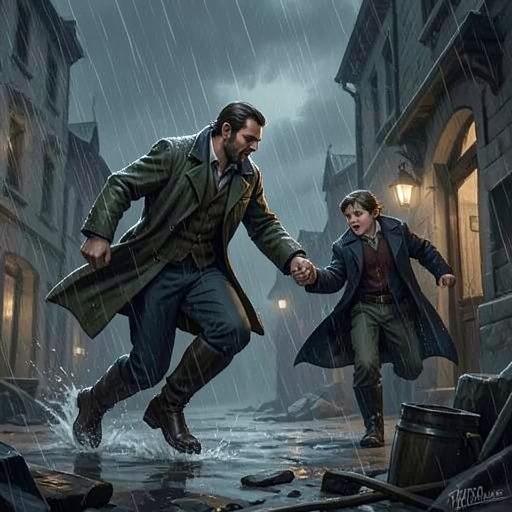
The memory also sharpens the meaning of his escape. He lifts out the caravan’s chemical toilet, loosens the plywood beneath it, and crawls through the opening under the floor. After reaching the yard, he gets to a Fiesta and starts it by joining wires. When the farmhouse lights come on and people shout, he drives on despite a tyre tearing on rocks. The repeated rhythm of the damaged tyre brings back the “kiss-me-quick” refrain, and his thoughts turn to May-Anne as he leaves the voices behind. A light, affectionate phrase from the beach thus recurs in a moment of flight, connecting his last remembered closeness with the act that carries him away from captivity.
Narrative Significance
The relationship is presented through the narrator’s first-person recollection, with the Garrettstown scene inserted into the account of confinement and escape. This ordering makes the memory do more than establish that he loves his daughter: it shows what he turns toward when fear and physical weakness narrow his world. The recollection’s specific details—the ice cream, the beach hats, May-Anne’s playful repetition, and his quick kisses—contrast with the conditions of the caravan and make the separation emotionally concrete.
The account does not resolve the estrangement or establish that the narrator reunites with May-Anne. Its ending instead carries her name and the remembered phrase into his departure from the farm. The bond remains powerful precisely because contact is absent: he cannot see or protect her, but she remains present in his thoughts as he finds a way out.