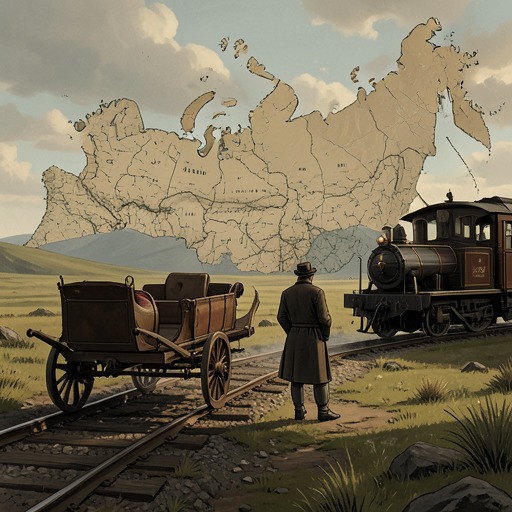
Chichikov–Platon Mikhalitch travel partnership
Dead SoulsChichikov–Platon Mikhalitch travel partnership begins as an answer to Platon’s ennui and becomes a practical arrangement for both men. Chichikov offers his companion the prospect of seeing the world; privately, he calculates how to make Platon share the costs. Platon accepts because he has little to do at home and his brother manages the estate. Their agreement sends them on the road together, eventually to inspect Khlobuev’s failing property with Constantine’s help.
The Proposal and Its Double Purpose
Chichikov suggests travel as the best remedy for ennui, after Platon admits that no charming and wealthy maiden is available in the neighborhood. The proposal sounds generous: Platon might join him as a companion and find distraction in seeing the world. Chichikov presents travel as an education, likening the whirligig of humanity to a living book and a second education. In the same conversation, however, he thinks through the arrangement’s financial advantages. He hopes to have half his expenses paid, charge Platon for repairs to the koliaska, and perhaps eventually make his companion bear the entire cost of the journey.
The contrast between what Chichikov says aloud and what he calculates privately defines the partnership from its outset. The invitation offers Platon movement and company, but Chichikov also treats the proposed companionship as a way to economize. He even imagines using Platon’s horses while turning his own out to graze on the other man’s farm. The journey is thus both an answer to personal idleness and an opportunity for Chichikov to make another person’s resources serve his plans.
Platon’s Decision and the Agreement
Platon considers the invitation against his circumstances at home. His brother has charge of estate management, and Platon reasons that his absence will cause no inconvenience. With no pressing occupation to keep him there, travel appears to offer a change from an idle routine. His acceptance is not presented as a grand ambition: it is a practical response to the fact that there is little for him to do at home.
Before setting out, Platon asks Chichikov to visit his brother and stay for a couple of days. Without that visit, he fears his brother might refuse consent. Chichikov agrees readily, offering to remain even three days. Platon then seals the plan with his hand and urges that they leave at once; the narrator notes that he seems suddenly to have come to life again. The gesture turns a speculative suggestion into an active undertaking, while Platon’s sudden animation marks the immediate appeal of having somewhere to go.
A Departure Delayed
Their host, Pietukh, interrupts the proposed immediate departure with a material obstacle: the wheels have been removed from Chichikov’s koliaska, and Platon’s horse has been sent to a grazing ground fifteen versts away. The two companions must therefore stay the night and leave after breakfast the next morning. Their new partnership begins not with uninterrupted freedom of movement but with a delay imposed by the host’s control of the vehicles and horses.
Pietukh makes the enforced pause pleasant by organizing a boating excursion on a spring evening. A dozen rowers carry the party across a lake and up a river, singing as the boat passes fishing ropes and the banks open onto successive stretches of woodland. This episode briefly redirects the journey into leisure. It also gives concrete form to the kind of diversion Chichikov has promised: travel brings encounters and changing scenery, even when the intended road departure has been postponed.
The Partnership Put to Use
The companions’ journey soon has a specific business. The next day, Chichikov sets out with Platon and Constantine to interview Khlobuev, whose estate Chichikov hopes to purchase. Constantine has agreed to assist with a loan of ten thousand roubles, without interest and without a formal obligation to repay. The visit shows that Chichikov’s travel is not simply a tour for its own sake: the road joins companionship to the pursuit of a property transaction.
The route itself makes the stakes visible before the prospective seller appears. For roughly the first fifteen versts, the travelers pass through forest and cultivated land belonging to Platon and his brother-in-law. Once beyond those domains, forest gives way to swamp and tillage to waste. Khlobuev’s village has a deserted air, and its owner is found in a disheveled state after recently getting out of bed: his cravat is crooked, his frockcoat stained, and one boot worn through. Chichikov is introduced as a possible purchaser, while Constantine frames the visit as business. The contrast along the road places Platon’s connection to productive land beside the disorder of the estate they have come to discuss.
Significance and Limits
The arrangement brings together two unequal motives without dissolving either. Platon accepts because his brother’s management leaves him free to go, and because travel promises relief from a home where he has nothing to do. Chichikov welcomes the same companionship while privately seeing its usefulness for reducing expenses and securing access to horses. The narrative therefore makes the partnership practical before it makes it intimate: a handclasp commits the men to travel, but the terms Chichikov imagines remain distinctly self-serving.
The journey also provides a bridge from Platon’s idleness to the novel’s next estate transaction. His presence accompanies Chichikov into the business of buying Khlobuev’s property, while the changing landscape—from cultivated domains to swamp and waste—contrasts sharply with the commercial possibility they pursue. The evidence establishes their shared departure and their role in this visit, but does not settle the partnership’s longer-term terms or outcome. Its defining tension is already clear: one traveler seeks activity, while the other sees in a companion a way to make movement cheaper and more useful.