Chichikov’s britchka
Dead SoulsChichikov’s britchka is more than transport: it is the mobile setting of his travels, the means by which he escapes one encounter and enters the next, and an image through which the narrative turns from individual schemes toward the vastness of the Russian road. Its changing condition registers the strain of travel, while its motion gives the novel a recurring figure for departure, speed, and uncertain direction.
Form and Function
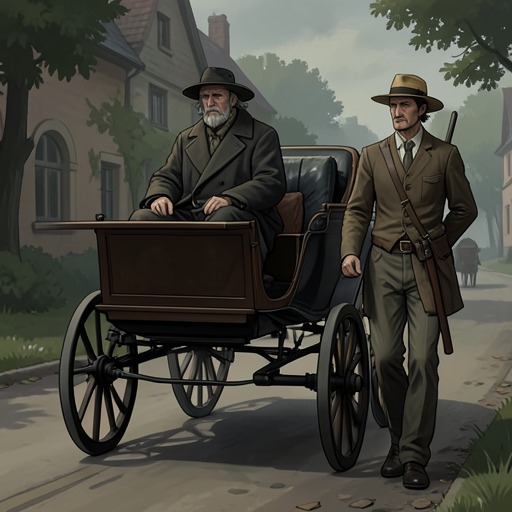
The britchka is a light carriage drawn by three horses, with Selifan driving and Petrushka accompanying Chichikov as his valet. It carries Chichikov between estates and the provincial town, allowing the plot to move through a series of visits, negotiations, and departures. The carriage’s routine function is repeatedly made visible: it arrives in courtyards, waits while repairs are made, and rattles from cobblestones onto the open highway.
Its role is not merely logistical. Because the narrative so often places Chichikov inside it, the britchka becomes a frame for observation and transition. A journey may begin as the practical aftermath of a negotiation, yet the carriage’s movement carries the narration beyond the immediate business and toward new scenes, reflections, or a fresh phase in Chichikov’s life.
Escape and Concealment
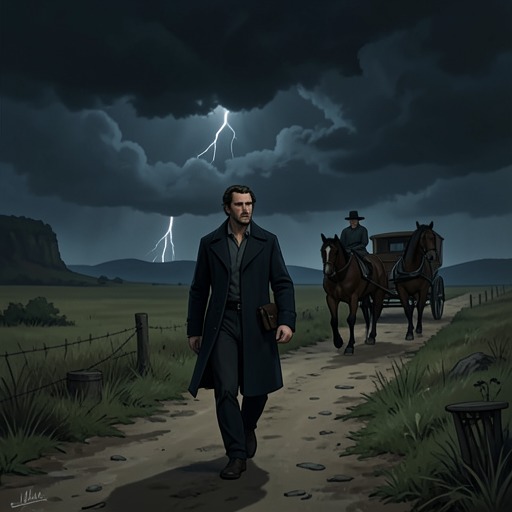
After the confrontation at Nozdrev’s estate, Chichikov snatches up his cap, slips behind the Superintendent, rushes onto the verandah, and springs into the britchka. He tells Selifan to drive at speed, and the vehicle carries him away before Nozdrev can reply. Even once the estate has disappeared behind the hillocks and hedgerows, Chichikov continues looking back anxiously. The carriage thus marks not a composed departure but a hasty escape whose emotional consequences follow him onto the road.
The vehicle also serves Chichikov’s discretion. Leaving Sobakevitch’s courtyard, he sees his host still watching from the verandah and orders Selifan to proceed so that the britchka’s direction will not be visible from the mansion. Chichikov intends to visit Plushkin, whose serfs, according to Sobakevitch, die in great numbers, but does not want his former host to know where he is going. The carriage makes this concealed change of destination possible: its movement protects the secrecy of a new transaction.
Collisions, Repairs, and Wear
Travel in the britchka is not uninterrupted progress. On the road, it collides violently with a six-horsed vehicle carrying two women. The horses and harnesses become entangled, and the drivers argue over who is at fault. The skewbald horse noses toward the unfamiliar animals instead of promptly moving away. The carriage’s journey is briefly suspended in a disorderly meeting between vehicles, and Chichikov notices the young woman among the passengers before turning his attention back to the commotion.
Later, after a faulty wheel requires attention, Chichikov orders Selifan to fetch a blacksmith and demands that the repair be completed within two hours. The blacksmiths take five and a half hours instead. Only after the britchka has been loaded with luggage, fitted with a new tyre, and joined by newly shod horses can it leave the inn. The delay makes the carriage’s material dependence unavoidable: travel requires repairs, labor, and payment, however impatient Chichikov may be. Its departure is also colored by his sense that he may never see the town’s houses, streets, and garden walls again.
When Chichikov reappears at Tientietnikov’s estate, both the britchka and its traveling equipment bear the signs of hardship. The horses, harness, coachman, and valet all look second-hand and worn, matching the evidence that Chichikov’s finances have declined. Yet the carriage still brings him to the next stage of his journey. Its shabby condition contrasts with the neatness of Chichikov’s collar and his carefully preserved manners: the outward polish of the passenger has survived better than the vehicle that carries him.
The Road as Narrative Space
After leaving the provincial town, the britchka passes from the less frequented streets, across the end of the cobblestones, and onto the highroad. The landscape unfolds through road markers, road menders, villages, inns, pedestrians, small market towns, repaired bridges, fields, and stretches of newly tilled earth. The carriage makes this succession of ordinary places into a continuous view of the country. The account widens from the practical route of one traveler to a meditation on Russia: the narrator acknowledges its disorder and plainness, yet asks what powerful attraction draws him toward it.
The road also gives the narrator room to shift focus. Once the town and its church steeples have disappeared below the horizon, Chichikov turns his attention to the road, then loses interest in it and leans back against the cushions. With his hero asleep in the britchka, the narrator pauses the journey’s immediate action to tell Chichikov’s history. The carriage is therefore both a vehicle in the story and a device in its telling: its onward movement creates a stretch of narrative in which the past can be examined.
Speed and the Troika Image
The britchka returns the story from sleep to motion when Chichikov wakes and rebukes Selifan for driving too slowly. Selifan has been drowsing, while Petrushka has lost his cap and slumped backward until his head rests against Chichikov’s knees. Selifan rouses himself and flicks the skewbald into a trot; the other two horses follow, and the light carriage moves forward rapidly. Chichikov settles back against the leather cushions, pleased by the sensation of speed.
From this concrete ride, the narration expands into an image of the troika racing across the landscape. Road markers, traders, forests, and the road itself seem to fly past; the vehicle becomes a figure of movement whose destination remains beyond the visible horizon. The contrast is central to the britchka’s significance: it is a particular, worn carriage on a difficult road, but it also carries the novel’s larger sense of forward motion and unanswered direction. Its journeys repeatedly take Chichikov away from one place and toward another, while the final image of the troika leaves the destination unresolved.