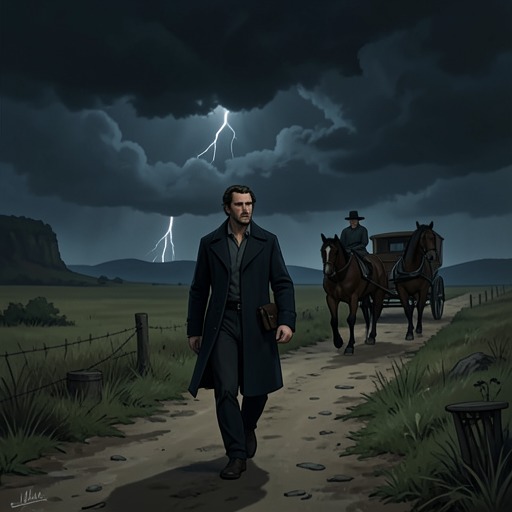
Chichikov’s carriage collision with the Governor’s party
Dead SoulsPaul Ivanovitch Chichikov’s carriage collision with the Governor’s party is a chance roadside encounter that momentarily unsettles his practical, business-minded attention. The tangled vehicles introduce him to a young woman whose appearance lingers in his thoughts, but the encounter yields neither her name nor a renewed connection: Chichikov turns her first into an imagined prospect, then returns to his journey and his dealings.
The Collision on the Road
After leaving Nozdrev, Chichikov travels in the britchka with Selifan and the three horses. The horses are already dispirited by their poor feeding at Nozdrev’s, and Selifan’s careless driving brings them into violent collision with a six-horsed carriage. The drivers trade accusations rather than immediately accepting responsibility, while the interlaced harnesses prevent either vehicle from moving free. The account makes the roadside delay a practical tangle as well as a comic one: the skewbald horse shows apparent interest in the unfamiliar team, and nearby peasants gather to help disentangle the traces. Their attempts to get the other carriage moving include mounting its horses, but the teams eventually set off after being allowed to rest.
The passengers in the other carriage are an old woman and a girl of about sixteen. Chichikov looks at the younger passenger with sustained attention and tries once or twice to speak to her, without success. When the two women depart, their carriage carries the encounter away as abruptly as it began. The narration returns him to the road, the britchka, Selifan, the horses, and the empty fields.
Chichikov’s Speculation
The interruption briefly opens a different line of thought for Chichikov. The narrator contrasts his response with what might have occupied a younger man: Chichikov is middle-aged and cautious, and his reflections do not become an impulsive reverie about romance. He asks himself instead whether the young woman is a good person and imagines her as still simple and direct because she seems recently out of school. He then speculates that her mother and aunts might change her, making her more self-conscious and calculating, and wonders whom she might eventually marry. These are Chichikov’s conjectures, not facts established about the girl or her family.
His thoughts soon turn explicitly to money and social advantage. He wonders who her father is and whether he is a wealthy landowner or a government servant who has acquired a fortune; a dowry of two hundred thousand roubles, he calculates, would make her an attractive match. The sum becomes vivid enough in his imagination that he reproaches himself for not asking the coachman or postillion who the travelers were. The passage thus makes the encounter revealing less for what Chichikov learns than for the terms in which he tries to convert an unknown person into a potential financial and social opportunity.
The Journey Resumes
Chichikov’s speculation ends when the sight of Sobakevitch’s country house restores his attention to his familiar subject. The collision has delayed travel, but it does not develop into a relationship or alter his immediate business. Its narrative effect lies in the temporary opening it creates between the journey’s practical purpose and a possibility that Chichikov quickly measures through calculation.
The surrounding road episodes emphasize how travel depends on circumstances beyond a traveler’s plans. Earlier, a thunderstorm on the dusty turnpike makes Chichikov draw the curtains and urge Selifan to hurry; Selifan, uncertain how many turnings have passed, chooses a direction without knowing where it leads. Later, sodden ground cakes the wheels with mire, and a girl’s directions help Selifan find the main road. Against this recurrent uncertainty, the collision makes a meeting possible by accident, but the meeting remains fleeting: the other carriage departs, and Chichikov’s attention returns to the estate ahead.
Narrative Significance
The episode places a brief glimpse of youthful possibility beside the habits that define Chichikov’s outlook. The girl is presented as an unknown person, while his response rapidly supplies an imagined character, family history, marriage future, and dowry. That gap between what is actually known and what he calculates gives the scene its irony. The carriage accident briefly interrupts the business journey, but it also exposes how readily Chichikov turns an encounter into an appraisal of advantage.
The contrast extends beyond the collision itself. The novel’s roads are subject to weather, mud, confusing turnings, and accidental encounters; movement does not guarantee a clear destination or a lasting change. Here, the road brings Chichikov face to face with someone who momentarily draws him away from his stock concerns, only for Sobakevitch’s house to reclaim his attention. The encounter’s significance rests in that short-lived diversion and in the self-portrait supplied by Chichikov’s calculations.