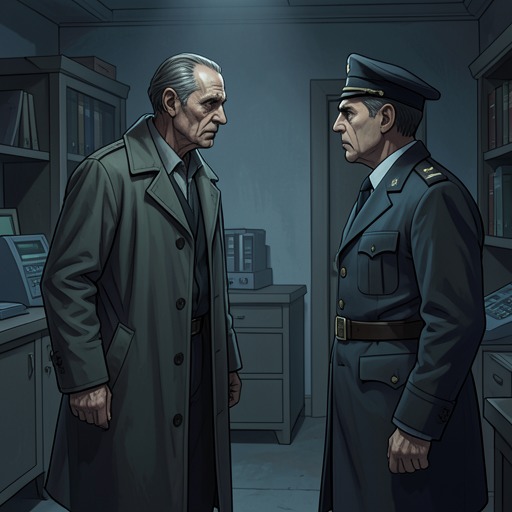
Chichikov’s dispatch-box
Dead SoulsChichikov’s dispatch-box is more than a travelling container: it holds the notices, stamped paper, lists, deeds, and money through which Chichikov conducts business and maintains his documentary identity. Across the novel, it serves first as an orderly instrument of private transactions and later as a prize in the struggle over evidence, when its seizure threatens him and Samosvitov secretly returns it with compromising papers removed.
A portable working archive
Early in his stay in the provincial town, Chichikov uses the box to store miscellaneous papers. After removing a theatre notice from his pocket and reading it by candlelight, he folds it away in the receptacle for odds and ends. The episode makes the box part of his methodical routine: even a seemingly incidental printed bill is examined, its details noted, and preserved rather than discarded.
The box also supplies the stamped paper needed for formal business. When Korobotchka asks for a sheet on which to write a plea, Chichikov explains that the paper in his dispatch-box is intended for serf indentures, not legal petitions. He nevertheless gives her a rouble-stamped sheet to quiet her, then asks her to dictate her peasants’ names because she has never made a list. The exchange shows how the box carries specialized materials that distinguish one kind of document from another, and how Chichikov’s travelling equipment lets him turn an informal conversation into a recorded transaction.
Names made into documents
After acquiring nearly four hundred souls, Chichikov takes the papers from the box and writes the necessary deeds himself, choosing to avoid a lawyer in order to save expense and hasten the process. He knows the terminology and completes the fair copies by two o’clock. The box thus connects acquisition to paperwork: it holds the materials from which the purchase can be given an official written form.
The lists inside it preserve sharply different traces of the dead peasants. Korobotchka’s entries are crowded with nicknames and additions; Plushkin’s list is so concise that some entries give only a Christian name, patronymic, and two dots; Sobakevitch’s is ample and circumstantial, noting trades, habits, and even parents. Reading these records, Chichikov feels that the names have acquired individual character and that their bearers seem to have lived only yesterday. The box’s contents therefore do more than support a scheme: for a moment, the documents make the people reduced to entries feel present to him.
From business tool to contested evidence
The dispatch-box’s practical value becomes a liability when Chichikov is imprisoned. He knows that his effects, including the box, have been sealed and taken away for examination, and asks how the proposed payment can be managed under those conditions. Samosvitov promises that the belongings will be back in Chichikov’s hands within an hour. Chichikov accepts the bargain with a beating heart, scarcely believing what he has heard.
Within the hour, a messenger returns the box with its papers and money practically intact. The appearance of an undisturbed return conceals Samosvitov’s intervention: he takes charge of the box, removes every paper that could compromise Chichikov, seals the remainder in a packet, and sends it back under the pretext that the prisoner needs clothing for the night. The box is simultaneously evidence, property, and a means of concealment; its apparent continuity hides a decisive alteration in what the archive contains.
Custody, reputation, and the documentary struggle
The box’s contents matter beyond the prison. While rumours that Chichikov is a millionaire circulate in N., an anonymous note arrives for him at the inn. Its unknown writer’s identity and the source of its delivery remain undiscovered. Elsewhere, Chichikov’s lawyer manipulates officials by spreading claims that one is preparing a damaging report against another, setting off a flood of reports and scandalous allegations that entangle Chichikov’s history with the dead-soul affair. Against this expanding documentary confusion, the dispatch-box represents a smaller, portable archive whose control can be seized, altered, and restored.
The object’s significance lies in the gap between possession and trustworthy custody. Chichikov carries papers that make transactions legible and usable, but once officials seal the box, his access to them—and their power to incriminate him—passes to others. Samosvitov’s return of the box offers immediate relief, yet the removal of compromising documents shows that the restored object is not the same archive that was taken. In the novel’s world, papers do not merely record identities and actions: whoever controls their circulation can reshape what can be proved about them.