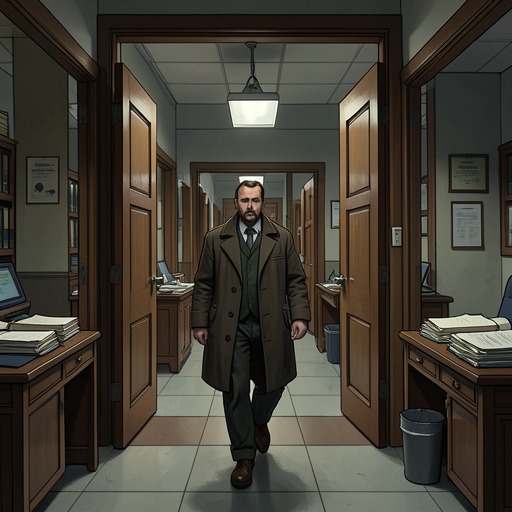
Colonel Koshkarev
Dead SoulsColonel Koshkarev is an estate owner who mistakes proliferating procedures for effective management. When Chichikov visits to seek confirmation of a purchase of serfs, the Colonel sends him through offices that have ceased to function, then treats the resulting confusion as evidence of how his estate’s administrative machine works. The episode makes his genial enthusiasm inseparable from the bureaucratic disorder he has created.
Identity and First Impression
Chichikov approaches the visit with apprehension, wondering whether Colonel Koshkarev will prove as mad as the previous landowner he encountered. On the road, Selifan identifies the Colonel by his conspicuously whiter skin and the respectable paunch of a gentleman. The description turns social status into a visual shorthand: the man who presides over an elaborate estate system is recognizable first by the comfortable bodily signs of his position.
Koshkarev’s reception initially seems to promise a more orderly encounter. Chichikov finds him behind a desk, a pen between his teeth, and meets a man who appears kindly and approachable. The Colonel welcomes him civilly and launches into an account of the labour required to bring the property to affluence. His manner is not hostile; the comic problem is that his confidence and courtesy coexist with a conception of administration that makes practical business harder at every turn.
The Estate as an Administrative Machine
The village attached to Koshkarev’s manor is in upheaval. Building and repair works are under way in every direction, while heaps of lime, bricks, and wooden beams choke the alleys. Some huts have been converted into offices, their gilt signs announcing a Depot for Agricultural Implements, a Chief Office of Accounts, an Estate Works Committee, and a Normal School for the Education of Colonists. The village has not simply acquired institutions: its ordinary spaces have been remade to resemble the offices and departments of a managerial system.
Koshkarev describes the estate’s intended transformation in similarly ambitious terms. He complains that the peasants do not understand the incentives to labour offered by science and art, and says he has failed to persuade the female serfs to wear corsets. He contrasts them with German millers’ daughters, who, in his account, can play the piano. He plans to persist until peasants walking behind the plough read Franklin’s Notes on Electricity, Virgil’s Georgics, or a work on soil chemistry. The books and the plough are joined in his vision, but the gulf between his imported ideal and the people he seeks to reform remains conspicuous.
His program extends from education and dress to national prosperity. Koshkarev asserts that if the Russian peasant can be made to wear German costume, science will advance, trade will grow, and a Golden Age will dawn in Russia. The scheme treats clothing as an instrument of social transformation and makes imitation of Germany the route to progress. Against this expansive account, Chichikov has a narrowly practical purpose: he wants to acquire a few serfs and have the purchase confirmed.
Chichikov’s Petition and the Office Maze
Koshkarev translates Chichikov’s request into administrative language, asking whether he wishes to present a Statement of Plea. Chichikov agrees. The Colonel instructs him to put it in writing so it can be forwarded to the Office for the Reception of Reports and Returns; that office, he explains, will consider it and send it back to him, after which the Estate Works Committee will revise it and submit it to the Administrator and Secretary. The procedure begins to multiply before the application has even left the Colonel’s account of it.
The Colonel rings a bell and summons his Secretary, who is told to call the Commissioner. The Commissioner appears with an air half peasant and half official, and Koshkarev assigns him to escort Chichikov. Rather than dismiss the arrangement as absurd, Chichikov follows, partly out of curiosity. The first office they seek has closed its shutters and locked its doors: its Director has been transferred to the newly formed Committee of Estate Management, and the Director’s successor has been annexed by the same committee.
Their next attempt fares no better. The Department of Estate Affairs is undergoing repairs, and no one answers their summons except a drunken peasant, from whom they cannot obtain a sensible word. The escort offers a plain diagnosis: the Committee of Management takes men away from their proper work and assigns them other duties, and nothing gets done except through that committee. His account exposes the machinery behind the official labels: offices are displaced, staff are absorbed, and the procedure that is supposed to coordinate work has become the obstacle to it.
Chichikov returns to the Colonel and reports that the Office for the Reception of Reports and Returns no longer exists. Instead of addressing the immediate failure, Koshkarev responds with noble indignation and gratitude to his visitor for supplying the information. He writes eight searching questions under three headings, asking why the Committee of Management has issued orders beyond its jurisdiction, why a chief manager allowed his predecessor to follow him into another department, and why the Committee of Estate Affairs allowed the reporting office to lapse. He makes the collapse of the system the occasion for another documentary exercise.
Exit and Narrative Significance
Chichikov’s patience ends when he learns that the escort had known about the problem from the beginning but considered it necessary for him to see it through the documentary process. The escort insists that an inexperienced person must not merely see such matters subconsciously, but consciously. The explanation turns Chichikov’s wasted journey into a purported lesson in administration; for Chichikov, it is simply enough. He seizes his cap, abandons ceremony, and rushes out through the courtyard.
Even the departure is caught in the estate’s procedural logic. The driver has not removed the horses, having learned that doing so would require a Statement of Plea for fodder and a twenty-four-hour wait for the resolution granting it. Koshkarev follows Chichikov to the gates, warmly presses his hand, and thanks him for enabling a practical display of estate management. He argues that the machine must be kept moving lest it grow rusty, then proposes a Committee of Supervision of the Committee of Management to detect backsliders in the first committee. The proposed remedy reproduces the very multiplication that has made the offices useless.
Chichikov returns tired and dissatisfied to Kostanzhoglo’s mansion after dark, with the candles already lit. Koshkarev’s episode thus ends not with a completed petition but with a journey, an explanation, and a new committee proposed in place of effective action. His kindly manner and professed desire for progress sharpen the satire: the failure does not arise from open malice, but from a system so devoted to forms and supervision that it cannot serve the practical purpose for which those forms exist.