Committee for the Reception of Reports and Returns
Dead SoulsThe Committee for the Reception of Reports and Returns is an administrative office in the estate bureaucracy encountered by Chichikov while he seeks a route to acquire dead serfs. Its most telling appearance is its absence: a procedure that promises orderly review leads him to a shuttered office, displaced personnel, and a department under repair. The episode makes the committee a concrete emblem of administration that exists in forms and titles but cannot reliably perform its stated work.
Role in the administrative process
At Colonel Koshkarev’s estate, Chichikov is told that his written statement of plea will first go to the Committee for the Reception of Reports and Returns. The office is to consider it and return it to the Colonel, who will then send it onward to the Estate Works Committee for revision before it reaches the Administrator and Secretary. The Colonel’s explanation turns a simple request into a multi-stage route through offices and officials; before that route can begin, Chichikov must put his purpose in writing, including the description of the souls he wants as, “so to speak, dead.”
The committee therefore has a defined place in a larger chain of jurisdiction, but the chain is presented as a source of delay as much as a means of review. Chichikov objects that the proposed procedure will take too much time. The Colonel, by contrast, treats written submission and referral as the proper forms of administration, even as the office at the head of the process proves unavailable.
Closure and institutional displacement
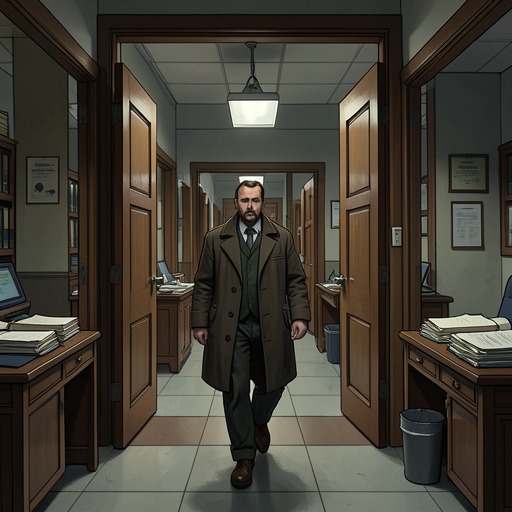
Curiosity leads Chichikov to accompany the Commissioner and inspect the relevant offices. They find the Committee for the Reception of Reports and Returns shuttered, with its doors locked. The explanation is a sequence of personnel transfers: its Director has been moved to the newly formed Committee of Estate Management, and his successor has been absorbed by that same committee. The intended recipient of Chichikov’s plea has not merely paused its work; its staff have been drawn into another body.
Their next stop, the Department of Estate Affairs, is also unable to receive them. Its quarters are under repair, and the only person who answers is a drunken peasant from whom they cannot obtain a coherent explanation. The Commissioner complains that the Committee of Management takes officials away from their proper work and assigns them elsewhere, adding that everything is done through that committee. His account suggests that the named offices do not operate as a stable, clearly bounded system: authority and personnel concentrate in a management body while ordinary departments lose the people and conditions needed to function.
The Colonel’s response and significance
When Chichikov reports that the committee’s office has ceased to exist, Colonel Koshkarev reacts with anger and gratitude. He takes paper and writes searching questions about why the Committee of Management has issued orders beyond its jurisdiction, why a chief manager has allowed his predecessor to follow him to another department while retaining his post, and why the Committee of Estate Affairs has allowed the reporting office to lapse. The committee’s disappearance thus becomes an occasion for an official challenge to overlapping authority, questionable appointments, and institutional neglect.
The scene’s irony lies in the contrast between the elaborate promised pathway and its practical failure. The committee is invoked as an essential first stage in processing a plea, but Chichikov encounters locked doors and administrative dislocation instead. Its absence does not end the matter: the Colonel redirects the case to a university-educated subordinate and offers Chichikov the use of his library and writing materials. The episode makes the committee’s name part of a broader satire on procedures that multiply stages and offices without ensuring that the offices can carry out their assigned tasks.