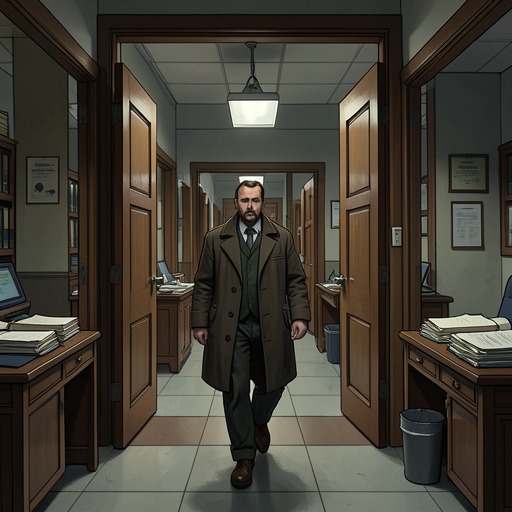
Farmer transfer contract registration procedure
Dead SoulsThe serf-transfer deed registration procedure is the local administrative process by which purchases of peasants are presented, witnessed, charged fees, and entered into official records. In Dead Souls, it gives Chichikov’s purchases of deceased serfs the outward form of lawful transfers: the documents pass through offices and acquire signatures, while personal connections and discretionary decisions smooth the way. The procedure thus makes the novel’s central paradox concrete: people who have died remain taxable entries, and paperwork can turn those entries into property for a living buyer.
Purpose and Administrative Requirements
Under the census and poll-tax system, a landowner remained responsible for taxes on serfs recorded at the last revision even if they had since died. Because such registered persons could also be used to support borrowing, Chichikov devises a scheme to purchase the dead at reduced prices and present them as transferable peasants. The formal transaction relies on the gap between the revision lists and actual life: the record continues to count people whom the world has lost.
When Chichikov approaches the local office, he describes his business as the registration of peasants bought from several landowners. He presents a purchase list and says that some vendors are present while he has powers of attorney from the others. He also has a written application, but wants the transaction completed that day. The official Ivan Antonovitch tells him it cannot proceed until further proof establishes that no impediments exist. A purchase list alone is not enough: the administrative process requires an application, documentation of the sellers’ authority, and official authorization to move the papers forward.
Connections, Discretion, and Procedure
Chichikov responds to the delay by invoking his close friendship with the President of the Council, Ivan Grigorievitch, and remarks that he too has served in government and understands how matters can be handled. Ivan Antonovitch does not simply waive the requirements. Instead, he advises Chichikov to obtain an order from the President addressed to the relevant officials. When Chichikov produces a paper, the clerk covers it with a book and indicates that it need not be shown again; he then arranges for another clerk to conduct Chichikov to the President. The scene makes procedure depend not only on documents but on knowing which official’s authority will make those documents effective.
Once the President is involved, the transaction acquires a wider administrative network. Ivan Antonovitch is instructed to take the indentures, and Sobakevitch intervenes to insist on witnesses, at least two on behalf of each party. He proposes summoning the Public Prosecutor and the Inspector of the Medical Department, describing them and other idle officials as men who merely cumber the ground. The President agrees and sends for them. Chichikov, in turn, asks that the representative of a woman landowner with whom he has done business also be called; the representative is identified as the son of Father Cyril and a clerk in the offices. The process draws together sellers’ representation, official authority, and witnesses from the local establishment.
The President tells Chichikov not to give any official a gratuity, insisting that no friend of his pays even a copper. The declaration presents the proceedings as protected from bribery, yet the transaction’s easy passage rests conspicuously on friendship and intervention. The procedure is not depicted as a simple, consistently applied rulebook: officials exercise judgment over what evidence is adequate, who must be summoned, and how quickly a matter can advance.
Registration and Its Costs
As the witnesses arrive, they include the blinking Public Prosecutor, the Inspector of the Medical Department, other officials, substitutes, and supernumeraries pressed into service from subordinate ranks. Father Cyril and his son both attend. Each witness adds a signature accompanied by a list of dignities and qualifications; the signatures vary in style, from printed characters to flowing or strangely formed handwriting. This accumulation of names and titles converts the sale into a witnessed public record, even as the gathering includes men whom Sobakevitch has dismissed as superfluous.
After the indentures have been signed, docketed, and registered, Chichikov pays only a small amount in government percentage and publication fees. The reduced charge is not presented as a general rule: the President has ordered that the purchaser pay only half the usual fees, with the other half somehow debited to the account of another applicant registering serfs. Official registration therefore produces a recognized transaction, but its costs are also subject to special treatment and an unexplained allocation. The paperwork’s validity and the manner of its processing are intertwined with administrative discretion.
Reach and Narrative Significance
The registration scene is one instance of a process whose logic extends beyond the provincial office. Chichikov first imagines making his scheme respectable through strict legal form, claiming that the dead serfs would be transferred to land in Kherson and that testimony could be supplied by a rural police superintendent who was, in his plan, Chichikov himself. Later, when he seeks souls through the offices on Colonel Koshkarev’s estate, the colonel proposes a chain of written review through several committees and administrators. Chichikov objects that the process will take too long and describes his request plainly as one for souls that are, so to speak, dead. The contrast shows how procedural machinery can multiply formal stages without resolving the underlying contradiction.
The registered deeds also give later suspicion a documentary focus. In the provincial town, rumors about Chichikov’s purchases of dead souls spread alongside the false story that he plans to abduct the Governor’s daughter. Officials investigate his identity and question people who have dealt with him; the resulting uncertainty shows that a completed registration does not settle what the transaction means. Much later, information about the dead-soul purchases resurfaces alongside allegations concerning Chichikov’s customs service and disputed wills. The deeds that helped him make the scheme credible are part of the record through which his concealed history can be examined.
The procedure’s importance lies in this double effect. It makes transactions possible by translating purchases into lists, indentures, witnesses, fees, and entries; it also exposes the distance between administrative truth and lived fact. In a system that continues to count the dead, orderly registration can certify a transfer without restoring a single life. The comic bustle of officials, signatures, and favors therefore carries a serious institutional irony: the records are not simply inaccurate, but powerful enough to turn an acknowledged fiction into a usable legal and financial asset.