General Alexander Dmitrievich Betrishev
Dead SoulsGeneral Alexander Dmitrievich Betrishev is a battle-honored military figure whose strained relationship with his neighbor Tientietnikov becomes the subject of Paul Ivanovitch Chichikov’s carefully managed visit. Though their earlier misunderstanding has left the General with an unfavorable impression, he says he bears Tientietnikov no grudge and continues to esteem him. The meeting turns that private goodwill into the prospect of reconciliation, while Ulinka’s intervention makes clear that the General’s view of his neighbor has been clouded by another man’s disparagement.
Identity and Introduction
The General receives Chichikov at his house after the visitor travels there in a borrowed koliaska. Chichikov enters with conspicuous deference, bowing and praising the valiant men who saved their country on the battlefield. The General responds graciously, and the encounter is established as one in which ceremony and flattery can open a path to a more delicate subject.
Chichikov describes his own career in government offices and presents himself as a man battered by misfortune, then says he is currently enjoying the hospitality of a neighbor the General knows. When asked who that is, he names Tientietnikov. The General frowns: the name immediately exposes the old tension that Chichikov has come to address. Betrishev is not introduced through an account of his military campaigns, but through the authority his service gives him and the lingering personal consequences of a quarrel.
Chichikov’s Mediation
Chichikov tells the General that Tientietnikov regrets failing to value the men who served the fatherland. He presents the neighbor’s supposed remorse as a way to invite the General’s own response, rather than confronting him with an accusation or demanding that he apologize. The tactic works. Betrishev says he bears Tientietnikov no grudge, has always felt sincere liking and esteem for him, and believes he may, in time, become a useful member of society.
That answer reveals a distinction between the General’s public dignity and his private readiness to forgive. The frown at Tientietnikov’s name gives way to an explicit declaration of goodwill once Chichikov offers a conciliatory account of the neighbor’s feelings. Betrishev’s response does not erase their estrangement, but it shows that resentment is not the obstacle Chichikov might have expected: the General is prepared to regard Tientietnikov favorably again.
Reputation and Ulinka’s Intervention
The General knows Tientietnikov as a writer, though he dismisses the work as verses or similar rubbish. Chichikov counters that Tientietnikov is a man of worth, eloquent, and skilled with the pen. Betrishev then reports the more consequential news Chichikov has supplied: Tientietnikov is working on a history of the Russian Generals of 1812. The project gives the neighbor’s writing a serious subject connected to the military men the General honors.
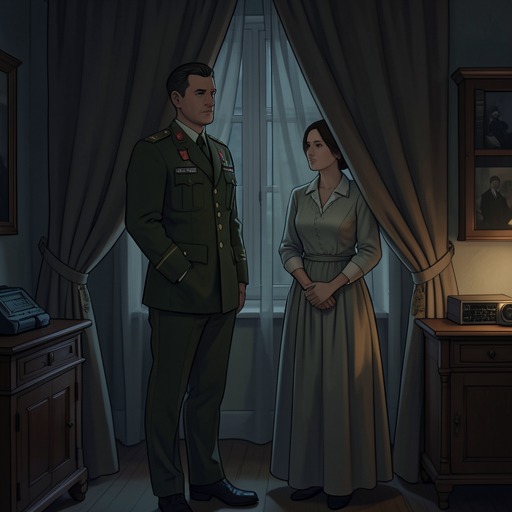
During the conversation, the door to the adjoining room opens and a young woman appears. Betrishev introduces Ulinka as his daughter and identifies Chichikov to her. When he describes Tientietnikov as someone they had once thought a fool but who is now engaged in important work, Ulinka immediately rejects the premise. She asks who ever supposed Tientietnikov a fool and says the General had taken the word of Vishnepokromov, whom she calls a fool and good-for-nothing. Her quick defense supplies the scene’s sharpest correction: the General’s unfavorable view was not simply a settled judgment, but one influenced by an unreliable critic.
Change and Narrative Role
Betrishev’s change in the scene is measured rather than dramatic. He moves from frowning at Tientietnikov’s name to affirming sincere esteem and a belief in his possible social usefulness; he also agrees that he would be happy to visit him. Chichikov cautions that Tientietnikov would prefer to make the first advance, preserving the neighbor’s pride while keeping open the possibility of renewed contact.
The General’s role is therefore both personal and structural: his approval matters to Tientietnikov, and the possibility of a visit offers a practical route out of their separation. Ulinka’s challenge further unsettles the reputation on which the conflict rests, identifying Vishnepokromov’s influence as a source of the General’s misjudgment. The episode ends with ordinary hospitality rather than a completed reconciliation: the General invites Chichikov to luncheon, while the renewed relationship with Tientietnikov remains a prospect, not yet an accomplished meeting.