Hai guan bu
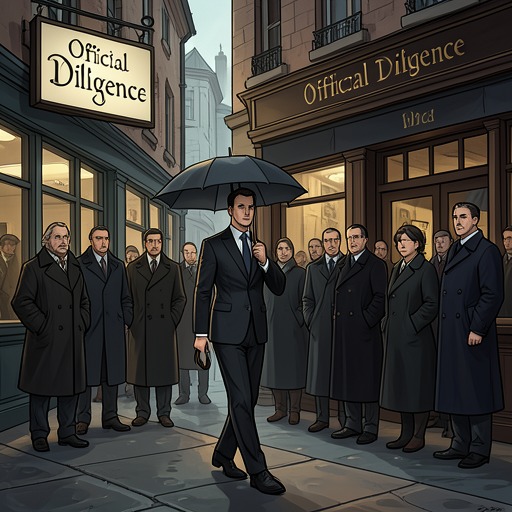
Dead SoulsThe Customs Department is the government service that Paul Ivanovitch Chichikov has long coveted for its foreign goods, fine linen, and coveted personal luxuries. He enters it after a period of professional setbacks and proves extraordinarily adept at its work; that competence wins him promotion and broad investigative powers, which he then exploits to join a lucrative smuggling operation. The department thus marks both the apparent high point of his official career and the exposure that brings it crashing down.
Entry and ambitions
After misfortune had forced him to change posts repeatedly, Chichikov was transferred to the Customs Department. He had long considered it his destination, attracted by the foreign elegances its officials could acquire and the imported gifts they could send to female relatives and acquaintances. He imagined a frontier posting as a practical route to excellent linen shirts and a particular French soap prized for the freshness it gave the skin. His earlier service in the Building Commission had kept him from pursuing this ambition, but when his circumstances changed he resolved to enter Customs and did so.
The motives are deliberately small in scale beside the power of the office he seeks. Chichikov’s dreams of fine shirts and soap supply a comic measure of his acquisitiveness, while also establishing how closely he connects public employment with private consumption. His attraction is not to the abstract duties of the service; it is to the material advantages he expects an official position to provide.
Exceptional competence and authority
Chichikov applies himself to his new work with striking speed. In no more than four weeks, he has mastered Customs procedure in detail: he can weigh and measure goods, infer from an invoice how much cloth a piece contains, and estimate its weight. His colleagues also recognize his patience and skill in searches. He examines suspected travelers with unfailing politeness, inspecting concealed places in clothing and luggage while maintaining an impassive manner even when those searched are angered by the intrusion.
His investigations extend to carriage wheels, poles, and horses’ ears—places where contraband might be hidden. The narrative presents this thoroughness as both professional virtuosity and a comic spectacle: travelers arriving at the frontier are left bewildered by the intensity of the examination. For a time, Chichikov’s efforts make it difficult for smugglers to operate. His conspicuous diligence draws the attention of his superiors, and he receives a promotion.
He then proposes a scheme for detecting smugglers, conditional on receiving the authority necessary to carry it out. The authorities grant him that power, including broad scope for searches and investigations. This promotion is the decisive institutional turn: his command of the procedures and his official reach give him the leverage he needs for an enterprise that depends on controlling the very mechanisms intended to prevent it.
Smuggling conspiracy
Chichikov had already known of an established smuggling association, whose operations were carefully prepared and promised profits on a scale of millions. When its emissaries first tried to recruit him, he refused to join, judging that he lacked the position to secure a substantial share. Once he had the necessary authority in his hands, he contacted the group and agreed to proceed. He also recruited a fellow official, described as vulnerable to temptation, and the association began its business.
The account identifies the smuggling method through repeated crossings by Spanish sheep carrying valuable Brabant lace between their outer and inner fleeces. These crossings took place after Chichikov had become head of Customs, and the narrative stresses that the operation could not have succeeded without his participation. After three or four such journeys, he and his accomplice had each acquired 400,000 roubles; some reports put Chichikov’s own gains at half a million because of his greater industry. His earlier reputation for incorruptible enforcement is therefore reversed: the skill that had obstructed smugglers now helps make their scheme possible.
The partnership breaks down in a quarrel. One account attributes it to an argument in which Chichikov insulted his colleague; another circulating explanation connects the rupture with a woman and an attempted assault that did not succeed. The narration treats the competing accounts as uncertain rather than resolving them. What is established is that the colleague submitted an anonymous denunciation to the authorities, and the conspiracy was exposed.
Exposure and aftermath
The two officials were interrogated, deprived of their property, and required to give written accounts of their actions. Chichikov’s accomplice disappeared into obscurity, while Chichikov avoided a criminal trial by using flattery, persuasive speech, personal charm, and occasional bribes. He nevertheless lost his capital and imported possessions. The account of the scandal records that the authorities could not uncover all his gains, and he managed to conceal part of them before the confiscations.
When he left the Customs service, he retained 10,000 roubles saved for emergencies, two dozen linen shirts, a small bachelor’s britchka, and his two servants, Selifan and Petrushka. The Customs officials also set aside several cakes of the soap he had prized. The inventory is at once a concrete account of his remaining resources and a pointed echo of the ambitions that first drew him to the department: among the wreckage of an official career and a smuggling fortune, the linen and soap survive as reminders of his original private desires.
Chichikov describes his losses as suffering in the service of truth, but he does not withdraw into a quiet life. Though angry and resentful after another reversal, he retains his energy and prepares to begin his career anew. The Customs episode therefore does not end his pursuit of advantage; it becomes another defeat from which he attempts to recover, confirming the recurring pattern of professional reinvention that drives his story.
Wider significance
The Customs Department’s role in the narrative depends on the contrast between public duty and private gain. Chichikov first performs his official work with such apparent rigor that smugglers cannot easily profit; his success earns him the authority that later enables their enterprise. The same procedures can thus signify either service or concealment, depending on the purposes of the person controlling them.
The episode also makes Chichikov’s bureaucratic talent inseparable from opportunism. He can master rules, read goods with unusual precision, and maintain a decorous manner under pressure, but these abilities do not secure a stable moral or professional identity. Once his enforcement work has won him position, he turns that position to personal enrichment. His eventual exposure removes his wealth and office, yet leaves intact the restless adaptability that makes another beginning possible.