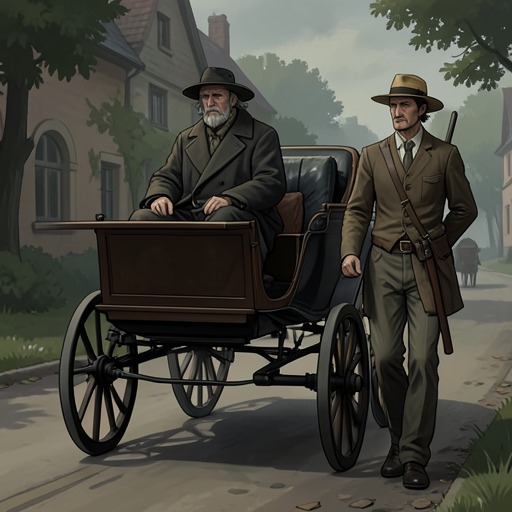
Horses
Dead SoulsThe horses are the three animals that pull Chichikov’s britchka, but they are more than interchangeable transport. The bay, the roan called the Assessor, and the skewbald each acquire a recognisable place in the journey: one is praised for steady work, another is named through the circumstances of its purchase, and the third repeatedly resists the effort expected of it. Their changing fortunes expose the uneven labour behind Chichikov’s movement through Russia. In the novel’s climactic image, the everyday team becomes a figure for the country itself, rushing forward with an energy whose destination remains unknown.
The three horses and their work
The team is harnessed abreast, with the bay in the middle, the roan nearest the carriage, and the skewbald on the outside. The roan’s name, the Assessor, comes from the rank of the gentleman from whom it was acquired. The naming makes the horse’s history part of the carriage’s practical world: even an animal in the harness bears a trace of acquisition and social status. The bay, by contrast, is described through its performance, while the skewbald becomes known for appearing to pull without giving the same effort.
As Chichikov rides away from Manilov’s hospitality, he is so absorbed in his calculations that he pays no attention to Selifan’s conversation with the skewbald. The coachman scolds the lazy horse, then praises the bay for doing its duty and promises it extra feed. He includes the Assessor among the good horses, while continuing to press the skewbald to work. The scene gives the team a small social order of its own: effort earns commendation and a material reward, whereas reluctance brings admonition and the whip.
Selifan’s talk is part reprimand, part instruction. He treats the skewbald as an animal that understands what is expected but chooses when to comply; after striking it, he observes that it can behave well when it wishes. The horses thus appear through the coachman’s practical, anthropomorphic language, which makes the routine management of a working team into a comic dialogue. Yet their labour is also tangible: the carriage’s progress depends on their exertion, and the driver’s praise, commands, and punishments register the unequal work on which that progress rests.
Weather, mishaps, and the road
The horses’ work is repeatedly tested by the road and weather. A sudden storm catches Chichikov’s carriage in the open: thunder breaks over the turnpike, rain lashes the side of the vehicle, and water splashes into his face. Selifan has to abandon his leisurely discourse, cover his sleeves with an old blanket, take up the reins, and hurry the team on. He cannot remember how many turnings they have passed, but turns right at the next crossroad and gallops ahead without knowing where the road leads. The horses are not masters of the journey; they are its moving force under the direction of a coachman who has lost his bearings.
In another spell of heavy rain, the britchka collides with a garden wall before Selifan can stop. Unable to see clearly, he drives by instinct toward a nearby house, while barking dogs and a light in a window help the travellers locate the entrance. Afterward, the route remains difficult even when the weather improves. Mud cakes the wheels until they are as heavy as if covered in felt, and the maze of roads makes the assistance of a local girl essential. The episodes show how the animals’ ability to carry their passengers depends on conditions beyond their control: rain, darkness, mud, and uncertain roads can turn forward motion into a slow and perilous undertaking.
The team’s treatment changes with Selifan’s state. After an episode in which he has been drinking, he drives in gloomy silence rather than talking affectionately to the horses. His whip falls more harshly on the skewbald, including its belly and ears, while the bay and the Assessor go without their usual endearments. The passage briefly imagines the skewbald’s bewildered question about what has put its master in such a mood. That shift makes the coachman’s habits visible through the animals: the team’s experience of the journey includes not just the road but the fluctuating attention and temper of the person holding the reins.
The skewbald’s poor reputation eventually becomes a point of disagreement between master and servant. When a wheel has failed and Chichikov orders repairs, Selifan proposes selling the horse, calling it more hindrance than help and saying it is good only for show. Chichikov rebukes him for presuming to decide what should be sold, insists that he will sell the animal when he chooses, and sends Selifan to fetch a blacksmith under threat of a beating. The exchange sets the horse at the centre of a dispute about authority: Selifan evaluates it by its usefulness on the road, while Chichikov reserves the decision as an owner. The skewbald is at once a troublesome worker, a piece of property, and a cause of friction between the men.
The team as a recurring measure of travel
The horses give the novel’s long journeys a physical measure. Chichikov’s itinerary is made not only of meetings and schemes but of roads, weather, repairs, and the varying willingness of animals to pull. After the inn’s faulty wheel has been replaced and the horses reshod, the britchka can set out again. The animals’ condition and the carriage’s condition are inseparable: a damaged wheel and worn horseshoes halt the journey, while repair restores movement. Travel depends on maintenance as much as intention.
Elsewhere, the animals themselves enjoy a temporary change of circumstance. At Tientietnikov’s estate, the bay, the Assessor, and the skewbald are all described as finding their stay comfortable. Each has a stall, with a partition between them that still allows the horses to see one another and answer a neighbour’s neigh. Their accommodation offers a quiet contrast to the exposed road and the unequal work of the harness: here, the three remain separate but within sight and sound of one another, and the skewbald is included in the team’s contentment rather than singled out as a failure.
The horses also help sustain the novel’s comic picture of travel. When Chichikov’s party leaves Peter Petrovich Pietukh’s household after an abundant meal, even the dog trots lazily behind, having over-eaten. The scene briefly brings the animals into the same world of bodily consequence as their human companions: movement slows after excess, and travel resumes at the pace permitted by tired or overfed bodies. At another point Selifan grows drowsy at the reins, Petrushka loses his cap and slumps against Chichikov’s knees, and the horses receive a few cuts that get them trotting. The light britchka then moves forward like thistledown. Human inattention, a whip’s brief stimulus, and the horses’ renewed pace combine to make motion possible.
From working team to national image
In the novel’s closing meditation on speed, the ordinary team becomes the Russian troika: a swift, practical vehicle associated with the land and the people who made it. The troika is not a fashionable construction of iron and fittings but a carriage shaped with a peasant’s axe or chisel, driven not by a coachman in German livery but by a bearded, mittened man. The horses fly forward; the spokes become transparent circles, the road seems to quiver, and a pedestrian stops in astonishment as the vehicle dwindles into a speck on the horizon. The image draws its force from concrete motion, but expands beyond the individual journey.
The narrator then directly compares Russia to the troika: both appear to be speeding beyond pursuit, leaving roads, bridges, and spectators behind. The question of where the country is going remains unanswered; the only reply is the sound of the horses’ collar bells. The team’s speed therefore does not amount to a clear destination or a settled promise. Its forward force inspires awe, but its direction is still mysterious. The horses carry the novel from the local comedy of a skewbald that will not pull evenly to a national image of movement that cannot yet explain itself.
This transformation does not erase the animals’ material presence. The troika’s grandeur rests on the same horses that tire, need feeding, endure the whip, and depend on roads and repairs. Their particular differences remain visible even as the team becomes a collective emblem: the bay earns praise, the Assessor carries the story of his acquisition in his name, and the skewbald is both comic problem and indispensable part of the harness. The contrast gives the national image its tension. Russia’s spectacular forward motion is imagined through an ordinary working arrangement, with all the strain, unevenness, and uncertainty that such motion entails.