Kopeykin Captain
Dead SoulsCaptain Kopeikin is a wounded veteran whose story exposes the gap between patriotic service and the state’s provision for those disabled in its defense. Related by the Postmaster while officials speculate about Chichikov’s identity, the tale follows Kopeikin’s attempt to obtain assistance in St. Petersburg and ends with his unexplained disappearance and a report that he became the leader of a band of robbers. The Postmaster’s mistaken identification turns the account into part of the novel’s larger comedy of rumor and misrecognition.
Identity and Background
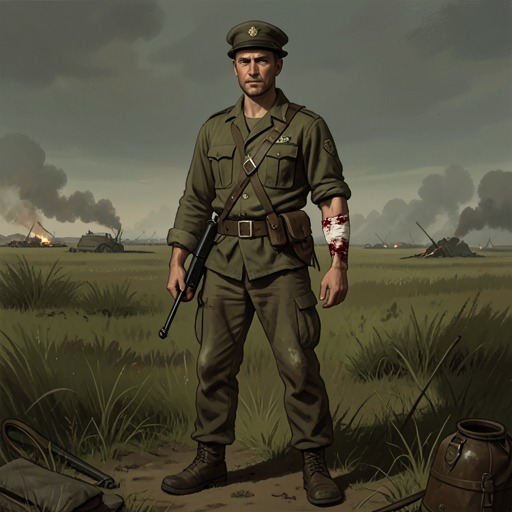
The Postmaster introduces Kopeikin as a captain wounded after fighting in the campaign of 1812. He describes him as headstrong and lively, a man who could enliven any situation whether on duty or under arrest. The account says that Kopeikin lost an arm and a leg, at Krasni or Leipzig; the Postmaster admits that he cannot settle which battle. The uncertainty is part of the story’s oral, digressive manner, while the consequences of the injuries are plainly stated: Kopeikin cannot work with his remaining arm alone.
The account places Kopeikin within a society that makes no provision for wounded soldiers. He first returns to his father, who is himself barely able to support his own household and cannot maintain his son. With ordinary work unavailable and family support out of reach, Kopeikin decides to seek help in St. Petersburg, on the grounds that he risked his life and shed blood in service to his country. His appeal begins not as a claim to wealth but as a search for the means to live.
The Journey and the Capital
Kopeikin reaches St. Petersburg on a baggage wagon and confronts a capital whose abundance is sharply at odds with his own scant resources. He cannot afford its well-appointed lodgings, so he takes a room at a tavern for a rouble a day, where the ration is cabbage soup and bread. As his limited money cannot sustain him there for long, he asks what course remains. He is directed to a Temporary Commission, since the government is away and the troops have not yet returned from the war.
The journey to make his petition is itself presented as a passage between radically different circumstances. Kopeikin shaves himself with his left hand to avoid paying a barber, then goes to the Commission president’s grand residence, where mirrors, statues, servants, and an imposing entrance mark the distance between the petitioner and the officials who may decide his fate. He waits four hours among a crowded room of applicants before the president arrives. The contrast gives the appeal a material setting: a veteran with little money must navigate the formal spaces of an administration surrounded by visible wealth.
Petition and Institutional Delay
When the president reaches him, Kopeikin explains that he has lost an arm and a leg in his country’s service and cannot work. He asks whether regulations permit help, a gratuity, a pension, or some comparable support. The president recognizes his wooden leg and empty sleeve, but does not grant a pension. Instead, he tells Kopeikin to return in a few days. Relieved by this apparent progress, Kopeikin briefly spends money on food and entertainment, believing that his petition has set assistance in motion.
At the next meeting, the president explains that the case cannot be decided without the Supreme Government’s authority. While the army remains away and the relevant minister has not returned, Kopeikin is told to wait patiently. The president gives him a small amount for immediate needs, but this is far less than the substantial gratuity Kopeikin had expected. The gap between his expectation and the official answer changes his situation: the capital’s temptations have already consumed much of his money, and the promised decision offers no immediate security.
On his third visit, Kopeikin rejects further postponement. He tells the president that he wants money for meals and the theatre; the president answers that the Commission cannot fund such choices and that he must find his own means of supporting himself. Kopeikin then causes a disturbance among the staff, accusing officials of failing in their duties. The president calls for strong measures, and a constable takes Kopeikin away in a police wagon to gaol. The process that began with a request for relief thus ends not in a decision on his claim but in his removal from the Commission.
Disappearance and the Postmaster’s Mistake
After being taken away, Kopeikin reflects that at least he will not have to pay for the ride, and recalls the instruction to make his own means of enjoying himself. The Postmaster does not establish what Kopeikin actually does next. He says that Kopeikin disappears from knowledge, as if sunk into the waters of Lethe, and that his subsequent actions lie buried in oblivion. He then offers a further thread: less than two months later, a band of robbers appears in the forests of Riazan, and he is about to identify Kopeikin as its leader.
The Head of the Police Department interrupts the account by pointing out that Kopeikin lost an arm and a leg, whereas Chichikov does not fit that description. The contradiction is enough to undo the Postmaster’s theory. He admits his error, then tries to excuse it by imagining that advanced mechanical legs might let their wearer vanish at the press of a spring. Other officials offer further explanations for Chichikov’s identity, including the theory that he is Napoleon in disguise. Kopeikin’s story therefore reveals less about Chichikov than about the officials’ readiness to turn fragments of rumor into elaborate identities.
Narrative Significance
Kopeikin’s tale combines a concrete account of disability and material hardship with a comic episode of failed identification. Its central institutional conflict is not resolved: the evidence does not say whether Kopeikin ever receives assistance, or whether he truly becomes a robber. What it does show is the sequence from military service, through an appeal delayed by administrative authority, to detention and disappearance. The unresolved ending keeps the story’s accusation alive while leaving its final claim uncertain.
The Postmaster’s digressions, changes of emphasis, and eventual correction make the tale a performance as much as a report. His confidence that Chichikov is Kopeikin collapses as soon as another official recalls the decisive physical difference. The story thus connects the veteran’s precarious life to the officials’ disorderly inquiry: both are shaped by gaps between what is known, what is promised, and what can be verified. Kopeikin remains a figure of abandonment in the account, but also the center of a rumor that the narration itself cannot conclusively confirm.