Koshkaryov Estate
Dead SoulsKoshkarev’s estate turns the promise of rational improvement into a comic landscape of building works, gilded office signs, and administrative paralysis. Its disorder is not simply a matter of unfinished construction: the estate’s elaborate institutional machinery obstructs the work it claims to organize, making the place a pointed contrast to productive, hands-on estate management.
Setting and Appearance
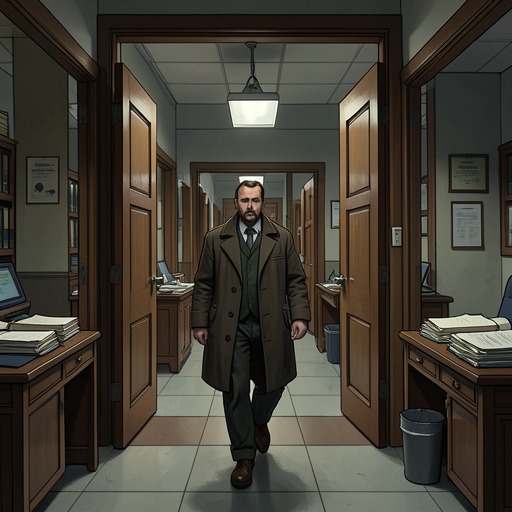
When Chichikov reaches the estate after a half-hour’s drive, the attached village is in upheaval. Building and repair are under way in every direction, and piles of lime, bricks, and timber choke the alleys. Some huts have been converted into offices, their signs announcing a “Depot for Agricultural Implements,” a “Chief Office of Accounts,” an “Estate Works Committee,” and a “Normal School for the Education of Colonists.” The signs project an orderly, reforming enterprise; the blocked lanes and makeshift premises show a village still physically unsettled.
Koshkarev’s Improvement Scheme
Koshkarev receives Chichikov civilly and recounts the labor he believes has brought the property to affluence. Yet his account of improvement reveals a gulf between institutional ambition and the people expected to embody it. He complains that the peasants do not understand the incentives offered by science and art, citing his failure to persuade the women on the estate to wear corsets. He compares them unfavorably with German millers’ daughters, who, he says, can play the piano, and proposes that peasants walking behind the plough should read Franklin’s notes on electricity, Virgil’s Georgics, or a work on soil chemistry. Chichikov’s private response—that he has not even found time to finish a book by the Duchesse de la Valliere—sharpens the comedy of an educational program conceived at a distance from ordinary labor.
Committees and Administrative Failure
The estate’s offices prove less functional than their titles suggest. Koshkarev sends Chichikov with a Commissioner to inspect them. The Committee for the Reception of Reports and Returns is shuttered: its director has been transferred to the newly created Committee of Estate Management, and his successor has been absorbed there as well. The Department of Estate Affairs is under repair, and the only person who answers their knock is a drunken peasant, incapable of giving a coherent account. The Commissioner complains that the Committee of Management takes officials away from their proper duties and assigns them elsewhere, even though, in his view, nothing gets done except through that committee.
Chichikov returns to report that the office for receiving reports and returns has ceased to exist. Koshkarev reacts with indignation and writes eight searching questions under three headings, challenging the Committee of Management’s authority over officials outside its jurisdiction, the transfer of a predecessor who supposedly remains in post, and the failure to keep the reporting office operating. The response extends the same administrative logic that produced the breakdown: instead of restoring a functioning office, Koshkarev generates a further paper inquiry into why it has failed.
Narrative Significance
Koshkarev’s estate is set against a different model of country life articulated by Kostanzhoglo, who presents attentive work through the seasons as varied, productive, and morally sustaining. Against that ideal, the estate’s scientific vocabulary and departmental organization look like substitutes for practical stewardship. Its disorder is also material: buildings remain under construction, departments are closed or being repaired, and officials are diverted from their work. The episode makes bureaucracy visible in the landscape itself, where office signs promise order while blocked alleys and empty rooms register its failure.