N. (the provincial town)
Dead SoulsN. (the provincial town) is the stage on which Paul Ivanovitch Chichikov’s transactions acquire a public life of their own. Here, the purchase of deceased and runaway serfs moves from private bargain to municipal registration, then becomes a source of wealth, admiration, gossip, and social danger. The town’s welcoming meals and polished civic exterior coexist with improvised administration, official favors, and a volatile social world: its institutions certify the transactions even as its inhabitants struggle to understand what they mean.
Setting and Everyday Life
At the beginning of the town episode, Chichikov stops at a tavern to rest his horses and eat. The narrator uses the pause to contrast the anxious, elaborate eating habits of wealthy people in St. Petersburg and Moscow with the robust appetite of the middle classes, who can relish a different dish at each posthouse. The tavern itself is a large wooden hut, its dark walls picked out by bright carved cornices and flowered pitchers painted on the shutters. Such detail makes the provincial setting both ordinary and hospitable, while the narrator’s digressions turn a meal into a means of measuring social habits and class pretensions.
The town’s social life is just as carefully staged. Its officials are hospitable and eager to keep Chichikov among them, and its women are described through their attention to dress, etiquette, visiting cards, and precedence. Their disagreements over missed calls and social rank reveal how intensely reputation circulates in a community where public appearances are carefully managed. The society that welcomes Chichikov is not merely a backdrop to his business: its habits of hospitality and status help convert his unexplained purchases into an attractive image of importance.
Offices and the Business of Registration
Chichikov returns to town after acquiring deceased serfs and runaway serfs, arriving after dark at the hostelry. The next day he dresses formally, gathers his papers, and hurries to the municipal offices to complete the transfer. He is anxious to conclude the matter, in part because the purchased souls seem insubstantial to him and he wants the burden of the paperwork off his shoulders. On the way, he meets Manilov, who embraces him extravagantly and produces a roll of papers tied with red ribbon: Manilov’s contribution to the transaction is thus made tangible just as Chichikov is heading to register it.
The municipal offices present an imposing public face. Their three-story building is the largest on the square, its chalky whiteness suggesting purity; inside, however, the corridors and rooms are dirty. The contrast makes the institution’s apparent dignity a visual joke. Chichikov asks where serf-indentures are handled, and the witnesses assemble as the deeds are signed and registered. Ivan Antonovitch manages the procedure, while the President’s order halves the ordinary government fees for Chichikov; the remainder is charged to another applicant. The purchase is legally processed not through impartial routine alone but through personal influence and an accommodating official decision.
Reputation and Public Spectacle
Once word of Chichikov’s purchases spreads, townspeople debate whether buying peasants for transfer is prudent. Some even recommend an escort for the journey, imagining the purchased peasants as a convoy that might require protection. Chichikov reassures them that the men are peaceable and willing to move. The purchases also earn him the reputation of a millionaire. That presumed wealth intensifies the town’s existing approval: citizens who had liked him already now press him to stay another week, and their hospitality threatens to make him less than a free agent.
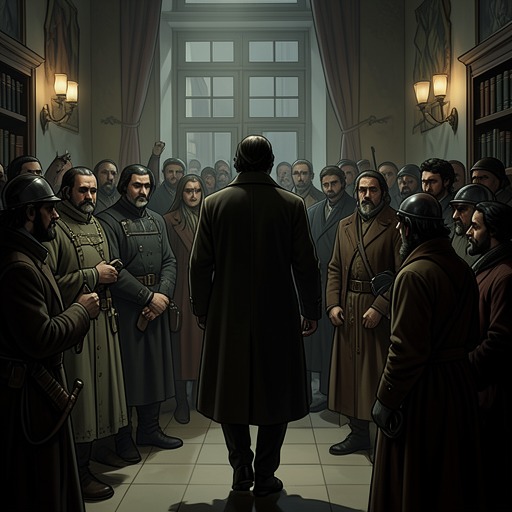
At the Governor’s ball, admiration turns into a precarious performance. Chichikov gives his attention to the Governor’s daughter while recounting his travels; the other women take offense, and the narrator presents the resulting social displeasure as a tacit proscription directed at both him and the young woman. Nozdrev’s entrance sharpens the danger. Arriving in an elevated state and dragging the Public Prosecutor with him, he is already lying freely. Chichikov recognizes that an encounter will be damaging and tries to leave, but the Governor detains him to settle a dispute between two ladies. In this crowded public setting, reputation can shift faster than the formal transactions that first made Chichikov fashionable.
A Community Under Strain
The officials’ later attempts to discover who Chichikov is reveal how little the town knows, despite its confidence in him. Their inquiries through his servants produce only scraps: Petrushka offers no useful account, and Selifan says that his master served the State and the Customs. The investigation leaves the officials uncertain whether Chichikov should be detained as a disreputable man or whether he might instead expose their own disrepute. Their confusion is not resolved by better evidence; it becomes the subject of another meeting.
At the Chief of Police’s residence, the officials appear physically worn down by the new Governor-General, the rumors, and two serious documents. Yet the gathering’s most striking feature is its lack of common sense. The narrator generalizes from this assembly to a failure of Russian representative meetings when no leading authority directs them, contrasting their confusion with their greater competence at dinners and festivities. N. therefore functions as more than the setting of Chichikov’s scheme: its appetite for sociability, deference, and status makes his rise possible, while its offices and assemblies expose the fragility of the order that appears to certify him.