Nozdrev
Dead SoulsNozdrev is a landowner whose turbulent sociability repeatedly disrupts the lives around him. Introduced as a new acquaintance of Paul Ivanovitch Chichikov in N. City, he is at once a gambler, a barterer, a habitual liar, and a man who calls people friends even as he insults or harms them. His importance lies less in any sustained plan than in the consequences of his restless appetite for company and incident: through him, Chichikov’s secret transaction becomes public talk, and rumor acquires a voice that is confident, entertaining, and unreliable.
Identity and First Appearance
Nozdrev enters the story within the town’s social circuit. Chichikov first encounters him at the Chief of Police’s dinner, where the two exchange only a few words before Nozdrev adopts an uninvited intimacy, addressing Chichikov familiarly. His manner disregards distinctions he also ignores with the Chief of Police and the Public Prosecutor. At the card table, however, these officials watch his play closely, suggesting that his easy familiarity does not make him trustworthy.
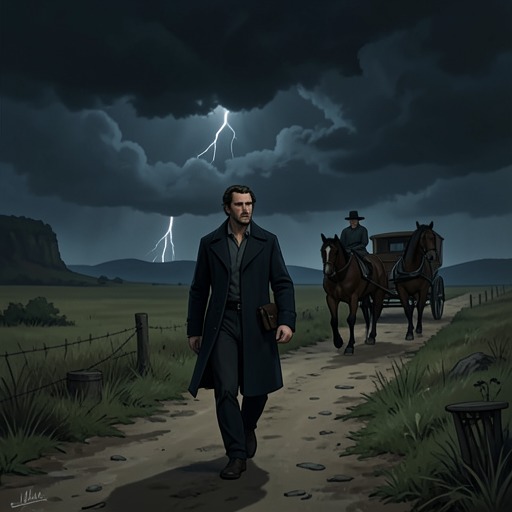
Their next encounter takes place at a tavern while Chichikov is travelling. Nozdrev arrives from a fair with his brother-in-law, Mizhuev, and tells Chichikov that he has been cleaned out and had to make the journey back using stage horses. He says that he and Mizhuev had been speaking of Chichikov that very morning and confidently predicts they would meet him. The episode captures his quickness to turn coincidence into a personal connection: he greets Chichikov with delighted surprise, assumes the right to steer the conversation, and immediately makes his own misfortunes its subject.
Temperament and Habits
The narrator presents Nozdrev as a recognizable social type: the energetic, overfamiliar companion whose friendship can turn into a quarrel within hours. The pattern dates back to his boyhood and school days, when he earned a reputation as a good comrade while also receiving hard knocks. At thirty-five he remains much as he was at eighteen or twenty, and marriage has not changed his way of life. His wife has died, leaving two children whom he does not want; they are placed in the care of a nursemaid.
Nozdrev is rarely at home for more than a day. His enthusiasm for fairs, balls, crowds, and gambling takes him wherever he expects diversion. At cards he is neither a faultless nor an honest player: mistakes and illicit cuts accompany his passion for the game, which can end in a brawl or in his friends driving him out. Yet even a recent quarrel does not hold. Soon he is again consorting with the same companions, without bringing up what happened and with no discussion from them either.
The narrator calls him a man of incident because his presence seems to invite disruption. A gathering may end with his expulsion by the gendarmes or his friends, while a quieter occasion may still feature his buffoonery or a lie. He fabricates without an evident practical purpose, as when he spins out claims about owning a horse of a particular color until his listeners leave him with a rebuke. He also insults neighbors without provocation; the more friendly he considers himself with someone, the sooner he may abuse that person and spread damaging stories, while continuing to regard the relationship as friendship.
Bargaining, Loss, and Self-Presentation
Nozdrev treats exchange as an extension of his appetite for activity rather than a disciplined effort to profit. He offers to travel anywhere, undertake any enterprise, or trade one thing for another; horses, guns, and dogs are among the goods he proposes to barter, usually on terms that would not benefit the other party. At fairs, a gambling win can lead him to spend his money on an indiscriminate assortment of purchases: horse-collars, cigar-lighters, clothing for the nursemaid, foals, raisins, silver vessels, cloth, grain, tobacco, revolvers, dried fish, pictures, whetstones, crockery, and boots. The goods commonly disappear the same day to a more skillful gambler, along with his pipe, tobacco pouch, mouthpiece, four-horse turnout, or coachman. Stripped of his possessions, he may have to ask a friend to lend him a vehicle.
This pattern helps explain why his apparent generosity and friendliness are unstable. He is always ready to propose a shared venture or a new exchange, but the energy of the proposal does not amount to reliable cooperation. Even after a dispute with Chichikov over a game of chess, he later tells Chichikov that he bears no grudge because he won. In his own account, the result of the game settles the matter; he does not dwell on the conflict as Chichikov might understand it.
Chichikov, the Rumors, and the Town
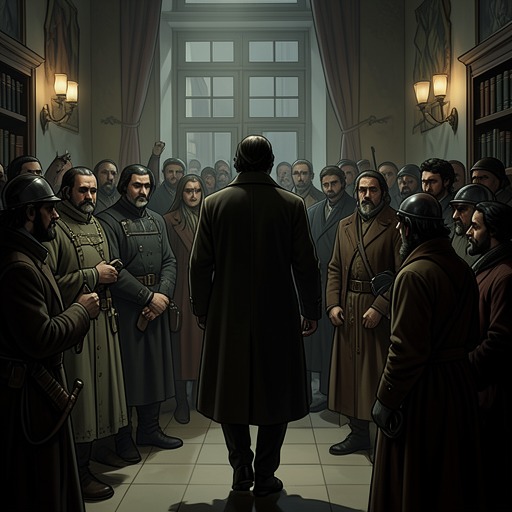
Nozdrev becomes consequential when N. City officials, alarmed by the stories surrounding Chichikov, summon him as someone believed to know Chichikov well and as the first person to have mentioned the dead souls. At the time, Nozdrev has been shut in his room for four days, marking selected cards for future use. He initially resents the interruption, but agrees to go when he hears that the Chief of Police will host a card-playing novice that evening.
Under questioning, he confirms that Chichikov bought dead souls and claims to have sold him some himself. He then affirms that Chichikov is a spy and a maker of counterfeit notes, supplying invented supporting stories, including a tale about forged notes and substituted seals. When asked whether Chichikov planned to abduct the Governor’s daughter, Nozdrev claims that he agreed to assist and begins adding a village church, a priest, a wedding fee of seventy-five roubles, a carriage, and relays of horses to the story. He stops himself when he realizes that the claim could cause trouble, but continues with the details. Asked about the possibility that Chichikov is Napoleon, he launches into a rambling account that convinces the officials they cannot extract useful information from him.
His later visit to Chichikov’s inn demonstrates how little the official questioning has restrained him. He presents his visit as the spontaneous act of a friend who happened to notice a light in the window, asks for tea and a pipe, and disregards Chichikov’s dry denial that he smokes. He then reports that the town believes Chichikov to be a forger and that some people consider him a disguised brigand or spy. Nozdrev says he defended Chichikov when questioned, despite having just supplied the officials with false claims. The Public Prosecutor, he adds, died after the public meeting; this report has a factual basis, though Nozdrev gives it amid an otherwise reckless account.
Nozdrev also treats the rumor about the Governor’s daughter as an established scheme, telling Chichikov that he expected it and offering to arrange the wedding, carriage, and horses in return for three thousand roubles. Chichikov is astonished and denies knowing what Nozdrev is talking about. Nozdrev’s offer does not clarify the truth: it extends the rumor by pretending that he can help execute a plan whose existence Chichikov rejects. His confident tone and mixture of genuine information with fabrication make him an especially disruptive source in a town already struggling to distinguish evidence from speculation.
Narrative Role and Limits
Nozdrev’s episodes link social comedy to the spread of consequential misinformation. At the Chief of Police’s dinner, his gambling draws scrutiny; in the later investigation, the same appetite for cards explains why he interrupts his seclusion for the prospect of another game. His easy claims of intimacy likewise recur: he calls Chichikov a friend, recounts having defended him, and offers to assist with an alleged elopement, while his conduct repeatedly makes him an unreliable ally.
The narrator’s description insists that Nozdrev is not an obsolete oddity. People of his kind remain present, the narrator argues, even if their clothes change. That observation widens the portrait beyond one landowner: Nozdrev’s particular mix of exuberant friendliness, unfounded assertion, impulsive spending, and recurring quarrels represents a social manner that can survive altered appearances. He is not a dependable guide to what has happened, but an effective agent in showing how a lie, passed along with conviction and detail, can enter public life and intensify an existing crisis.