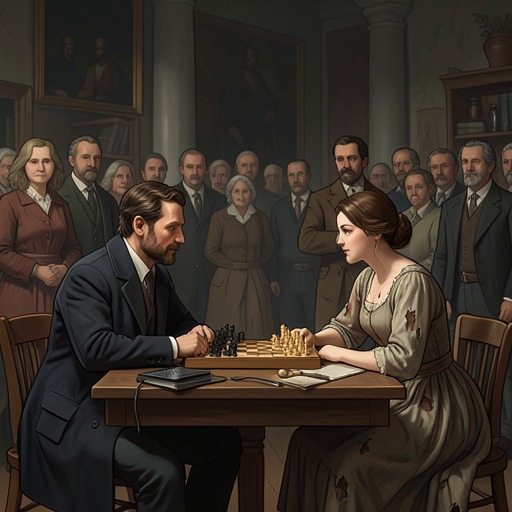
Nozdrev exposes Chichikov at the Governor’s ball
Dead SoulsAt the Governor’s ball, Nozdrev exposes Chichikov’s purchase of dead peasants in a drunken, theatrical outburst. The episode turns a transaction that had helped make Chichikov seem prosperous and important into a public scandal: the guests do not simply dismiss the notorious liar, because his strange accusation gives them a new and unsettling question to ask about their visitor.
Setting and immediate circumstances
The confrontation follows an evening in which social display has already begun to turn against Chichikov. He has been talking to the Governor’s daughter, recounting adventures and touching on Greek philosophy, while she grows bored. The other women take offense at his attention to her: one deliberately jostles the young woman and flicks her face with a scarf, while another makes a venomous remark. Dissatisfaction spreads across the room, and the women’s silent hostility grows into a tacit proscription against both Chichikov and the Governor’s daughter. His wealth and newly acquired standing cannot protect him from this shift in the company’s favor.
The awkwardness becomes danger when Nozdrev appears from an adjoining room, elevated by drink and dragging the Public Prosecutor along with him. The narrator leaves uncertain whether Nozdrev came from the buffet, had been playing a more strenuous game than whist, or had been expelled from it. What is clear is that he is already lying freely after drinking tea mixed with rum. Chichikov recognizes that an encounter can only harm him and tries to withdraw, but the Governor stops him to arbitrate a dispute between two ladies. Nozdrev sees him before he can escape.
The accusation in the ballroom
Nozdrev greets Chichikov as the landowner of Kherson and asks whether he has been trading much in departed souls. He then turns to the Governor and loudly declares that Chichikov traffics in dead peasants. The phrasing transforms the concealed business into an accusation delivered before the town’s assembled society. Nozdrev claims Chichikov had asked him to sell his own dead souls; he says he laughed at the request, then links it to reports that Chichikov has bought peasants worth three million roubles for transferment. He alternates denunciation with professions of intimacy, calling Chichikov a swine while insisting they have been inseparable friends.
The contradiction becomes part of the spectacle. Nozdrev tells the Governor that, if asked whether he loved his father or Chichikov more, he would have answered Chichikov; then he tries to force kisses onto his supposed friend. His effort to impose these embraces brings him close to falling flat on the floor. The physical comedy does not soften the disclosure: Nozdrev has said the essential words at the top of his voice, in a crowded ballroom, and made the subject impossible to overlook.
From babble to public suspicion
The company edges away and gives Nozdrev’s continued babbling little attention, but the outburst has already reached the far corners of the room. The guests stand in dull wonder at the unfamiliar notion of dead souls as a commodity. They know that Nozdrev is a notorious liar and are not surprised by his foolish behavior; nevertheless, his reference to a dead-soul transaction is so strange that they cannot tell what to make of it. Some women exchange knowing, ill-natured winks and sarcastic smiles, deepening Chichikov’s embarrassment.
This is the episode’s decisive reversal. Nozdrev is not treated as a reliable witness, yet his lack of credibility does not neutralize what he has revealed. His words provide the company with a question rather than a settled explanation, and that question is enough to make Chichikov’s former good standing precarious. The scene’s social ritual of the ball—where reputation is performed before an audience—becomes the setting for an uncontrolled disclosure that the audience cannot simply unhear.
Chichikov’s discomfiture and departure
Chichikov feels the exposure as an abrupt stain on his composure, like stepping in a dirty, foul-smelling puddle while wearing polished boots. He tries to recover and even joins a game of whist, but his concentration fails. Twice he plays badly; the President of the Local Council, accustomed to trusting Chichikov’s circumspection, is astonished when he throws away the king of spades that the President had been relying on. At supper the company is agreeable and Nozdrev has been removed, after the women find his behavior intolerable when he sits on the floor and plucks at passing dancers’ skirts. Even in his absence, the atmosphere remains awkward for Chichikov. He leaves before supper ends and much earlier than he usually returns to the inn.
Alone in his room, with the connecting door blocked by a wardrobe, Chichikov remains oppressed by the encounter. His heart aches with an empty, dull discomfort. His thoughts turn from Nozdrev’s accusation to the expense and corruption behind provincial balls: he resents the costly dresses, the overtaxed peasants who pay for them, and the bribes that sustain such display. The episode therefore carries the scandal beyond the ballroom. Chichikov’s private shame gives way to an angry judgment of a society whose gaiety rests, in his account, on crooked officials and the burdens imposed on peasants.
Consequences and narrative significance
The exposure takes place just as Chichikov’s purchases have made him the talk of the town. Citizens had debated whether the purchased peasants needed an escort for their transfer, and Chichikov had reassured them that the dead and living peasants involved were peaceable and consenting. The publicity had helped establish him as a millionaire and increased the townspeople’s liking for him. Nozdrev’s intervention overturns the benefit of that reputation: the same conspicuous transactions that had enhanced Chichikov’s status now furnish the substance of a public accusation.
The scandal does not immediately give the officials a clear account of Chichikov’s identity or intentions. Rather, it supplies a disturbing fragment that feeds uncertainty. That uncertainty matters because even a madman’s words, the narrator observes, can sow doubt among saner people. Nozdrev’s exposure is thus less a formal confession or proof than a social spark: it changes the value of Chichikov’s prominence, turning admiration into wary curiosity and preparing the ground for the investigation that follows.