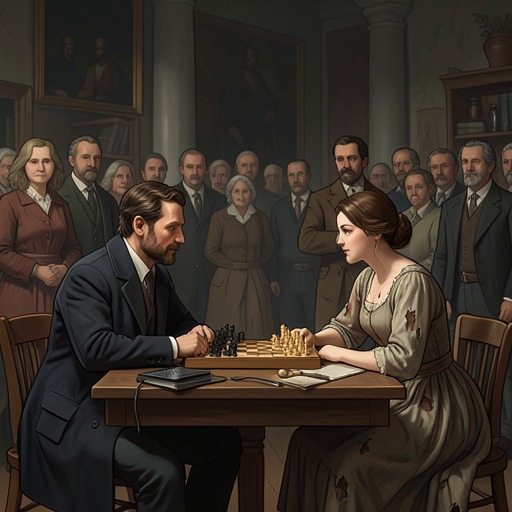
Nozdrev’s attempted assault on Chichikov
Dead SoulsNozdrev’s attempted assault on Chichikov turns a failed negotiation over dead serfs into an immediate threat of violence. The chess game Nozdrev proposes as a wager becomes a test of control: when Chichikov refuses to accept cheating or continue playing, Nozdrev calls on his servants to attack him. Their confrontation is interrupted by the arrival of the Superintendent of Rural Police, giving Chichikov an opportunity to escape.
From bargaining to the chessboard
The quarrel grows out of Nozdrev’s efforts to make a deal with Chichikov. When an exchange is refused, Nozdrev proposes chess instead: if he wins, he will acquire the souls, and he says he wants some names crossed off the revision list. Chichikov declines to play either chess or cards. Nozdrev argues that chess depends on skill rather than luck, but adds that he should be allowed a move or two in advance—a qualification that already puts the proposed test of fair play in doubt.
Chichikov eventually plays, while insisting that he has not handled a chessman for a long time. Nozdrev repeats this claim as he makes moves, and his sleeve dislodges a piece from its position. When Chichikov objects, Nozdrev disputes the charge and treats the game as something Chichikov must finish. The board becomes the immediate point of conflict: Nozdrev insists that the game continue, while Chichikov refuses to let a compromised wager dictate the outcome of their transaction.
Refusal and escalation
Chichikov answers Nozdrev’s demand by sweeping the chessmen into confusion. Nozdrev claims he can remember their positions and says the game can be restored. Chichikov refuses to be forced to play. As the argument grows heated, he raises his hands defensively; Nozdrev also raises a fist. Chichikov parries the threatened blow and holds Nozdrev’s arms, preventing the exchange from immediately becoming an attack. When Nozdrev calls for Porphyri and Pavlushka, Chichikov releases him rather than keep the servants as witnesses to the scene.
Nozdrev renews the accusation that Chichikov will not finish because he is losing. He orders the servants to thrash his guest and takes hold of the cherrywood shank of his pipe. Chichikov turns pale and cannot speak. The narration frames Nozdrev’s rush as a reckless military assault, but undercuts the comparison: the apparent fortress, Chichikov, is not an impregnable defender, and the servants wrest the chair he has tried to use for protection from his grasp. The episode brings the dispute over the game to the edge of violence without establishing that Nozdrev actually strikes him.
Interruption and escape
The arrival of a vehicle at the entrance interrupts the confrontation. The newcomer is the Superintendent of Rural Police, who asks which man is Nozdrev and identifies himself as a government officer. He is investigating an allegation involving the landowner Maksimov; Nozdrev denies knowing Maksimov. The police visit is separate from the chess dispute, but its timing changes the immediate balance of the scene: the attention of the room shifts from Nozdrev’s threat to the official’s inquiry.
Before Nozdrev can answer further, Chichikov takes his cap, slips behind the Superintendent, rushes onto the verandah, and gets into his britchka. He orders Selifan to drive at speed. The confrontation therefore ends not with a settled bargain or a completed assault, but with Chichikov’s flight as the official arrives. Once clear of the estate, Chichikov continues to look behind him nervously, showing that the interruption has enabled escape without making him feel secure.
Narrative function
The attempted assault gives a physical consequence to Nozdrev’s refusal to keep negotiation within agreed limits. His effort to turn chess into a wager over the souls, his disputed move, and his insistence that Chichikov continue culminate in a demand enforced by servants rather than by agreement. Chichikov, for his part, first resists the game, then plays, objects to the displaced piece, ends the contest, and finally takes advantage of the Superintendent’s arrival to leave.
The scene also makes its comic escalation depend on a sudden collision between private disorder and public authority. Nozdrev’s theatrical aggression is checked not by a negotiated resolution but by an official arriving on another matter. Chichikov escapes the immediate danger, yet the episode leaves the attempted transaction unresolved and carries the conflict forward as part of his departure from Nozdrev’s estate.