Peter Petrovich Pietukh
Dead SoulsPeter Petrovich Pietukh is a landowner whose exuberant hospitality, confidence in routine pleasures, and inability to recognize a guest’s wish to leave turn a brief visit into an enforced overnight stay. In the episode with Chichikov and Platon, he is at once a vivid host and a comic study in appetite: he keeps the travelers through practical obstruction, then feeds them so lavishly that they set off the next morning diminished by excess.
Identity and Circumstances
Pietukh first appears through a mistaken arrival. Chichikov expects Colonel Koshkarev, but the man who identifies himself is Pietukh, and Chichikov realizes that Selifan and Petrushka have brought him to the wrong house. The encounter places Pietukh in the path of a journey whose purpose lies elsewhere, and makes his estate an unexpected stop rather than a destination Chichikov has chosen.
The household’s circumstances complicate Pietukh’s easy manner. When Chichikov asks about the father’s property, the father returns to the room and says that it is all mortgaged, every bit of it. Pietukh does not present the mortgages as a crisis: he says that people consider it a good thing to mortgage an estate and that everyone else is doing it. He also says he has had enough of living there and would like to try Moscow, especially because his sons want a metropolitan education. His casual acceptance of debt sits beside his appetite for pleasure, while the prospect of leaving the estate suggests a household already oriented toward life elsewhere.
Pleasure as a Daily Routine
Pietukh rejects the idea that he might grow weary of life. His account of an ordinary day is built from successive duties and enjoyments: the cook awaits him in the morning, he orders dinner, drinks tea, gives orders to the bailiff, goes fishing, eats, and then has to order supper and the following day’s dinner. In his telling, the day’s full schedule leaves no time for weariness. The answer is comic in its self-assurance, but it also shows how thoroughly he treats food and diversion as the substance and measure of a well-filled life.
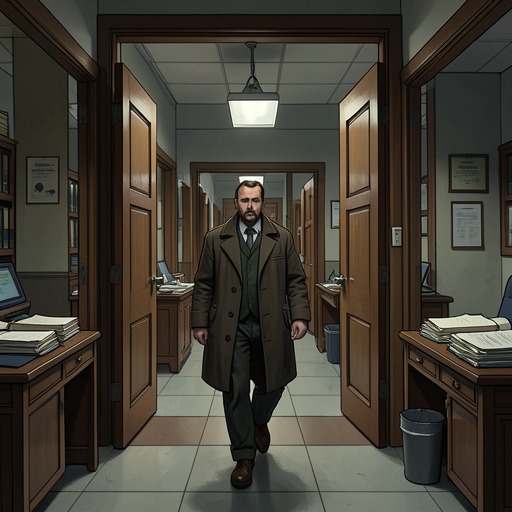
Chichikov observes that Pietukh is strikingly handsome, upright, youthful, and innocent-looking. Yet the appearance of fresh, unwasted youth does not signal depth or inner struggle: his face seems dreamlike, and the life that care or passion might have written there is absent. An occasional ironic smile briefly disturbs its calm. Pietukh’s claim never to be bored therefore has a visible counterpart in a face untouched by anxiety, though Chichikov’s observation leaves open whether this serenity is vitality or emotional vacancy.
Hospitality and the Halted Journey
When Platon and Chichikov prepare to leave, Pietukh intervenes by revealing that he has had the wheels removed from Chichikov’s carriage and sent Platon’s horse to a grazing ground fifteen versts away. They must stay the night and depart after breakfast. Hospitality here becomes control: Pietukh does not merely invite his guests to remain but has made departure impossible until the next morning. His action frustrates their intended onward movement without any prolonged argument.
The delay brings a beautiful spring evening on the water. Pietukh arranges a boating expedition, and a dozen rowers carry the party across the lake and up a great river beneath towering banks. Their song expands with the landscape, and Pietukh joins the chorus. Chichikov, too, feels acutely conscious of being Russian; Platon responds differently, finding the melancholy songs depressing. The outing thus places Pietukh’s exuberant participation beside Platon’s resistance, showing that the same spectacle can intensify one man’s pleasure and another’s gloom.
Excess and the Morning After
Food finally brings the visit to its characteristic scale. Pietukh orders one dish after another, describing how sturgeon should be garnished with beetroot, smelts, peppered mushrooms, young radishes, carrots, beans, and other trimmings, and how ice should be put into a pig’s bladder to swell it. His talk of boiling, roasting, and stewing continues through the menu; Chichikov falls asleep while Pietukh is still ordering dishes. The host’s abundance is not a passing courtesy but the episode’s governing rhythm, extending hospitality until it overwhelms the guests.
The consequence is physical and immediate the next morning. Platon is so full that he cannot mount his horse, so Pietukh sends him home with one of his grooms, while Chichikov and Platon set off in Chichikov’s carriage. Even the dog trots lazily behind, having also overeaten. Chichikov admits that the meal has been rather too much of a good thing; Platon is vexed that Pietukh never seems to tire of it. The guests leave, but their departure carries the mark of the host’s excess.
Narrative Role
Pietukh’s encounter functions as an episode in the travelers’ interrupted progress: an accidental wrong turn leads not to their intended host but to a man who turns a stop into a night of boating, song, and extravagant eating. The sequence contrasts Chichikov’s practical impatience and watchfulness with Pietukh’s abundance and Platon’s weariness. Pietukh’s insistence on pleasure does not resolve the differences between them; it makes those differences visible, from the river song that delights Chichikov to the feast that leaves Platon unable to mount his horse.