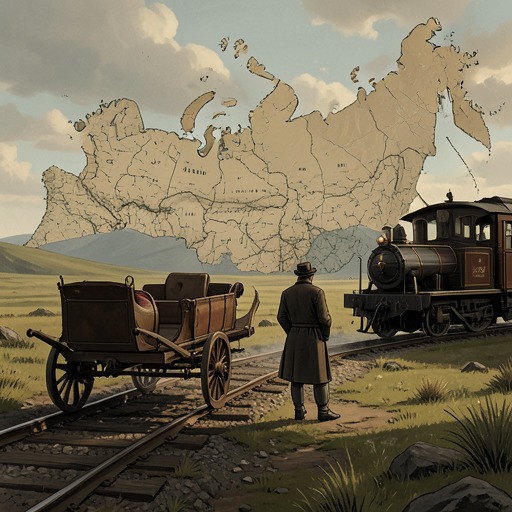
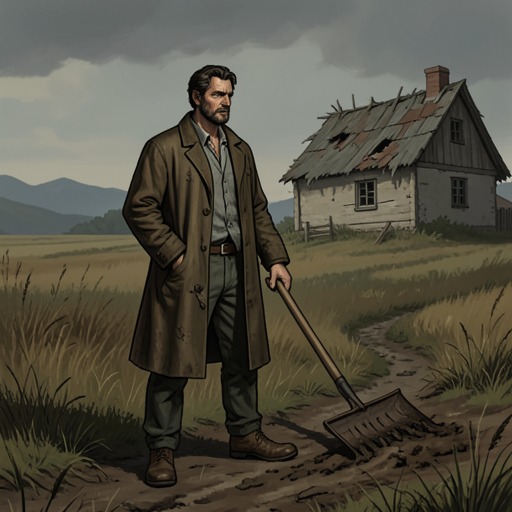
Platon Mikhailovich
Dead SoulsPlaton Mikhailovich is a tall, handsome landowner with bright red hair, introduced beside his keen-muzzled sporting dog, Yarb. Melancholy and inactive at home, he is also the character whose sudden agreement to travel with Paul Ivanovitch Chichikov sets the novel’s next journey in motion. His brief change of energy gives the road a double meaning: it is both an escape from idleness and an opening for Chichikov’s opportunism.
Identity and Circumstances
Platon enters the room as a neighbor and “an excellent fellow,” according to his host. His first distinguishing details are physical and companionable: he is tall, handsome, and extremely red-haired, and he has brought Yarb, a dog of the keen-muzzled type used for shooting. The dog accompanies him into the scene and later helps mark his arrival at his brother’s home.
Platon’s domestic circumstances help explain why departure is possible. He says that his brother has charge of managing the estate and that his own absence would cause no inconvenience there. His freedom to leave is thus practical as well as emotional: the household’s main responsibility already rests elsewhere, leaving him with little to do at home.
Melancholy and the Proposal to Travel
The conversation turns to remedies for ennui. When Chichikov suggests that Platon might seek a charming and wealthy bride elsewhere, Platon answers that there are no such prospects nearby. Chichikov then recommends travel as the best resource against ennui. The suggestion gives Platon a concrete alternative to his settled, inactive life, and he takes it seriously rather than dismissing it as idle talk.
The two men attach different purposes to the same journey. Chichikov presents travel as a chance to see the world and the whirligig of humanity, describing it as a living book and a second education. At the same time, he privately considers whether Platon might pay their expenses and provide the horses, allowing Chichikov’s own animals to rest and graze. Platon, by contrast, sees the journey as a possible way to rid himself of melancholy. Their agreement therefore begins in shared movement but not in shared motives.
Departure and Relationship with His Brother
Platon agrees to set out, but first asks Chichikov to stay with his brother for a couple of days; without that visit, he suggests, his brother might refuse consent. Chichikov readily accepts, even offering to stay for three days. Platon then clasps the agreement and proposes that they leave at once. The narrator marks the effect of the decision directly: Platon seems suddenly to have come to life again. The change is modest but decisive—the prospect of movement briefly interrupts the melancholy that had defined his situation.
When the travelers reach his brother’s village, Platon identifies the approaching gentleman as his brother and descends from the carriage, followed by Chichikov. Yarb greets the brother’s English dog, Azor; Azor then leaves Yarb to lick Platon’s hands before leaping on Chichikov and slobbering in his ear. The brothers embrace. This domestic welcome places the journey within a family relationship, but it does not erase the brother’s surprise at Platon’s sudden decision.
His brother, Vassili, questions what has prompted the change and privately finds it striking that Platon would travel with a man he has only just met, who might prove a rascal or worse. Vassili scrutinizes Chichikov’s appearance and judges it respectable enough, though the narrator makes clear that this is an assessment of outward appearance rather than knowledge of his character. Platon explains that he has decided to tour Holy Russia with Chichikov, perhaps to escape his melancholy. The contrast between the brothers is also registered through their appearance and manner: Vassili is shorter and darker-haired, and his features seem livelier and kinder, while Platon is more given to dreaming.
Narrative Role and Significance
Platon’s decision supplies Chichikov with a companion and a reason to continue along the road. For Platon, travel promises release from ennui; for Chichikov, it is also a practical arrangement from which he hopes to benefit. That divergence makes their partnership less a declaration of deep friendship than a meeting of convenience, enabled by Platon’s willingness to act on a sudden suggestion.
The journey’s arrival at Vassili’s home gives the episode a threshold quality: the travelers leave the open road, meet the brother whose permission Platon anticipated needing, and enter an old-fashioned house concealed among trees and flowering shrubs. Platon’s story in this episode ends not with a cure for his melancholy, but with movement begun. He has chosen to travel, and his momentary revival makes the choice feel like a break in the inertia of home life; whether the road can sustain that renewed energy remains unresolved in the supplied episode.