Prosecutor
Dead SoulsThe Public Prosecutor is one of the senior officials in the provincial town, but his limited appearances give him little individual characterization beyond his office and his place in the municipal hierarchy. His decisive role emerges during the public alarm over Chichikov: the official becomes one of the crisis’s casualties, and his funeral provides a stark measure of how rumor and bureaucratic fear have overtaken ordinary civic life.
Office and Place in the Town
The Public Prosecutor appears among the officials whom Chichikov visits soon after arriving. He is part of the circle of local authorities that also includes the Governor, the Vice-Governor, the President of the Local Council, and the Chief of Police. Chichikov’s round of calls is an exercise in social positioning: he flatters each dignitary, and the visits bring invitations to receptions and meals. The Public Prosecutor is thus introduced not through independent action but as one node in a tightly connected official society, where courtesy, rank, and access matter.
His office also gives him a practical place in the town’s administration. When Chichikov later arranges the paperwork for his purchases, Sobakevitch proposes summoning the Public Prosecutor as a witness, describing him as a man with little to do and even that little performed for him by his chief clerk, Zolotucha. The President agrees and sends a clerk to fetch the named witnesses. The episode presents the official through another man’s blunt assessment, linking his nominal authority to the idleness and delegated work that characterize the local bureaucracy.
Drawn into the Chichikov Affair
The Public Prosecutor is pulled into the affair as reports of Chichikov’s purchases and an alleged plan to abduct the Governor’s daughter circulate through the town. Two women bring him the details they have heard, including the dead-soul transactions and the supposed abduction scheme. They then leave to spread the account further. Their intervention helps turn private rumor into a town-wide commotion, and the officials’ attention divides between the meaning of the dead-soul purchases and the imagined threat to the Governor’s family.
The episode does not show the Public Prosecutor independently testing the claims or establishing what is true. Instead, he occupies the position through which alarming information passes as it spreads. The plot’s emphasis falls on the velocity and distortion of rumor: within half an hour, the account has been carried across town, and the officials are left trying to interpret stories that have already multiplied beyond their control.
Panic and Death
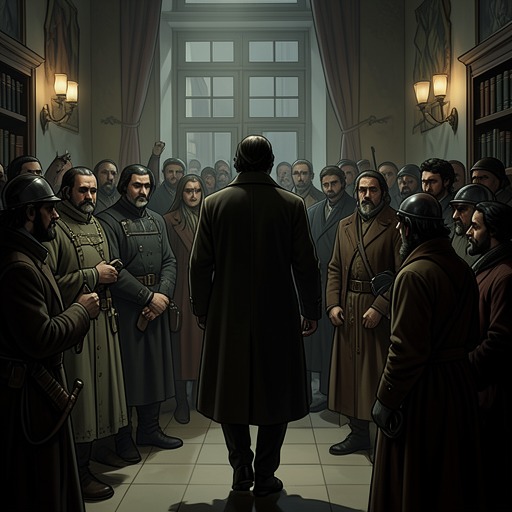
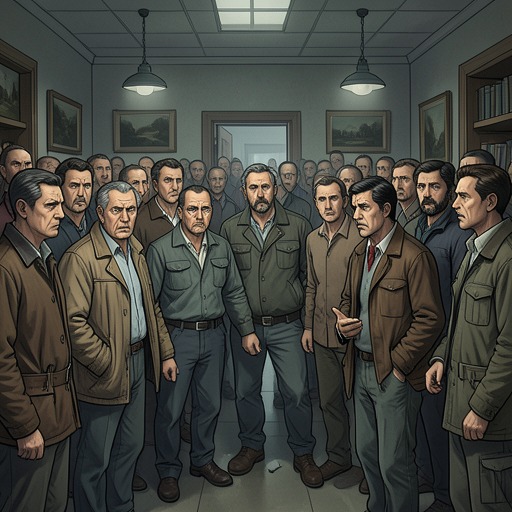
At the officials’ gathering, anxiety over the rumors and the expected arrival of a new Governor-General has visibly affected the assembled men. Their faces have changed, their coats hang loosely, and the Public Prosecutor is among those said to have grown thinner. The meeting is marked by confusion and indecision: its participants contradict themselves and lack a guiding authority, while their personal exposure to possible scrutiny makes the crisis feel threatening to every official present.
Nozdrev later tells Chichikov that the Public Prosecutor has died and is to be buried the following day. The narrator confirms the essential fact: the official suffered a fatal stroke on the previous day, probably brought on by the excitement of the public meeting. The death is reported amid Nozdrev’s extravagant claims and comic digressions, but this detail is true. It turns the town’s agitation from a farcical spectacle into a crisis with an irreversible human consequence.
Funeral and Narrative Significance
As Chichikov leaves, a long funeral procession blocks the street. Petrushka tells him that it is the Public Prosecutor’s funeral. Chichikov raises the carriage hood, draws the curtains, and leans back, fearing that the officials following the hearse might recognize him. Selifan and Petrushka watch bareheaded, under strict instructions not to greet any servants they recognize. The procession therefore puts the dead official and the fugitive visitor in the same scene, but Chichikov remains concealed while the town’s authorities pass by.
The officials behind the hearse are not exchanging the customary conversation of a funeral procession; they are absorbed in thoughts of their own affairs, the incoming Governor-General, and how he will take control of the administration. The mourning ladies in the carriages appear equally occupied with conversation about the Governor-General, expected balls, and their finery. Chichikov’s private mockery of the dead man’s anticipated newspaper eulogies reduces public praise to a pair of unusually thick eyebrows, while the cortege itself shows a community unable to stop thinking about rank and self-preservation even in the presence of death.
The Public Prosecutor remains a lightly drawn character, yet his death gathers several strands of the episode into one consequence: the rumors about Chichikov, the officials’ fear of scrutiny, and the town’s inability to think clearly together. The funeral does not resolve the mystery of Chichikov’s identity. Instead, it carries him out of the town as its officials attend to their own danger, leaving the dead man’s passing as an indictment of a public order more absorbed in appearances and personal security than in the person being buried.