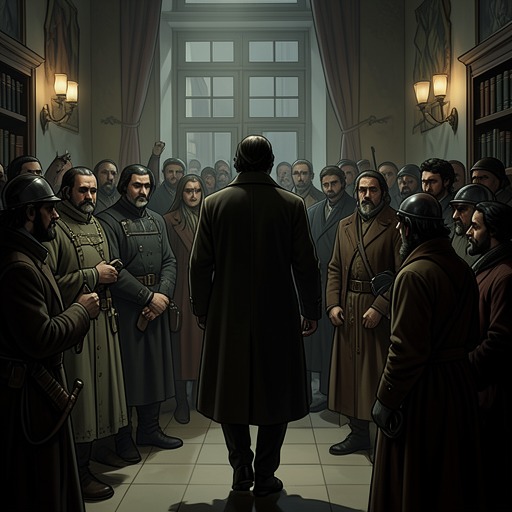
Provincial Governor
Dead SoulsThe Governor is a prominent and approachable official in the provincial town, introduced as large, good-natured, and fond of occasional knitting. His house anchors the town’s social life: he receives Chichikov on the visitor’s first day of calls, later hosts the ball at which the young daughter reappears, and joins the officials whose welcome and credulity help convert Chichikov’s financial scheme into public prestige and then public suspicion.
Identity and Public Standing
When Chichikov makes his formal round of officials, the Governor is the first to receive him. He wears the riband of the Order of Saint Anna and is reportedly recommended for its star. The description balances rank with domestic ease: he is physically large and good-natured, and sometimes occupies himself with knitting. His office places him at the center of the provincial hierarchy, while his genial manner makes that authority seem hospitable rather than forbidding.
Chichikov quickly discovers how readily the Governor can be courted. He praises the province’s velvety roads and credits capable subordinates with deserving ample praise. The Governor responds by inviting him to an evening reception; other officials follow with invitations to dinner and tea. These calls are more than polite preliminaries: they open a network of social access through which Chichikov becomes familiar and well regarded.
Host and Patron of Chichikov’s Rise
After Chichikov’s purchases become town talk, residents advise him to take an escort for the peasants he claims are being transferred. He dismisses the concern by presenting them as peaceable and willing. The scheme’s publicity elevates him, in local estimation, to the status of a millionaire, and the townspeople like him more than before. The Governor’s circle treats the supposed new landowner as a figure to celebrate: at a dinner, the company drinks to the health of the new landowner of Kherson, to the prosperity and safe transfer of his peasants, and to the beauty of his future wife.
The Governor joins the company’s efforts to keep Chichikov in town and find him a bride. The President of the Local Council insists that they mean to have him married; Chichikov answers that marriage would suit him if a betrothed could be provided, and the President promises to arrange one. The exchange shows the town’s hospitality sliding into presumption: the officials treat Chichikov not merely as a guest but as someone whose private future they can collectively arrange.
The Ball and the Governor’s Daughter
At the Governor’s ball, Chichikov receives an exuberant welcome. Officials pass him from one embrace to another, and the Governor abandons a box of sweets and his lap-dog to greet him. Chichikov is at ease amid the acclaim, while the ladies gather around him and the room’s admiration makes his new social standing visible. The scene’s comic abundance also establishes how quickly collective approval can form around a reputation.
The Governor’s wife approaches with their daughter, a young woman Chichikov had encountered on the road after fleeing from Nozdrev. The recognition leaves him unable to speak coherently. When the Governor’s wife says that her daughter has just come from school, Chichikov confirms that he has met her before, but cannot manage a further reply. He then devotes himself to talking with the young woman, recounting adventures and touching on Greek philosophy, while she yawns and the other women take offense at his inattention to them.
That social slight has consequences. The ladies’ dissatisfaction becomes general, and their verses at the ball target Chichikov; a tacit proscription falls on both him and the Governor’s daughter. The Governor himself is drawn into the moment when he asks Chichikov to arbitrate a dispute about whether a woman’s love lasts. The interruption gives Nozdrev an opening to approach, and his appearance at the ball soon becomes part of the chain of disclosures and rumors.
From Hospitality to Scandal
After Nozdrev’s claims reach the Public Prosecutor, the women spread accounts of both the dead-soul purchases and an alleged plan to abduct the Governor’s daughter. Within half an hour, the story has circulated through the town. The supposed abduction acquires elaborate, contradictory explanations: some women claim that Chichikov and the daughter are secretly in love and that her parents would have consented because he is rich; others invent a different scheme involving the Governor’s wife. The Governor’s family thus becomes the focus of a rumor that transforms a brief encounter and Chichikov’s attentions at the ball into a supposed conspiracy.
The scandal does not leave the Governor’s household untouched, even though the evidence does not show him directing the investigation. Officials question landowners and servants about Chichikov, yet learn little that clarifies his identity. The resulting confusion exposes the fragility of the same social network that had elevated him: invitations, praise, and public embraces had helped make him a millionaire in the town’s imagination, while gossip now makes the Governor’s daughter the center of an accusation. Near the end of the supplied episodes, reports about Chichikov’s dead-soul purchases and customs contraband are again circulating among the authorities, showing how the town’s early celebrations and later suspicions belong to one unstable public story.