Russia
Dead SoulsRussia is the landscape, social order, and unresolved question that gives Dead Souls its scale. The journey of Paul Ivanovitch Chichikov turns a fraudulent purchase of deceased serfs into a passage through the country’s estates, towns, roads, and official life; the novel’s final vision then enlarges the troika’s speed into a figure for Russia itself, moving with immense force toward a future no one can name.
Setting and material conditions
The country is presented through the institutions and distances that shape ordinary life. Under serfdom, an owner’s standing could be measured by the number of “souls” registered to him. A census might occur only once in ten or twenty years, yet owners remained liable for taxes on those listed at the previous count, including serfs who had since died. The same system made deceased serfs usable as collateral for loans. Chichikov’s plan exploits that gap: he intends to acquire the names at reduced prices, mortgage the fictitious population, and use the proceeds to buy an estate and living serfs. His scheme is therefore not detached from the country’s workings; it converts a bureaucratic lag and the valuation of people into a speculative opportunity.
The novel’s journey offers a broad cross-section rather than a single monumental capital. In the framing account, Chichikov travels across Russia in a troika, with Selifan as coachman, meeting people from the nobly born to humble workers. The landscape and its inhabitants serve the author’s stated purpose of displaying commonplace vices and failings, while the characters around the traveler expose further national weaknesses. The itinerary supplies a structure for looking across social ranks: the country becomes legible through successive encounters, and its vastness gives those encounters room to accumulate into a panorama.
The road and the view of the country
The road carries the narrative out from provincial streets into a changing procession of ordinary places and people: wooden fences at a town’s edge, the highroad, milestones, road menders, grey villages, inns, small market towns, repaired bridges, fields, landowners, and travelers. The scene does not replace the plain countryside with picturesque grandeur. Instead, the movement of the vehicle gathers dispersed details into a continuous view, making the open road a way of seeing Russia as both extensive and materially unadorned.
That view becomes more explicitly ambivalent when the narrator turns from the passing landscape to address Russia. The country is described as poor, disordered, and flat, without the grand cities, celebrated ruins, waterfalls, or mountain vistas associated with more conventionally picturesque scenery. Yet this inventory of what is absent does not settle into rejection. The narrator asks what hidden bond draws him toward the country and hears a sorrowful song extending across its breadth. Russia’s plainness and disorder remain visible, but they coexist with an attraction the speaker cannot explain and a sense that its immense open spaces may presage ideas and achievements on an equally expansive scale.
A comic panorama and its social meaning
The framing account describes the plot as a device that allows Chichikov to travel through Russia and reveal a panorama populated by recognizable types. It emphasizes that the comedy is not simply an end in itself. When Gogol read the work to Pushkin, Pushkin’s response shifted from laughter toward grief: he lamented the sadness of the country and later judged the book to portray terrible truth rather than invention. These reactions frame the novel’s comic observations as a way of making social conditions visible, not as proof that those conditions are harmless.
The country is also the object of a dispute over representation. The reception of the work could make it seem like an exposure of all Russia, while liberal readers welcomed it as a revelation and a possible sign of a freer future. Gogol, according to the introduction, had intended to serve Russia rather than heap ridicule upon it; criticism from Slavophiles troubled him, and he promised that later volumes would redeem Chichikov and the other knaves and blockheads. The conflicting responses leave Russia more than a setting: it is the contested subject against which readers measure satire, truth, national loyalty, and the possibility of reform.
The troika and an unfinished future
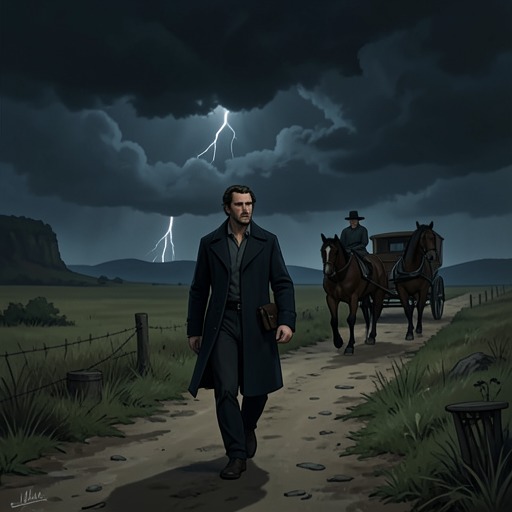
The troika gives the country’s scale a moving emblem. It is described not as a fashionable, German-equipped vehicle but as a practical conveyance shaped with the tools of a peasant craftsman from Yaroslav and driven by a bearded, mittened coachman. Its passage turns road, wheels, and horses into a single image of speed. The narrator extends that motion into a comparison with Russia: the country seems to race forward, leaving bridges and spectators behind, while the question of where it is going remains unanswered. The momentum is powerful, but its destination is withheld.
The second part reopens the tension between national breadth and social imperfection rather than resolving it. The narrator asks why he continues to paint Russian poverty and seek subjects in the empire’s remote corners, answering that this follows his artistic inclination. Soon afterward, Chichikov considers travel a way to see the world and the “whirligig of humanity,” a living book and a second education; in practice, he also weighs the financial advantages of traveling with a companion. The encounter thus places an expansive idea of travel beside the familiar calculations of self-interest.
The surviving later fragment returns to provincial life through preparations for a second fair, bad roads, and the effects of a poor harvest. Landowners remain in the countryside because of the failed crop, while local officials, whose circumstances are unaffected by that failure, pursue luxury and hope to resume taking bribes. Fine equipages parade despite wet and snowy weather; merchants and attorneys court appearances shaped by European fashions. The episode ties national scope back to concrete social contrasts: the country’s economic hardship exists alongside officials’ indulgence and status-seeking. Because only fragments of the second part survived, this material does not supply the intended conclusion. Russia remains at once a particular landscape, a network of institutions and habits, and the open-ended horizon toward which the troika continues to run.