The Russian troika
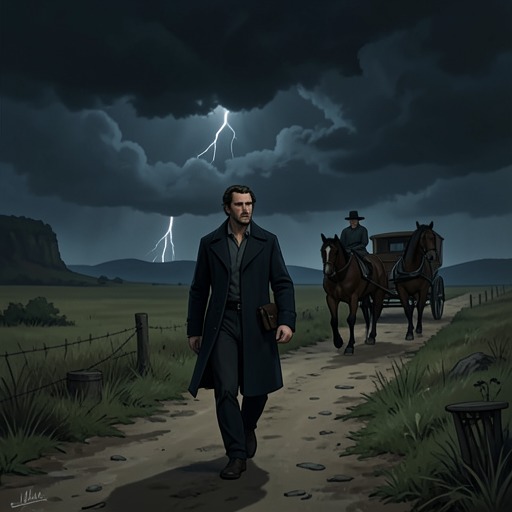
Dead SoulsThe Russian troika begins as the vehicle carrying Paul Ivanovitch Chichikov along the road, but it becomes the novel’s culminating image of Russia itself: immense energy in motion, at once exhilarating and alarming, with no destination disclosed. A sleepy coachman rouses the horses; the carriage surges forward; and the narrator’s attention widens from that ordinary ride to a vision of a nation outrunning the world. Its momentum is palpable, but its meaning remains unresolved: the road is visible, the direction is not.
From a drowsy ride to sudden speed
The image is rooted in a specific scene of negligence and awakening. Selifan has been sitting with half-closed eyes, offering the horses little encouragement beyond occasional flicks of the reins. Petrushka has lost his cap and slumped backward until his head rests against Chichikov’s knees, so Chichikov wakes him with a cuff. Selifan rouses himself too, strikes the skewbald horse, and gets it trotting; when the other two follow, the light britchka moves like thistledown. The troika’s speed is therefore not presented as a constant or effortless condition: it breaks out of an ordinary, sleepy interval through a sharply physical gesture.
As the road jolts Selifan vertically on his seat and he flourishes the whip, Chichikov reclines against the carriage’s leather cushions and smiles at the sensation of going fast. The scene gives speed both bodily force and pleasure. The vehicle seems light, yet it carries its passengers through a world of jolting road, reins, horses, and motion; the contrast between Selifan’s bouncing and Chichikov’s comfortable recline makes the same ride feel differently to driver and passenger. From this small, concrete pleasure, the narrator turns to a more general claim about the attraction of letting horses run freely.
The road as an altered landscape
The passage makes speed change how the world is perceived. Verst stones, traders riding on their wagons’ shafts, and a forest of spruce and fir seem to fly backward; the woodcutter’s axe and a raven’s croaking remain audible amid the passing landscape. The road, by contrast, comes toward the traveler from a dim distance. The brief glimpses reveal little clearly, and the scene acquires a pervasive mystery. Movement thus sharpens sensation while frustrating complete vision: the faster the vehicle goes, the less securely the surrounding world can be taken in.
The troika’s flight is made distinctly local rather than mechanically modern. The narrator contrasts it with a fashionably constructed road vehicle of clamps and iron: this carriage has been shaped with an axe or chisel by a handy peasant of Yaroslav. Its driver is not dressed in German livery but is a bearded, mittened man, who mounts, flourishes his whip, and breaks into a long-drawn song. The horses race until their wheels appear as transparent circles and the road seems to quiver beneath them. A pedestrian halts in astonishment to watch the carriage shrink toward the horizon, becoming a speck in a cloud of dust. These details make the troika a product of vernacular skill, human effort, and animal power, rather than of polished machinery.
From vehicle to national emblem
Once the carriage has raced out toward the horizon, the narrator asks whether Russia itself is not speeding like a troika that nothing can overtake. The road smokes beneath its wheels and bridges thunder as it crosses; everything is left behind. Spectators stop in wonder, unsure whether they are seeing a nation in motion or a thunderbolt launched from heaven. The transformation is not merely a comparison of speed: the image enlarges the vehicle into a question about national power and historical direction.
The language gives that power an almost sacred charge. The horses’ manes seem to contain the winds, and every vein in their bodies becomes an ear listening for a celestial message; their iron-girded breasts and barely touching hooves carry them forward as though on a divine mission. Yet this elevated imagery does not supply an explanation of where Russia is going. The narrator asks what the progress foretells and what unknown force lies within the mysterious horses, but receives no answer. The troika’s strength is vividly imagined; its purpose remains open.
An unanswered destination
The passage closes not with arrival but with acceleration. The air roars as Russia overtakes the whole world, and the other nations and empires are imagined as one day having to stand aside and yield the way. This forecast makes the image grander than Chichikov’s pleasure in a fast drive, but it does not settle whether the implied future will be triumph or danger. The troika commands attention through its sheer force while withholding a clear account of its destination.
That withholding is built into the final exchange between movement and silence. The narrator asks where Russia is speeding and calls for an answer; none comes, and only the strange sound of the collar-bells is heard. The road image therefore holds aspiration and uncertainty together: the country appears capable of leaving all others behind, but the meaning of that advance cannot be read from its speed alone. The literal three-horse carriage, first jolted awake on an ordinary road, ends as an emblem of collective momentum whose horizon recedes even as the vehicle flies toward it.