The road
Dead SoulsThe road in Dead Souls is more than the route between estates and towns: it is the condition that makes Chichikov’s episodic travels possible, an unruly material environment that frustrates control, and an image through which the narrator meditates on Russia and the novel’s unfinished forward motion. Its meaning shifts between mud-caked wheels and a vast, lyrical prospect; between the business of acquiring souls and the possibility of a life directed toward productive labor.
Travel and Material Resistance
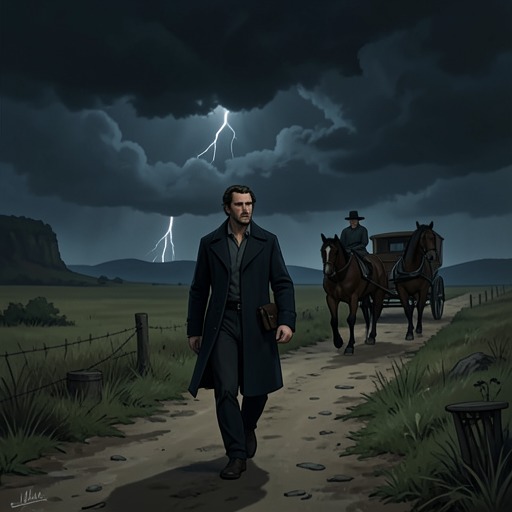
Travel on the road is governed by weather and ground as much as by intention. During one journey, thunder interrupts Selifan’s rambling speech, rain beats slantwise against the carriage, and Chichikov draws the curtains and urges the coachman to hurry. Selifan gathers up an old blanket to protect his sleeves, takes the reins, and sets the three horses moving. But he cannot remember whether they have passed two turnings or three—or, as he comes to suspect, many more. He chooses right at the next crossroad and gallops on without considering where it leads. The road makes a practical decision into a gamble: speed answers the storm, but does not guarantee direction.
A later passage shows the opposite difficulty. The weather is fine, yet the ground is so sodden that mud cakes the wheels of Chichikov’s britchka like felt, adding weight and slowing the vehicle. The party cannot clear the neighboring parishes before afternoon. With paths twisting in every direction, Selifan depends on a girl’s assistance to find the way; she points out the main road and identifies a building ahead as a tavern. The contrast between storm and fair weather does not make travel predictable. Rain threatens the travelers from above; wet ground holds them back below, while the branching roads make local knowledge essential.
These obstacles give the road a concrete place in the book’s social geography. It links the movement of Chichikov and his household to villages, inns, market towns, fields, and estates, but never becomes a frictionless line between destinations. The journey takes time, involves dependence on drivers and guides, and unfolds amid the ordinary conditions of Russian travel. Its openness is real, but so is its resistance.
A Moving Landscape of Russia
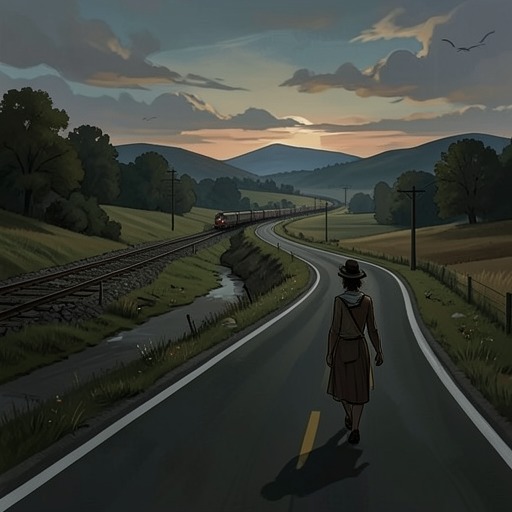
When Chichikov’s britchka leaves the streets of a town, the narrator’s attention expands from the vehicle’s progress to the landscape passing beside the highway. Wooden fences give way to the open turnpike and its verst stones, road menders, and grey villages. Inns, pedestrians in worn shoes, small towns with booths, repaired bridges, fields, landowners, and a mounted soldier carrying a green, iron-clamped artillery box come into view. The roadside is neither an empty wilderness nor a carefully arranged panorama: it is a lived-in sequence of work, commerce, travel, and settlement.
That sequence leads into a meditation on Russia. The narrator sets the country’s flat, open expanse against the picturesque mountains, ruins, waterfalls, and richly varied scenery associated with other landscapes. Russia, as seen here, lacks the visual features that conventionally promise picturesque beauty; its towns rise from smooth plains, and the eye finds little to delight or dazzle it. Yet this apparent plainness cannot explain the country’s hold on the narrator. He hears a sad song running across its breadth and asks what hidden bond draws him toward it. The road’s wide horizon becomes an occasion not for a settled answer but for questions about Russia’s future, its capacity for ideas as boundless as its space, and the heroes that might one day arise there.
The passage’s movement between a specific roadside inventory and a sweeping national address is central to the road’s imaginative force. The highway does not merely lead through Russia; it gives the narrator a changing vantage from which to see the country as both materially disordered and capable of an unrealized immensity. The landscape remains open, and so does the meaning attached to it.
The Highway as Narrative Form
The narrator also pauses the forward action to reflect directly on the experience of highway travel. In an imagined journey on a chilly autumn day, a traveler draws a cloak close, settles into a corner of the britchka, hears the horses’ breathing and the wheels’ rumble, and falls asleep. Waking in stages, the traveler discovers a succession of places and times: a moonlit town of churches and wooden roofs, dark fields and steppes, the first gold at the horizon, and, later, water, scattered huts, a manor house, and a village church. The passage transforms the ordinary, interrupted rhythm of a long ride—sleep, jolt, waking, sleep again—into a way of encountering distance.
The highway matters to the narrator not only as scenery but as a source of imaginative renewal. He recalls setting out along it in weariness and despondency and finding rest there, along with “wonderful thoughts and poetic dreams and curious, wild impressions!” Travel offers a release from mental stasis, though not a tidy resolution. The road’s value lies in the movement and impressions it makes possible: its changing views unsettle habitual perception, while its long duration gives reflection room to unfold.
This reflective detour also reveals the novel’s self-conscious structure. As Chichikov lolls against the cushions after leaving N. behind, the narrator says that the vanished town disappears from his thoughts and takes the opportunity to turn to his hero. The road thus provides a hinge between scenes of local intrigue and a broader account of Chichikov. It allows the narrative to pause the itinerary while converting travel into a reason to speak about the character, the book, and the reader’s expectations.
Chichikov’s Journey and the Unfinished Road
The road is bound to Chichikov’s enterprise. He travels under the pretense of looking for a place to settle, inspecting parts of the Russian Empire especially affected by crop failures, high mortality, or other misfortunes that might make the purchase of souls cheaper. He selects landowners rather than approaching them at random, seeking those with whom he expects to make agreements easily; when possible, he first cultivates acquaintance or friendship in the hope of obtaining souls without paying. The physical itinerary therefore carries a calculated commercial project, even as the narrative gives the journey meanings that exceed Chichikov’s purpose.
At the end of the novel’s first part, the narrator emphasizes how much road remains. Chichikov’s party consists of the elderly traveler, his bachelor’s britchka, Petrushka, Selifan, and three horses individually known by name. The promise of more versts ahead keeps the story from closing into a completed circuit: the initial purchases are only the beginning of an enterprise that will encounter further problems, success or failure, and a widening horizon. The road is both a literal measure of distance yet to travel and a structural sign of a narrative still in motion.
Its meanings are not all aligned. Chichikov’s travel serves acquisition, while the narrator’s highway meditation makes travel a source of rest, thought, and poetic impressions. Elsewhere, the road’s surroundings recall the labor that sustains estates. In Kostanzhoglo’s account of the agricultural year, preparations for sowing begin before spring; ploughing, sowing, and planting are followed by summer reaping, storage, winter threshing, and attention to mills, factories, and workers’ huts. The estate owner’s days take their shape from land, seasons, and work. Set beside Chichikov’s mobile search for opportunities to buy souls, this account distinguishes acquisitive movement from an ideal of sustained, productive care. The road connects these different visions without resolving their tension: it leads onward, carrying both the business of the plot and the question of what kind of life its traveler might make.