The shadow administration of bribery
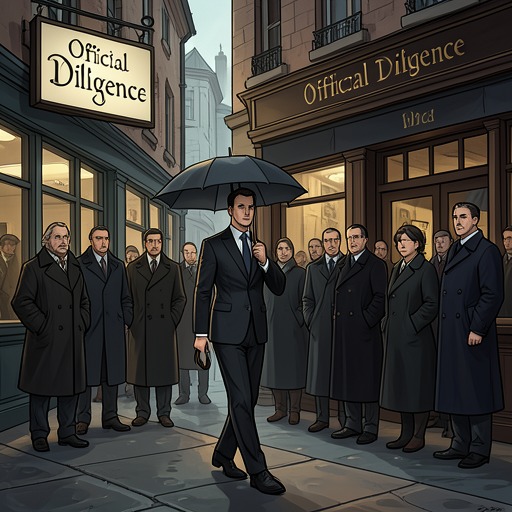
Dead SoulsThe shadow administration of bribery is the informal power system that grows alongside lawful government in Dead Souls, turning personal access, payments, favors, and manufactured information into instruments of administration. Its decisive significance is stated by the Governor-General near the novel’s abrupt ending: corruption has become a second administration, more powerful than the lawful one, with its own conditions and tariff. The idea gathers together the smaller transactions and evasions scattered through the book, then makes them the subject of an unfinished appeal for public reform.
Definition and Scope
The Governor-General’s closing speech gives the system its clearest formulation. He argues that the country suffers not from foreign invasion but from its own actions: beside the lawful administration, a second has arisen with greater power. It has established conditions and fixed prices, and has circulated its tariff. This is not merely a collection of individual bribes. It is an alternative order of influence, sufficiently established that even a wise ruler can do little more than limit the damage by placing more upright supervisors over venal officials.
The speech also explains why the system persists. The Governor-General recognizes that dishonesty has deep roots and that the traffic in bribes has become a necessity, even a mainstay, for some officials who are not naturally corrupt. Many, he says, find it impossible to swim against the current. His account therefore presents corruption as both personal misconduct and a structure that shapes the conditions under which official work is performed.
Ordinary Administration and Informal Access
The novel’s municipal scenes show how official business is conducted through relationships as well as rules. When Chichikov arrives in N. City, he makes a deliberate round of calls on the Governor and other senior officials, including the President of the Local Council, the Chief of Police, the tax commissioner, and municipal officers. His flattering remarks and deferential attention help establish him socially before he brings forward his business. The visits do not themselves prove that every official is corrupt, but they show how access and reputation form part of the environment in which public affairs proceed.
The registration of Chichikov’s purchases makes the interaction between formal procedure and personal connections more explicit. At the municipal office, he submits a list of peasants bought from landowners and asks for the transfers to be registered. The clerk says that the matter cannot be completed that day because further proof is required. Chichikov responds by invoking his intimacy with the President of the Council; the clerk indicates that this connection alone is insufficient. The exchange presents friendship as a resource brought to the counter, even as official requirements continue to obstruct immediate completion.
Once the President intervenes, the procedure moves forward. Witnesses are summoned, including the Public Prosecutor and the Inspector of the Medical Department, whom Sobakevitch describes as men with little to do. After the indentures are signed, docketed, and registered, Chichikov pays only half the usual government charges; the other half is somehow assigned to another applicant. The transaction is completed through formal documents, but its cost is altered by the President’s discretion. The scene makes the system legible in small administrative particulars: a counter, proofs, witnesses, signatures, fees, and an unexplained redistribution of charges.
Networks, Information, and Fabrication
The shadow administration also works through channels that bypass official inquiry. When officials try to learn about Chichikov, they send their servants to question his household servants. The effort yields little: Petrushka offers no useful account beyond the odor of his room, while Selifan says only that his master has served in government and in the Customs. The episode shows how information travels through subordinate personal networks, but also how unreliable and limited those channels can be. The officials remain unsure who Chichikov is, and even debate whether he should be detained or might himself be able to detain them for misconduct.
Later, during the investigation into Chichikov and the inheritance dispute, information and rumor proliferate on a larger scale. Relatives emerge to pursue claims against Madam Khanasarova’s property, while reports about the wills, alleged theft, Chichikov’s dead-soul purchases, and his earlier Customs service enter the authorities’ inquiry. The investigation draws together matters that Chichikov had believed known only to himself and a few others. The episode reveals the reach of official information-gathering, while its uncertain sources and accumulating allegations also make the investigation vulnerable to distortion.
That vulnerability becomes a tool in the scheme organized by Chichikov’s lawyer and Samosvitov. The lawyer circulates claims that officials are preparing damaging reports against one another. The resulting fear drives the Governor, the Chief of Gendarmery, and a confidential official to seek Samosvitov’s advice. Reports then multiply, mixing the Chichikov affair with invented or irrelevant personal scandals until the dossier becomes so tangled that its claims cannot be sorted into a coherent account. The operation does not simply bribe a single official; it manufactures a climate of mutual suspicion and uses competing accusations to make ordinary investigation harder.
Crisis and Political Diagnosis
The immediate crisis exposes both the reach and the limits of this parallel system. The Governor-General receives the chaotic dossier while facing other serious problems: famine relief has been badly administered, Old Believers are in turmoil over rumors about an Antichrist, and peasants in another district have resisted taxation after being told that social roles would be reversed. These pressures leave him confronting a province in which rumor, defective administration, and official misconduct reinforce one another. The fabricated reports complicate an already difficult inquiry, while the surrounding disorders show that administrative failure has consequences beyond the officials’ private rivalries.
In his final address, the Governor-General says that the scandal has brought other dishonorable matters to light and that he knows both the ringleader and the aim of those who have made the case almost impossible to resolve by ordinary methods. He proposes seeking imperial authority for a court-martial because some documents have been burned and false, extraneous evidence and fictitious reports have further obscured the investigation. His proposed response is thus to invoke extraordinary authority against a crisis made worse by the manipulation of ordinary legal and documentary processes.
Yet the speech does not end with punishment as a sufficient remedy. The Governor-General acknowledges his own possible errors in dealing with subordinates and appeals to the officials’ sense of responsibility toward the country. He argues that rules, penalties, and supervision cannot by themselves eliminate dishonesty. Each person must make a stand against it, he says, as citizens once took up arms during a national upheaval. The address breaks off before its argument is complete, leaving the proposed renewal as an appeal rather than a demonstrated outcome.
Narrative and Thematic Significance
Across the novel, the shadow administration is visible at different scales: the cultivation of official favor, the discretionary adjustment of fees, the circulation of information through household servants, and the deliberate production of false reports. These are distinct practices, but the ending draws them into one political diagnosis. What first appears as local convenience or individual maneuver becomes a system with its own rules, costs, intermediaries, and power over the lawful process.
The contrast between the orderly language of administration and the improvised methods used to influence it gives the concept its satirical force. Documents are signed and registered, witnesses are called, and offices follow procedures; at the same time, friendships, favors, and invented allegations can bend or overwhelm those forms. The Governor-General’s closing image of a second administration therefore names the central institutional danger: corruption does not merely violate the official order from outside but grows within it, competing with lawful authority and making reform depend on more than formal procedure.