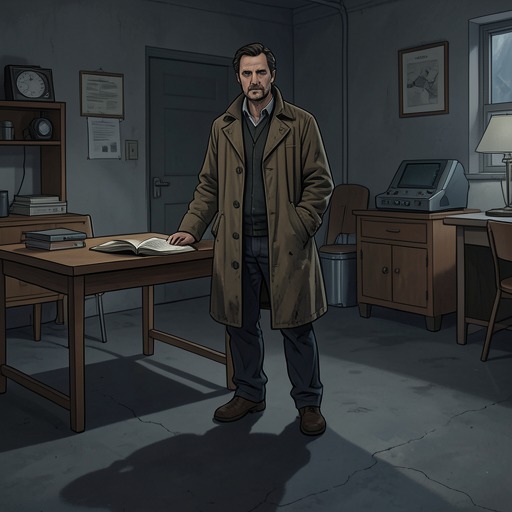
Tientietnikov’s neglected estate
Dead SoulsTientietnikov’s neglected estate is the setting in which his reforming intentions meet the practical and human limits of his authority. He reduces compulsory labor and tries to manage the property personally, yet good intentions do not produce cooperation or prosperity. The estate’s decline is therefore not simply a matter of neglected fields: it grows out of a widening failure of understanding between landlord and peasants, until Tientietnikov abandons both active management and company.
Reform and the limits of supervision
After returning to his estate, Tientietnikov responds to the peasants’ affectionate welcome with a vow to share their tasks and concerns. He reduces the barstchina, the compulsory labor owed to the proprietor, cuts the number of workdays for the owner, and increases the peasants’ leisure. He dismisses the bailiff and takes a personal hand in the work, appearing in the fields, at the threshing-floor and kilns, at the wharf, and during the loading and movement of barges and rafts. For a time, even the previously lazy workers seem to take more care.
That initial energy soon reveals a basic weakness: Tientietnikov wants to supervise everything but lacks practical knowledge of how to do it. The peasants recognize that he is eager and energetic, yet speaks from books rather than experience. The problem is not simply that master and workers cannot understand one another; they cannot bring their efforts into a common rhythm. His presence in the work sites cannot substitute for the knowledge and trust that effective management requires.
Unequal harvests and contested labor
The fields make the failure visible. The peasants appear to work hard, and Tientietnikov rewards them with mugs of vodka. Their rye forms ears, their oats begin to fill, and their millet ripens, while the crops on the manorial lands have barely reached the stalk stage. When he asks why his fields have fared so badly, the peasants blame a grub and a summer without rain. Tientietnikov notices the discrepancy: no grub has harmed the peasants’ crops, and the rain seems to have fallen in patches, benefiting their land while leaving his with only a sprinkling.
The contrast turns his generous reforms into a test of confidence that he cannot resolve. He first remonstrates with the peasants, then finds that their account of the harvest does not match what he sees. Nor does the narrative present a practical remedy that restores the manorial crops. Instead, the uneven growth records a breakdown in cooperation: labor appears to have been performed, but the landlord cannot tell how to make that labor serve the estate’s fields as well as the peasants’ own.
Women’s work becomes another point of friction. Tientietnikov abolishes most of the dues in linen, hedge fruit, mushrooms, and nuts, and halves other tasks, hoping that the time released will be used for sewing, mending, making clothes for husbands, and tending kitchen gardens. The hoped-for results do not follow. The narrator describes idleness, quarrels, and intrigue, while the women’s husbands repeatedly ask the landlord to rid them of wives they say have become impossible to live with. When Tientietnikov tries severity, a woman pleads illness while clutching filthy rags, then, as she leaves the gates, fights a neighbor over a turnip. The episode presents his attempts at control as both ineffectual and comic, without turning the conflict into a workable system of discipline.
Failed institutions and retreat
The same distance between theory and lived conditions frustrates Tientietnikov’s plans for schooling and justice. His attempt to establish a school for the people ends in farce. In disputes, the legal subtleties and philosophical maxims learned from professors prove useless: each side lies, and he concludes that only the devil could decide between them. He recognizes that knowledge of human beings would have served him better than abstract legal refinement, but cannot identify what he lacks. The result is mutual disaffection between landlord and peasant.
As this discouragement grows, Tientietnikov supervises the fields less attentively. Even when workers are scything grass, building ricks, or loading rafts, his gaze drifts to a heron on the stream and to the birds overhead. The countryside briefly offers him a different kind of order: quail call in the rye, corncrakes in the grass, larks sing above, and cranes move in triangular flocks. Yet this attentive contemplation does not revive his management. The beauty of the rural scene follows, rather than solves, the failure of his practical plans.
Estate neglect and its significance
Soon even the fields cease to draw him. Tientietnikov shuts himself in his rooms and refuses to receive the bailiff when he comes with reports. He also breaks with his visitors: a retired hussar colonel and a student whose opinions come largely from newspapers and pamphlets. Finding their talk superficial and their European manner of conversation tiresome, he dismisses them rudely. After one visitor is told that Tientietnikov is not at home, the two men see each other through the window; the visitor curses him, Tientietnikov answers with an insult, and the acquaintance ends. No one visits the mansion thereafter.
In isolation, Tientietnikov turns to a grand work on Russia, conceived on a large scale but pursued through an unsystematic method. His withdrawal is not wholly free of regret. When newspapers and reviews bring news of former comrades who have succeeded in public service or contributed to science, he feels a suppressed grief at how little he himself has done. The neglected estate thus embodies a larger frustration: the impulse to improve Russia and its rural life remains, but neither the landlord’s book learning nor his solitary ambition has supplied the patient, practical engagement that the work demands.
The estate’s failures also sharpen the contrast with the account of successful land management given by Kostanzhoglo. He describes the year as a continuous sequence of observation and labor: preparing seed before spring, sowing and planting as the ground permits, reaping in summer, storing produce for winter, and threshing and inspecting workshops and workers’ huts in the cold season. His ideal depends on attention to each stage and on knowledge grounded in work. Tientietnikov’s experience shows the opposite: reforms and good intentions cannot sustain a property when its manager lacks practical command, loses the trust of those who work it, and finally withdraws from the fields altogether.