A spring afternoon in May, in the year 19—
A Walk at the North Cemetery
After a punishing morning of work, [Gustav von Aschenbach](entity:character-recall-character-gustav-von-aschenba-050eb4ea234a) walks through the English Gardens in [Munich](entity:location-recall-location-d277927d86b1), hoping fresh air will restore him. At the North Cemetery he waits for a tram beneath the ominous inscriptions of the funeral hall and notices a strange red-haired traveler standing in its portico.
The stranger’s foreign appearance and fierce gaze awaken in Aschenbach a sudden, almost hallucinatory longing for distant places. A vision of tropical wilderness, rank vegetation, and a lurking [Tiger](entity:creature-recall-creature-c09ecbd5b296) gives shape to an appetite that his disciplined life has long suppressed.
That evening, after the cemetery walk
The Decision to Travel
Aschenbach recognizes that his desire to travel is also a desire to escape. His work has reached a frustrating impasse, and the severity with which he has governed his emotions and routine has left him weary and dissatisfied with the polished work that brings him public admiration.
He decides that a short southern holiday may restore his energy without derailing his larger plans. Rather than attempt the distant world conjured in his imagination, he will seek a pleasant seaside resort within easy reach; he resolves to consult maps and timetables that evening.
Before the journey, in recollection
The Making of a Famous Writer
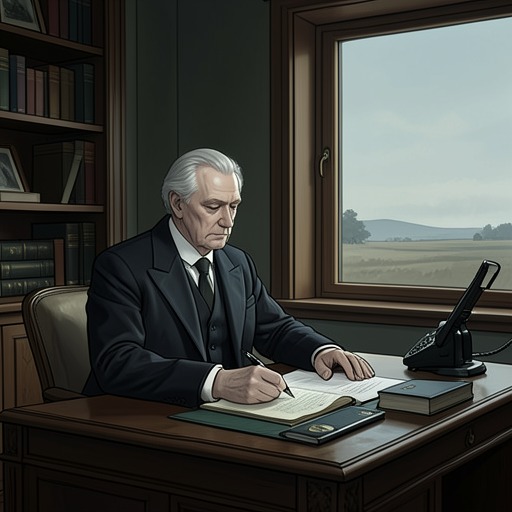
Aschenbach’s public identity rests on a life of strenuous work. Born into a family that joined official discipline with his mother’s more sensuous artistic inheritance, he learned early to write through illness, solitude, and the demands of a growing reputation.
He builds his works in painstaking daily installments and believes that greatness is achieved despite weakness, hardship, or passion. His favored ideal, “[Carrying through](entity:expression-recall-expression-carrying-through-11e59e688af4),” and his image of the heroism of weakness explain both his artistic method and the stern self-command that has shaped his life.
Before the journey, in recollection
The Hero of Weakness
Aschenbach’s fiction repeatedly gives dignity to figures who meet adversity through restraint rather than easy strength. A critic describes this type as “intellectual and youthful masculinity,” poised against danger with a proud, controlled bearing; Aschenbach sees this as a form of aggression and triumph, not mere endurance.
His own career has followed a similar path: youthful skepticism gives way to a public style marked by formal mastery and moral seriousness. Yet his reflections also suggest that artistic form may be morally double-edged—born of discipline, but capable of making morality submit to beauty and sensation.
Before the journey, in recollection
A Life of Discipline
Ill health kept Aschenbach from ordinary schooling and left him without childhood companions. Convinced that his talent rested on a frail physical foundation, he made discipline the condition of survival: early mornings, cold-water ablutions, and a few intensely concentrated hours at his writing desk became the structure of his work.
He wanted to live long enough for his art to reflect every stage of human development. His celebrated epics were not products of effortless abundance but of sustained labor, revision, and a will trained to carry a project through.
Years before the journey, in recollection
The Return from Skepticism
As a young writer, Aschenbach had unsettled readers with attacks on the uncertain nature of art and talent. In maturity he turns away from knowledge when it threatens to paralyze action or degrade the will, and his work increasingly favors clarity, restraint, and dignity.
His story The Wretch rejects the idea that psychological understanding can excuse moral degradation. Yet Aschenbach’s own reflections recognize a danger in this simplification: a strict exclusion of unsettling knowledge may also strengthen the artist’s capacity for what is forbidden, and artistic form may serve discipline while remaining indifferent to morality.
Before the journey, in recollection
The Honored Master
Aschenbach’s later career brings official honors, school-reader selections, and a title of nobility. His marriage ends with his wife’s early death, and his daughter is now married; he has never had a son. [Munich](entity:location-recall-location-d277927d86b1) becomes his settled home, while a mountain house serves as his summer retreat.
The quiet respectability of this public life contrasts with the intensity of the imaginary adventures his art has carved into his face and nerves. He is admired as a master of controlled expression, but privately fears that age and fatigue are narrowing his creative powers.
About two weeks after the walk, in mid-to-late May
Departure for the Adriatic
Literary and social obligations delay Aschenbach’s departure. He arranges for his country house to be ready within a month, then takes the night train to Trieste and continues by ship to Pola.
He seeks something foreign yet accessible, a change that might interrupt his familiar routines without carrying him too far from home. An Adriatic island initially seems to promise this, but the weather and the resort’s atmosphere soon disappoint him.
About a week and a half after arriving on the Adriatic island
The Wrong Resort
Rain, a heavy atmosphere, the hotel’s provincial clientele, and the absence of a welcoming sandy beach prevent Aschenbach from settling into the island resort. He senses that he has mistaken his destination and consults sailing schedules until the answer suddenly seems obvious: [Venice](entity:location-recall-location-venice-0377938b8d6a).
Before dawn, a motorboat carries him and his luggage back to the naval port. There he boards a steamer already preparing to sail for Venice, allowing the original longing for the unfamiliar and remote to draw him onward.
On the steamer to Venice
The Old Dandy
The decrepit Italian steamer is captained by a theatrical, obsequious ticket-seller, while a group of young Pola clerks celebrates its excursion to Italy. Among them, Aschenbach notices a conspicuously dressed youth whose supposed youth is a grotesque disguise: he is an old man wearing makeup, a wig, dyed facial hair, and artificial teeth.
The clerks accept him as one of their own, and his drunken attempts to imitate their exuberance deepen Aschenbach’s sense that the world around him is becoming distorted. The encounter introduces a grotesque counterfeit of youth that will later echo his own attempts to disguise age.
Later that day, during the sea passage
The Crossing to Venice
As the ship leaves harbor, the sky remains grey, the sea empty, and damp coal dust settles over the deck. Aschenbach sleeps and dreams among disjointed impressions of the old dandy and the ticket-seller, while the long crossing loosens his sense of time.
When he sees [Venice](entity:location-recall-location-venice-0377938b8d6a)’s coastline, the dreary weather disappoints him. He wonders whether the city can still offer a late emotional adventure, then watches the steamer approach the lagoon and wait for the health department’s barque.
The following day, on reaching Venice
Arrival by Sea
The steamer finally passes through the San Marco canal, bringing into view the palaces, Bridge of Sighs, columns, and domes of [Venice](entity:location-recall-location-venice-0377938b8d6a). Aschenbach thinks that a city so unreal should be entered by sea, as though arriving at a palace through its ceremonial front rather than its back entrance.
The passengers disembark amid the old dandy’s drunken, indecorous farewells. Aschenbach escapes his importunities and boards a gondola, beginning a passage through the city that feels both luxurious and funereal.
Immediately after landing in Venice
The Unlicensed Gondolier
Aschenbach asks to be taken to the landing for the steamers to the [Lido](entity:location-recall-location-a2228ea2c9f0), but the gondolier insists that he is already going there and refuses to turn back. The rower’s manner is harsh and commanding, and Aschenbach briefly imagines that he may have fallen into the hands of a criminal.
Instead of resisting, he lets the black, coffin-like gondola carry him onward, seduced by its soft seat and the quiet motion of the oar. When he reaches the landing and returns with money to pay, the gondolier has vanished; a local tells him that the man was unlicensed and has carried him for nothing.
That afternoon, after crossing to the Lido
The Hotel by the Sea
Aschenbach settles into a room at a large hotel on the [Lido](entity:location-recall-location-a2228ea2c9f0), with an open view of the sea. The quiet, solitary setting intensifies his habit of turning small observations into emotionally charged experiences, and the troubling encounters from his journey continue to unsettle him.
At dinner he notices a Polish family gathered around a table: three severely dressed girls, a governess, and a beautiful boy whose honey-colored curls and pale, sculptural face immediately arrest his attention. The boy’s freedom and luxurious clothing stand out against his sisters’ deliberate austerity.
The first evening at the Lido
The Boy’s First Glance
When the children’s mother enters, the family rises and greets her with formal respect. The boy turns back toward Aschenbach before following the others into the dining room, and their eyes meet briefly.
Aschenbach is moved by the precision of the family’s manners and by the contrast between the boy’s apparent tenderness and his sisters’ rigid upbringing. He takes his place at a distant table, but the image of the beautiful child remains with him through the evening.
The morning after arrival
The Empty Place at Breakfast
Under a grey sky and a land breeze, Aschenbach considers leaving the [Lido](entity:location-recall-location-a2228ea2c9f0) because the weather and the smell of the lagoon recall an earlier illness. He has not fully unpacked and eats breakfast in the hotel buffet room, where he sees the Polish girls and their governess but finds the boy absent.
He jokes to himself that the child is enjoying the privilege of sleeping late. The small absence already draws his attention, turning an ordinary hotel morning into a wait for the boy’s appearance.
Later that morning
The Beauty in Motion
The boy finally enters the breakfast room and walks toward his sisters with a light, graceful, slightly shy manner. His beauty again overwhelms Aschenbach, who privately compares his head to the image of [Eros](entity:concept-recall-concept-eros-0e04c2b6957e) in marble and reluctantly leaves for the beach.
At the shore, Aschenbach watches the varied life of the resort and decides that the place may suit him after all. When the boy passes nearby, he sees a sudden expression of scorn directed at the Russian family, a flash of childish hostility that makes the boy seem more individual and compelling than a beautiful image alone.
That morning on the beach
Learning the Name Tadzio
Aschenbach listens to the children calling to the boy, catching only a repeated name that sounds like “Adgio.” He abandons his correspondence to watch him play with a group of companions around a sandcastle, where the boy is plainly admired and sought after.
A stocky Polish boy, later understood to be [Jaschu](entity:character-recall-character-0379b84e3b67), walks arm in arm with him and kisses him. Aschenbach puzzles over the name until he identifies it as [Tadzio](entity:character-recall-character-792c693d883b), the familiar form of Tadeusz; the name’s sound becomes part of the pleasure he attaches to the boy.
Later that morning
Tadzio Rises from the Sea
[Tadzio](entity:character-recall-character-792c693d883b) swims far out into the smooth water while women call anxiously from the bathing houses. Their repeated cries of his name carry across the beach, and he turns back toward shore, beating through the water with a graceful, unhurried strength.
As he emerges from sea and sky, Aschenbach experiences the sight as almost mythical: a beautiful figure seeming to rise from the elements themselves. The spectacle confirms his wish to remain at the [Lido](entity:location-recall-location-a2228ea2c9f0) and watch the boy again.
Later that day
The Boy as a Living Image
[Tadzio](entity:character-recall-character-792c693d883b) rests in the sand beneath a white robe, and Aschenbach remains aware of him even when he is reading. The writer describes his own feeling as a paternal affection, a pull from someone devoted to creating beauty toward someone who possesses it naturally.
After lunch, Tadzio enters the lift and stands near Aschenbach. In this close encounter, Aschenbach notices that the boy’s teeth appear unhealthy and privately judges him frail, perhaps unlikely to grow old. The observation brings a disturbing element of mortality into his admiration, but he cannot dismiss the satisfaction the thought seems to give him.
That afternoon
The Sirocco in Venice
Aschenbach crosses the lagoon to [Venice](entity:location-recall-location-venice-0377938b8d6a) and walks through streets where heat and sirocco trap foul smells in the air. The crowd, the oppressive atmosphere, and the physical strain leave him sweating, feverish, and short of breath.
He decides that Venice is unhealthy for him and resolves to leave the next morning for another seaside resort. He returns through the canals, announces his departure at the hotel desk, settles his account, and prepares his luggage despite the growing reluctance he has not yet admitted.
The next morning
A Hasty Departure
The sky is still overcast, but the air feels fresher, and Aschenbach begins to regret the decision made the previous day. At breakfast the hotel staff urge him to leave early, though his train is still more than an hour away; he insists on finishing his meal in peace.
[Tadzio](entity:character-recall-character-792c693d883b) enters the room on his way to breakfast, lowers his eyes, then raises them softly toward Aschenbach. The writer silently bids him farewell and offers a blessing, but leaves the hotel on foot, accompanied by a servant carrying his hand luggage.
That morning, at the Venice station
The Trunk Sent to Como
On the journey across the lagoon, Aschenbach realizes how deeply he is attached to [Venice](entity:location-recall-location-venice-0377938b8d6a). The thought of never seeing the city again turns his earlier misgivings into acute grief, and the prospect of leaving feels like a humiliating defeat by his own physical weakness.
At the station he discovers that his large trunk has been sent in the wrong direction, to Como. Rather than travel without it, he decides to return to the beach hotel and wait for its recovery; the mistake gives him an unexpected reason to reverse his departure.
Twenty minutes after reaching the station
Return to the Lido
Aschenbach is almost giddy with relief at the mishap that has interrupted his escape. He tells himself that the error could hardly have turned out better, and hurries back across the lagoon with a mixture of nervous excitement and feigned annoyance.
The hotel manager provides another room, and Aschenbach settles in again. When he sees [Tadzio](entity:character-recall-character-792c693d883b) returning from the sea, he understands that the boy—not merely [Venice](entity:location-recall-location-venice-0377938b8d6a) or the beach—has made departure so difficult. His return becomes a deliberate surrender to the attraction he had not acknowledged.
That noon, after returning to the hotel
An Embrace of Fate
Alone in his room, Aschenbach watches the sea and admits that he is glad to be back. When [Tadzio](entity:character-recall-character-792c693d883b) appears below, an ordinary greeting dies on his lips as he recognizes the truth of his attachment.
He raises his hands in a slow, open gesture of welcome and acceptance. The moment marks the point at which his stay ceases to be a temporary holiday and becomes a choice shaped by the boy’s presence.
The following days at the Lido
The Daily Life of Admiration
The days grow hot and bright, and the easy rhythm of the resort overcomes Aschenbach’s resistance to idleness. He unpacks fully, dresses for the beach and dinner, and lets the sea, the evenings, and the nearby city replace his former routine of work.
[Tadzio](entity:character-recall-character-792c693d883b) is repeatedly within sight—in the hotel, on boats, in the city, and most reliably on the beach. Aschenbach begins to regard the daily chance to observe him as the chief guarantee of his happiness, arranging the hours of his holiday around the boy’s presence.
During the first weeks at the Lido
The Sculptural Body
From his place on the beach, Aschenbach studies [Tadzio](entity:character-recall-character-792c693d883b)’s play, gestures, and posture with the concentration of an artist examining a work of art. The boy’s body seems to him a perfect form, shaped by a pure and strenuous will that he recognizes as akin to his own labor over language.
He comes to believe that the beauty before him offers access to a higher, spiritual reality. This idea becomes the frame through which he justifies his growing fixation: beauty is not only sensuous pleasure but a path toward the divine.
During the first weeks at the Lido
The Phaedrus Meditation
The sight of [Tadzio](entity:character-recall-character-792c693d883b) prompts Aschenbach to imagine Socrates instructing Phaedrus beneath a plane tree. In this imagined dialogue, beauty is the visible form through which the spirit becomes perceptible, and the lover’s desire can appear more divine than the beloved’s beauty.
The meditation gives philosophical language to an attraction that Aschenbach has not acted upon. It also exposes the instability of his defense: he calls beauty a road to the spirit, while sensing that the same road may lead the artist into desire and away from dignified self-command.
During the first weeks at the Lido
Writing in Tadzio’s Presence
A request for a public statement on culture and taste reaches Aschenbach at the resort, and he suddenly feels an intense desire to write. He works in [Tadzio](entity:character-recall-character-792c693d883b)’s presence, measuring the movement of his prose against the boy’s visible form and carrying the image of his beauty into the structure of the essay.
The resulting piece is brief, controlled, and admired for its clarity and emotion. Yet Aschenbach feels depleted afterward, as though the act of creation has crossed a boundary between artistic discipline and private indulgence.
The morning after writing in Tadzio’s presence
The Failed Approach
Aschenbach sees [Tadzio](entity:character-recall-character-792c693d883b) alone on the way to the beach and decides he might speak to him in French. He quickens his pace, but as he comes close his heart pounds and his breath fails; afraid of being seen following the boy, he passes him without speaking.
He tells himself that a simple conversation might have restored him to ordinary sobriety, but he recognizes that he does not want sobriety. His failure is therefore not merely a collapse of nerve: it preserves the intoxicating distance on which his fantasy depends.
Over the following days
The Unspoken Familiarity
Ashenbach no longer calculated his stay according to the original plan for vacation. Instead, he worried that the Polish family might leave. He spent extravagantly, slept restlessly, rose before dawn to watch the sunrise, and interpreted the sight of the sun rising with imagery of desire and the myths of
During the following days
The Vision of Hyacinth
Aschenbach watches [Tadzio](entity:character-recall-character-792c693d883b) play ball near sunset and imagines the myth of Hyacinth, beloved by gods and killed by a jealous wind. The boy’s beauty seems to draw ancient stories into the present, allowing the writer to experience his attraction as part of a timeless pattern.
These myths do not bring him closer to Tadzio in any real sense. Instead, they give his isolated watching an exalted, almost sacred language that makes his private fixation feel larger than ordinary life.
One evening, several weeks into the stay
The Smile on the Terrace
After the Polish family misses dinner, Aschenbach sees them return from [Venice](entity:location-recall-location-venice-0377938b8d6a) under the terrace lamps. [Tadzio](entity:character-recall-character-792c693d883b)’s face appears especially pale and beautiful in the light, and Aschenbach is unprepared when their eyes meet.
Tadzio smiles at him—an open, fascinating smile that Aschenbach compares to Narcissus reaching toward his reflection. The apparent intimacy of the gesture overwhelms him; he flees into the dark park and whispers the words “I love you,” recognizing the depth of his desire while remaining unable to address the boy directly.
During Aschenbach’s fourth week at the Lido
The First Signs of Cholera
As the season advances, Aschenbach notices that the hotel’s guest population is shrinking and that German visitors are disappearing. A barber casually mentions that those who remain have no fear of the plague, then becomes evasive when Aschenbach questions him.
Later, Aschenbach detects a sweet, medicinal odor in [Venice](entity:location-recall-location-venice-0377938b8d6a) and finds official notices warning against certain foods and canal water. Shopkeepers explain the disinfectant as a precaution against the heat and sirocco, but the rumors and departures make clear that the city’s assurances are incomplete.
That afternoon and evening
A Secret Worth Keeping
Aschenbach searches the newspapers and finds rumors, statistics, denials, and evasions. He understands that the authorities are trying to keep the outbreak quiet, but the secret gives him a perverse satisfaction: the disorder of the city seems to promise an advantage to his own private desire.
His greatest fear is that [Tadzio](entity:character-recall-character-792c693d883b) may leave. Aschenbach realizes that he has become dependent on the boy’s continued presence and begins to treat the city’s concealment as a condition that protects the world in which his infatuation can continue.
During the cholera rumors, on a Sunday
The Secret Pursuit
Aschenbach learns that the Polish family attends Mass at St Mark’s Basilica on Sundays and hurries there to find [Tadzio](entity:character-recall-character-792c693d883b) praying. He watches from the back of the church as incense mingles with the faint smell of the infected city; Tadzio turns and looks toward him through the smoke.
When the family leaves, Aschenbach follows them through [Venice](entity:location-recall-location-venice-0377938b8d6a), hiding in shops and courtyards when they stop or turn around. He loses them in the narrow streets and suffers moments of panic when they approach, yet he is not truly deterred: his steps now obey the impulse to pursue.
During the same period
The Gondola Pursuit
When [Tadzio](entity:character-recall-character-792c693d883b) and his companions board a gondola, Aschenbach hides nearby and hires another rower to follow them at a distance. He thrills at the gondolier’s willingness to become an accomplice and lets the black boat carry him through the foul, labyrinthine canals.
The city’s beauty and corruption merge in his eyes: music, crumbling palaces, beggars, and the smell of disease all seem to belong to a seductive trap. Returning late to the hotel, he even stops outside the boy’s room and presses his head against the door, risking discovery rather than ending the pursuit.
During the secret pursuit
Justifying the Transgression
In moments of self-reproach, Aschenbach imagines the judgment of his stern ancestors and compares their discipline with his own career. He tells himself that his life as an artist has also been a battle of self-conquest and that even the ancient heroes had submitted to [Eros](entity:concept-recall-concept-eros-0e04c2b6957e) without disgrace.
The argument restores a fragile sense of dignity, but it also reveals how thoroughly desire has begun to govern his reasoning. He uses the language of bravery to defend conduct that he knows is secretive and undignified, while the outbreak in [Venice](entity:location-recall-location-venice-0377938b8d6a) supplies a wider disorder that seems to excuse his own.
Several days into the outbreak’s concealment
The Clown’s Warning
Aschenbach questions the hotel manager about the widespread disinfection and receives the official explanation that the measures are only precautions against unusually warm weather. That evening, a troupe of street singers performs in the hotel garden, and one clown’s clothes and body carry the unmistakable carbolic smell.
Aschenbach quietly asks whether there is plague in [Venice](entity:location-recall-location-venice-0377938b8d6a). The performer denies it with theatrical evasions, then is questioned by hotel employees after collecting money. The exchange confirms that the city’s silence is deliberate, even as the guests continue their entertainment above a concealed danger.
The evening of the street singers’ performance
Tadzio at the Balustrade
[Tadzio](entity:character-recall-character-792c693d883b) stands near Aschenbach on the hotel terrace while the clown performs below. Aschenbach watches the boy turn his head in his direction, but the women who guard Tadzio are nearby, and he fears that his attention may be noticed.
The boy’s proximity, the sickening odor, and the performer’s grotesque laughter combine to hold Aschenbach in a trance. Tadzio remains solemn amid the guests’ amusement, and Aschenbach interprets that seriousness as a private alignment between them. The scene deepens both his sense of intimacy and his fear of losing the boy.
The following afternoon
The Englishman Tells the Truth
At a travel bureau near [Piazza San Marco](entity:location-recall-location-eb49d3d3852a), Aschenbach asks an English clerk about the disinfectants. The young man begins with the official explanation, then admits that the city is concealing a serious cholera outbreak and tells Aschenbach the truth.
The disease has spread from India across parts of Asia and into Mediterranean ports. In [Venice](entity:location-recall-location-venice-0377938b8d6a), cases are multiplying, deaths are frequent, and the authorities suppress reports to protect trade and tourism; the clerk urges Aschenbach to leave before a quarantine is declared.
That evening, after learning the truth
Aschenbach Chooses Silence
Aschenbach considers warning [Tadzio](entity:character-recall-character-792c693d883b)’s mother and urging the family to leave [Venice](entity:location-recall-location-venice-0377938b8d6a). He even prepares the words he might use, imagining that the warning would absolve him and allow him to escape the city.
But he does not want to retrace his steps. The prospect of losing Tadzio and returning to a life of prudence and self-command disgusts him, while the epidemic seems to open a lawless space for his hopes. He decides to keep the outbreak secret and remain in Venice.
The night after he chooses to remain
The Dionysian Dream
Aschenbach dreams of a foreign god and a violent, ecstatic revel descending through a mountain landscape. A crowd of women, men, and animals dances to drums and flutes; the revelers’ cries, the smell of bodies, stagnant water, and disease overwhelm the dreamer’s resistance.
He is drawn into the frenzy, joining its cruelty and sexual abandon until he belongs to the god and tastes the corruption of decay. The dream dramatizes the collapse of the discipline he once treated as the foundation of his life, and gives mythic form to the disorder he has embraced in [Venice](entity:location-recall-location-venice-0377938b8d6a).
After the dream, as the outbreak worsens
The Beautification of Aschenbach
More guests flee the hotel, the beach becomes increasingly empty, and the truth of the epidemic can no longer be kept wholly secret. [Tadzio](entity:character-recall-character-792c693d883b) and his family nevertheless remain, and Aschenbach continues to follow the boy through the city despite exhaustion and the presence of disease.
Wanting to please Tadzio, he becomes ashamed of his grey hair and aging face. At the hotel barber’s suggestion, he submits to a transformation: his hair is darkened and curled, his brows and eyes are reshaped with cosmetics, and color is applied to his lips and cheeks. He leaves delighted by the artificial youth reflected in the mirror.
Several days later
The Lost Trail
Under a damp storm wind and the stench of decay, Aschenbach tracks [Tadzio](entity:character-recall-character-792c693d883b) through the tangled streets of [Venice](entity:location-recall-location-venice-0377938b8d6a). He hides behind walls and passersby, while the boy walks behind his companions and occasionally looks back to make sure that his admirer is following.
Aschenbach loses sight of the family after they cross a bridge and searches in vain through the narrow lanes. Overheated and exhausted, he buys soft, overripe strawberries and sinks down beside a cistern in a neglected square, where the city’s disorder and his own physical collapse converge.
In the neglected square, shortly before his final illness
The Phaedrus Confession
Half asleep beside the cistern, Aschenbach sees himself as the decorated public master, author of The Wretch, and guardian of dignity. Yet the thoughts he murmurs turn against the authority he once claimed: he questions whether artists can remain wise when beauty leads them through the senses.
He now recognizes that the road of beauty may lead toward desire and the precipice, and that the artist’s disciplined style may conceal weakness, appetite, and self-deception. The imagined address to Phaedrus becomes a confession that artistic mastery has not saved him from the very dangers he tried to control.
A few days later, late in the summer stay
The Family Prepares to Leave
Feeling unwell and suffering attacks of vertigo, Aschenbach leaves the hotel later than usual. In the lobby he notices luggage prepared for shipment and learns that the Polish family is departing after lunch.
He accepts the news without visible reaction and goes to the beach. The resort is nearly deserted, the weather has turned unsettled, and the season’s former brightness seems to be draining away. The departure that he has feared is now imminent.
That morning, before the family’s departure
Jaschu’s Final Struggle
Aschenbach watches [Tadzio](entity:character-recall-character-792c693d883b) and the remaining children playing without adult supervision. A quarrel with [Jaschu](entity:character-recall-character-0379b84e3b67) turns into a wrestling match, and the stronger boy pins Tadzio down, pressing his face into the sand until the beautiful child is nearly choked.
Tadzio eventually breaks free, pale and furious. He rejects Jaschu’s attempts to make amends, then walks alone toward the shallows; Aschenbach is poised to intervene but is too late to do so. The contest exposes the boy’s vulnerability and marks the last time Aschenbach watches him on the beach.
That day, shortly before Aschenbach’s collapse
The Final Look
[Tadzio](entity:character-recall-character-792c693d883b) crosses the shallow water to a sandbank and walks along it, separated from his family and companions by the sea. He turns to look back toward the shore, where Aschenbach sits watching with his head slowly sinking against his chest.
To the exhausted writer, the boy seems to smile, nod, and beckon him toward some distant promise. Aschenbach rises as though to follow, repeating the pattern that has governed his stay, though his body can no longer sustain the pursuit.
Later that same day
Death on the Lido
Several minutes pass before anyone notices that Aschenbach has collapsed in his chair. He is carried back to his room, but the story gives no recovery or reconciliation; the aging writer’s pursuit ends in physical death.
News of his death reaches the world with respectful shock. His public reputation remains intact, but the final image leaves his private surrender to beauty, desire, and disorder unresolved.