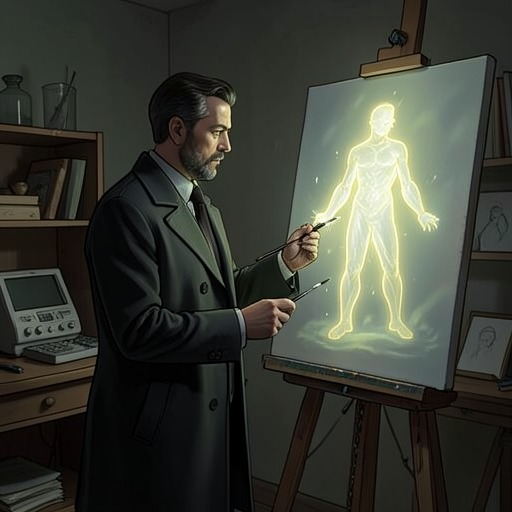
“Beauty alone is both divine and visible”
Death in Venice“Beauty alone is both divine and visible” is the pivotal claim in Gustav von Aschenbach’s meditation on beauty as a sensory route toward the spiritual. It grants beauty a rare power—to make an otherwise imperceptible ideal available to human perception—while exposing the danger in that mediation: the artist who follows beauty through the senses may be led away from the dignity and self-command he seeks to preserve.
Meaning and Philosophical Frame
Aschenbach imagines that Amor uses the form and colour of youth as a tangible representation of pure forms, much as a teacher might make an abstract mathematical truth visible. Beauty’s reflection of spiritual perfection awakens both hope and pain; it is not simply pleasing appearance but a bodily sign that invites the mind to reach beyond the body. The phrase therefore holds together two levels that Aschenbach cannot safely separate: the visible object and the ideal he believes it reveals.
The thought unfolds through an imagined classical scene. Aschenbach pictures Socrates instructing Phaedrus beneath a plane tree near Athens, where wisdom and loveliness are brought into intimate proximity. In this imagined instruction, the noble-minded person confronted with a beautiful body trembles, feels reverence, and is drawn toward the spiritual meaning of beauty. The same beauty that can elevate perception also unsettles it: its force is first felt as an emotional and bodily response, not as detached knowledge.
Beauty as a Road—and a Danger
The maxim does not make sensual beauty identical with spiritual truth. Aschenbach’s imagined Socrates calls beauty a road and a means: the sensible person reaches toward the spirit through what can be seen, but must not mistake the path for its destination. The distinction makes the idea unstable. Beauty offers access to a higher reality, yet the very attraction that opens that access can hold the beholder at the level of desire.
The meditation sharpens this instability with the claim that the lover is more divine than the beloved, because the god is present in the lover and not in the object of love. Desire thus becomes a possible source of insight, but also a source of self-deception: the lover may interpret the beloved’s visible beauty as proof of a spiritual relation that exists chiefly in the lover’s own response. The maxim dignifies the experience without resolving its moral ambiguity.
Tadzio and Artistic Creation
For Aschenbach, these ideas arise while he watches Tadzio. The boy’s appearance gives abstract reflections on form and spiritual beauty an immediate object, and Aschenbach comes to regard him as a measure for his own writing. He works in Tadzio’s presence, letting the boy’s form guide his style as he composes a short tract on culture and taste. The episode makes the maxim active in the story: perceived beauty becomes a stimulus to intellectual and artistic production.
That productivity carries a cost. Aschenbach’s attention to Tadzio is not a disinterested philosophical exercise; he prefers to write while the boy is before him and turns the visible body into a standard for literary form. The finished prose may be admired for its clarity and poise, but its conditions of creation reveal how closely artistic discipline has become entangled with personal desire. Beauty appears to elevate his work even as it compromises the distance on which his public dignity depends.
Reversal and Final Formulation
The expression returns in Aschenbach’s last address to Phaedrus, spoken as he sits in a state of half-slumber after accepting the disorder that has overtaken his judgment. He repeats that beauty is both divine and visible, but now explicitly calls it the artist’s road to the spiritual and asks whether that road is pleasant yet perilous, or even sinful. The earlier theory of beauty as a means has become a question about the artist’s responsibility for following it.
His final formulation extends the danger from sensual attraction to artistic form itself. Poets may claim simplicity, greatness, rigour, and openness, yet Aschenbach argues that form and openness can also lead to intoxication and desire. The maxim therefore ends not as a stable celebration of beauty but as part of a divided judgment: beauty offers the artist a way toward the spiritual, while the sensual route may draw him toward the precipice. Its significance lies in preserving both sides of that contradiction rather than settling it.