Artistic discipline
Death in VeniceArtistic discipline is the self-command by which Gustav von Aschenbach has made a long career out of sustained labor, exacting craft, and the capacity to carry work through despite weakness. It begins as a practical and moral answer to a frail constitution; in Venice, however, the same rigor that once governed his life is exposed as vulnerable to desire. His decline is not simply an abandonment of discipline but a reversal of its force: the man who once compelled himself to work comes to indulge an intoxication he knows he could interrupt.
Formation and Principle
Aschenbach’s discipline answers to a bodily history. Ill health kept him from school and required him to be taught at home; he grew up without comrades and understood early that talent might lack the physical foundation needed to endure. He was not naturally strong, yet felt pledged to sustained effort. His chosen principle was “carrying through”: he admired work completed over time and wanted to live long enough for artistry to bear the fruits of different stages of life.
That principle shaped not only his schedule but his idea of achievement. Aschenbach believed that great work comes into being despite impediments such as suffering, poverty, physical weakness, or passion. The phrase was more than a general observation: it became a formula for his own life and reputation, and the ethical gesture he recognized in his characteristic figures. His public stature rested, in his view, on a capacity to make persistence meaningful where natural ease and strength could not be assumed.
The Daily Practice of Craft
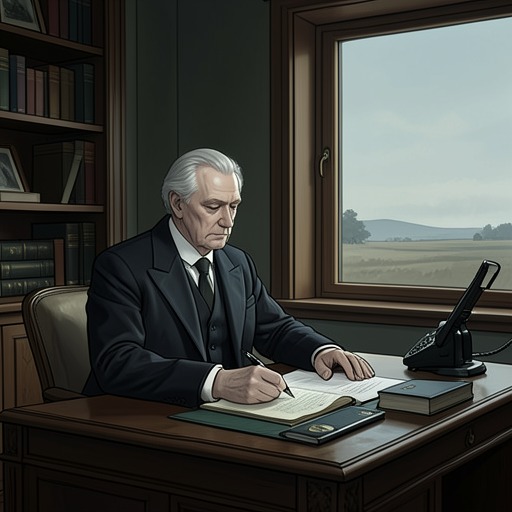
Discipline was reinforced by inheritance from his father’s side and made visible in a precise daily routine. Aschenbach rose early, doused his chest and back with cold water, and worked at his manuscript by the light of a couple of tall wax candles in silver candlesticks. For two or three concentrated morning hours, he spent the strength accumulated in sleep on his art. The apparent breadth of his epic work was therefore not the product of a single prolonged outpouring: it had been assembled in small daily allotments, through hundreds of inspirations and years of persistence.
His craft also demanded restraint in revision. He gave his most vital hours to minute changes, holding to a work over years until its composition and texture achieved the excellence admired by readers. The routine exemplifies discipline as both endurance and control of form: the sustained labor builds the work, while revision keeps its parts exact. The public could read the resulting epic scale as evidence of boundless energy, but the narrative reveals the careful, finite installments behind that impression.
Discipline Under Strain
In the period before his journey, Aschenbach’s self-command is already under pressure. He has planned to carry his life’s work to a particular point before moving to the country, and a long journey seems lax and contrary to that plan. Yet he recognizes the temptation to travel as a desire to escape the work itself: to seek what is new and distant, to feel free of burdens and forgetfulness, and to withdraw from the coldly passionate daily service to which he remains attached. He attempts to return to a passage where he has stalled, but gives up in repugnance. The obstacle is not an extraordinary technical difficulty; it is a fastidious dissatisfaction that will not accept approximation.
That dissatisfaction had once seemed to him the essence of talent. He had restrained and cooled his emotions because they might settle for a merely approximate completion. Now he wonders whether those emotions are taking their revenge by withholding the pleasure and interest that had fed his art. His years still leave him in command of his craftsmanship, and his work is not bad; what troubles him is that secure competence no longer satisfies him. The discipline that enabled him to produce cannot by itself restore the fluctuating emotional force he thinks his work lacks. He fears the prospect of another summer at the mountain house, alone with its familiar landscape and routine, and the urge for a break becomes difficult to dismiss.
The Venetian Reversal
The return to the Lido after his trunk has been sent astray provides a concrete reversal of his efforts to leave. He says he will not travel without the trunk and arranges to return to the beach hotel; within twenty minutes of arriving at the station, he is back on the Grand Canal. What might have been a logistical inconvenience becomes, in his response, an adventure that restores what he believed he was leaving behind. He laughs at the mishap and imagines that an error has been corrected and everything remains available to him. The episode does not demonstrate his former workmanlike mastery; it shows how readily circumstance and pleasure can redirect his intentions.
At the Lido, the repetitive structure of his days gradually displaces the calendar and obligations that once organized him. He sees Tadzio frequently in the hotel, on trips to the city, in the square, and most regularly on the beach, where several morning hours allow him to watch the boy. The recurrence becomes part of what makes the stay precious. Aschenbach continues to rise early, but the morning hours that once belonged to manuscript work now belong to watching; the habit of punctuality remains while its object has changed. He sends for more money, ceases to think about when his vacation should end, and worries instead that the Polish family might depart.
One morning he nearly speaks to Tadzio on the boardwalk, imagining that an amiable greeting might establish a simple, open acquaintance. He quickens his pace, but his heart pounds, he loses his breath, and he fears that the boy will turn and notice how closely he has followed. He gives up and passes with bowed head. The missed approach exposes a choice rather than merely a failure: Aschenbach thinks that speaking might have restored a sound and sober basis, but recognizes that he does not want sobriety. His intoxication has become too precious. The discipline that once meant governing impulse now coexists with a deliberate refusal to govern it.
From Restraint to Pursuit
Aschenbach’s remaining habits of self-command do not disappear so much as become instruments of obsession. His sleep is fitful, and the day seems over when Tadzio disappears at nine in the evening. At dawn he rises to watch the sunrise from his open window, and the scene returns him to emotions and longings suppressed by his rigorous life. The early hour and attentive watching resemble his former disciplined routine, but the work of the morning has become inward reverie rather than artistic production. His orderly habit persists as the setting for a changed allegiance.
Later, he follows Tadzio and his companions through Venice, hiding in the vestibule as they leave the church, waiting for them to take their route, and trailing them through streets and narrow passages. When they board a gondola, Aschenbach hides behind a well, hires another gondola, and instructs its rower to follow at a distance. He is no longer carrying through a chosen work by patient stages; he is pursuing the boy furtively, dependent on the gondolier’s manoeuvres to keep the gondola in view. The narrator describes him as drunk and as following a force that tramples reason and dignity. The precision once devoted to art has not made him immune to excess; it has been redirected into the management of concealment and pursuit.
At the story’s close, Aschenbach watches Tadzio move alone into the shallow water and onto a sandbank. When the boy looks back, Aschenbach seems to interpret the gesture as a smile and an invitation to follow. He rises once more, but this time collapses into his chair. Others hurry to help only after several minutes, and he is taken to his room; that day the news of his death is received by a respectfully shocked public. The ending sharply contracts the time and space that his former discipline had stretched across years of work. A life defined by endurance and completion ends in an unfinished movement toward the figure of his desire.
Significance
Artistic discipline in Aschenbach’s story is both the foundation of his achievement and an incomplete safeguard against disorder. It allows a physically vulnerable man to build an admired body of work through morning labor, incremental construction, and minute revision. Yet craft mastery does not resolve the emotional and moral tensions that his professional self-control has kept at a distance. When the pressure of work and the exhaustion of familiar life grow intolerable, his wish for release does not remain a temporary break: at the Lido it takes the form of increasingly consuming attachment and secret pursuit.
The contrast is not simply between a disciplined past and an undisciplined present. Aschenbach’s habits survive in altered form: he rises early, watches closely, and follows a repeated daily pattern, but no longer directs those capacities toward the work that once governed him. The narrative thus makes discipline’s limits legible through its reversal. The method that enabled him to carry an artistic task through years of resistance cannot ensure that he will master the desires that emerge when artistic effort falters. His death completes that contrast without making the earlier achievement unreal: the same life contains both the sustained labor that earned public honor and the late surrender that carries him beyond self-command.