Aschenbach dies on the Lido
Death in VeniceAschenbach dies on the Lido after watching Tadzio move alone across a sandbank and interpreting a look back as a summons. The ending brings his private fixation and the city’s concealed public danger into the same frame: he rises to follow the boy, collapses before he can reach him, and is carried to his room, where he dies that day. His death resolves the novella’s plot without resolving the tension between artistic self-command and desire that has shaped his decline.
Final Morning and the News of Departure
A few days after the conversation about the cholera, Aschenbach feels unwell and leaves the beach hotel later than usual. Vertigo and a sense of bafflement and hopelessness trouble him; he cannot tell whether they arise from external conditions or from his own nature. In the lobby, he notices a large pile of luggage ready for shipment and asks the door-keeper who is leaving. The answer is Tadzio’s family, a departure Aschenbach has learned about secretly. He keeps his expression controlled, asks when they will go, and is told that they will leave after lunch. He nods and proceeds to the beach.
The landscape offers no cheerful counterweight to this news. Rain retreats in rippling patches across the shallow water between the beach and the first sandbank, while the pleasure spot, once bright with colour, is almost deserted. The sand is no longer kept clean, and an unattended camera stands at the water’s edge beneath a black cloth that flaps in the wind. The neglected setting and the family’s imminent departure make this last morning feel like an ending before Aschenbach himself collapses.
Tadzio’s Isolation
Tadzio remains near his family’s cabin with three or four companions. Their game has no clear rules and begins to break down. Jaschu, angered after sand is thrown into his face, wrestles Tadzio to the ground and holds him there. Aschenbach is about to spring up and intervene, but Jaschu releases the boy. Tadzio sits still for several minutes, pale and disordered, then gets to his feet and walks away despite the companions calling after him. Jaschu follows in an effort to placate him; Tadzio dismisses him with a movement of the shoulder and continues toward the water in his striped linen suit and red bow.
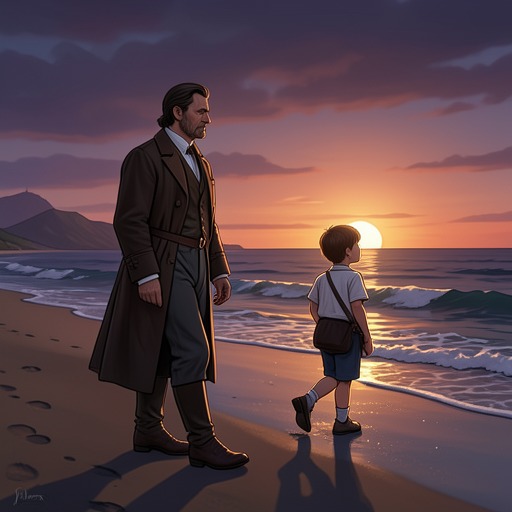
At the water’s edge, Tadzio draws figures in the wet sand with one toe. He then crosses the shallows, which reach only as high as his knees at their deepest point, and reaches the sandbank. He walks slowly along its exposed strip, separated from the mainland by water and from his companions by his mood. For a moment he stops and looks back toward the shore. The scene places him apart from both groups and makes his solitary movement across the sandbank the focus of Aschenbach’s final attention.
The Look and the Collapse
Aschenbach watches from his chair, his head following Tadzio’s movements. When the boy turns, Aschenbach’s head rises and falls against his breast, and his face appears inwardly relaxed, as if in deep sleep. To him, Tadzio seems to smile and nod, then to gesture toward the sea as though inviting him to come out. The narration presents this as Aschenbach’s impression, not as a confirmed invitation from Tadzio. Aschenbach nevertheless stands to follow him, repeating the impulse to pursue the boy that has governed his conduct on the Lido.
Before anyone hurries to his aid, Aschenbach collapses into one corner of his chair. He is carried back to his room, and on that same day news of his death reaches the world, which receives it with respectful shock. The ending does not show a successful pursuit or a conversation between the two: the movement toward Tadzio is interrupted by Aschenbach’s collapse. His final gesture thus joins the persistence of his desire to the abrupt limit imposed by his failing health.
Death, Plague, and the Ending’s Pattern
The cholera outbreak forms the wider context for this private death. In Venice, the disease spreads during the premature summer heat, and the narrative describes cases with a high fatality rate. The pesthouse at the Ospedale Civico fills, the orphan asylums have little room left, and a steady movement carries the dead from the Fondamenta Nuove to the burial island of San Michele. Yet the city authorities continue to deny and conceal the outbreak, fearing the damage that panic and unfavourable reports could do to tourism and business. Aschenbach’s death occurs within this atmosphere of danger and institutional silence, though the account does not identify its immediate medical cause.
Death has also been prepared as an image and a setting well before the final scene. In Munich, Aschenbach waits at the North Cemetery beside a silent funeral hall whose inscriptions direct the mind toward the afterlife. Later, on arriving in Venice, he rides in a gondola whose coffin-black appearance evokes a bier and a final journey, even as its soft seat lulls him into relaxation. These earlier associations make the ending feel foreshadowed without making it inevitable: the quiet descent into the chair at the close converts the recurring image of a journey toward death into the final event of the plot.
The death is decisive because it brings Aschenbach’s pursuit to an end at the moment it seems to renew. He watches Tadzio depart from his companions, imagines the boy’s glance as a call, and stands; but the narrative replaces the anticipated approach with collapse, removal to his room, and a public announcement of death. Alongside the city’s denial of its epidemic, that contrast gives the ending its bleak force: the danger is present, the departure is imminent, and the watcher’s last act is to follow an image that cannot answer for him.