Aschenbach secretly follows Tadzio
Death in VeniceAschenbach secretly follows Tadzio as his infatuation shifts from watching at a distance to actively pursuing the boy through Venice. The pursuit recurs in church, streets, canals, and the hotel, exposing how the city’s tourist routes and maze-like passages become a setting for private obsession. His eventual loss of Tadzio in the streets leaves him exhausted, but does not end the pattern: concealment and following have become part of the attachment itself.
From Repeated Sightings to Pursuit
At first, Aschenbach’s access to Tadzio comes through the regular routine of the hotel and beach. The boy is often nearby—in the hotel, on trips between the Lido and the city, and most reliably on the beach each morning. This recurrence gives Aschenbach sustained opportunities to look at him, and the ordinary rhythm of resort life makes observation seem easy and unremarkable. Aschenbach’s later pursuit changes the nature of that attention: rather than waiting for chance encounters, he starts arranging his movements around Tadzio’s whereabouts.
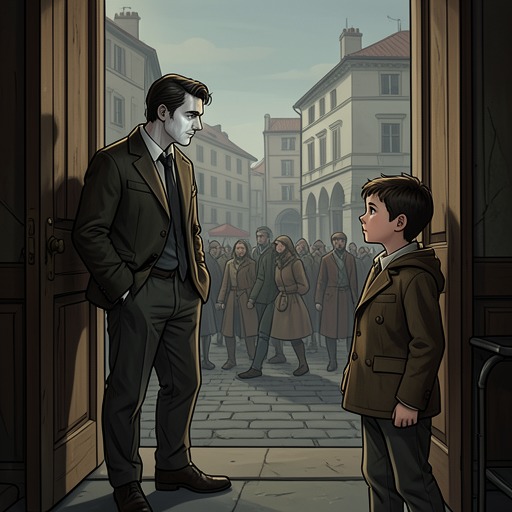
The Polish family’s absence from the beach on Sundays prompts one such change. Aschenbach guesses that they have gone to mass at San Marco and hurries there. Inside the church, he finds Tadzio praying at a prie-dieu, while Aschenbach remains in the background among the congregation. The boy turns and looks toward him through the smoke and candlelight. The encounter is not a conversation or mutual approach; it is a moment of recognition that Aschenbach carries into the furtive following that begins as the family leaves.
Following the Family Through Venice
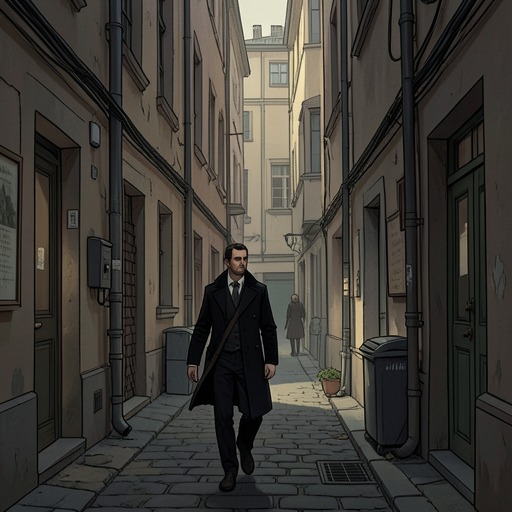
As the crowd streams out of the church into the bright square, Aschenbach hides in the vestibule and waits for the family to emerge. He watches Tadzio, the sisters, and their governess set off through the gateway near the dock tower and into the Merceria. After allowing them a short lead, he follows them through the city, stopping when they stop and taking refuge in shops and courtyards when they turn back. The route forces him into a repeated alternation between pursuit and concealment: he loses sight of them, searches bridges and narrow side streets, and experiences acute anxiety when they suddenly approach along a passage where he cannot easily get away.
The pursuit becomes more deliberate when Tadzio and his companions board a gondola. Aschenbach, who has concealed himself nearby while they climbed aboard, engages another gondolier and promises a generous tip to have the family’s boat followed without attracting notice. The gondolier agrees to carry out the request. Aschenbach is no longer merely taking advantage of a shared public space: he employs a hired boat and a willing intermediary to maintain his view of Tadzio while remaining at a distance.
From the gondola, the pursuit takes on the rhythm of an anxious chase. When the family’s boat slips out of sight, Aschenbach grows uneasy; the gondolier uses detours and shortcuts to bring it back into view. The route through Venice passes walls, gardens, church steps, and streetside businesses. The city is beautiful but also difficult to read, and its winding waterways and passages serve Aschenbach’s pursuit while making it uncertain and precarious. He remembers that the city is diseased and that its authorities conceal the danger, yet the knowledge does not displace his attention from the gondola ahead.
Secrecy, Self-Recognition, and Escalation
Aschenbach’s secret pursuit forms part of a wider secrecy surrounding his stay. He knows of the cholera outbreak and of the authorities’ policy of silence, but his own concealment is driven by fear that the Polish family may leave. He has become so concerned with preserving the chance to see Tadzio that the city’s danger and the consequences of staying recede behind that immediate preoccupation. The parallel is not an equivalence of scale: public concealment endangers visitors, while Aschenbach’s private secrecy enables his continued pursuit. Yet both forms of concealment allow an appearance of ordinary life to persist while important knowledge is withheld.
His conduct also unsettles the identity he has built around discipline and self-command. At moments he asks himself where his course is leading and recalls the stern principles of his ancestors. He nevertheless finds ways to reconcile his present transgression with his earlier life of artistic effort, which he had understood as a kind of battle and self-conquest. That reasoning does not stop the pursuit; instead, it shows his mind working to accommodate conduct that he recognizes as illicit and degrading to his own dignity.
The pursuit extends beyond the streets. Returning late to the hotel, Aschenbach stops outside Tadzio’s room and rests his head against the door hinge, unable for a long time to leave despite the risk of being discovered. The gesture marks a further narrowing of the distance between observing the boy in public and seeking proximity to his private space. He does not speak to Tadzio or establish a reciprocal relationship; the intimacy remains imagined and one-sided, sustained by watching, following, and the desire to remain near.
Renewed Pursuit and Its Limit
Later, Aschenbach tracks Tadzio again into the city, now in a condition of mounting physical and mental exhaustion. Venice’s lanes, canals, bridges, and small squares seem alike, and he becomes unsure of his direction while concentrating on keeping the boy in view. He hides against walls and behind other people, while Tadzio walks behind his companions and occasionally looks over his shoulder. Aschenbach interprets the boy’s awareness and failure to expose him as encouragement, and follows on that understanding. The episode makes the gap between what Aschenbach believes and what the evidence establishes especially clear: Tadzio sees him, but no direct invitation or exchange is shown.
The pursuit ends when the family crosses a short arched bridge. Its rise briefly blocks Aschenbach’s view, and, once he reaches it, he cannot find them. He searches in three directions along the nearby wharf, then has to give up because he is too tired and unnerved to continue. This failure is a practical limit, not a release from the obsession. The narrative has shown how repeated sightings became planned surveillance, how public routes became instruments of following, and how Aschenbach’s private justifications failed to restore the control he had once valued.