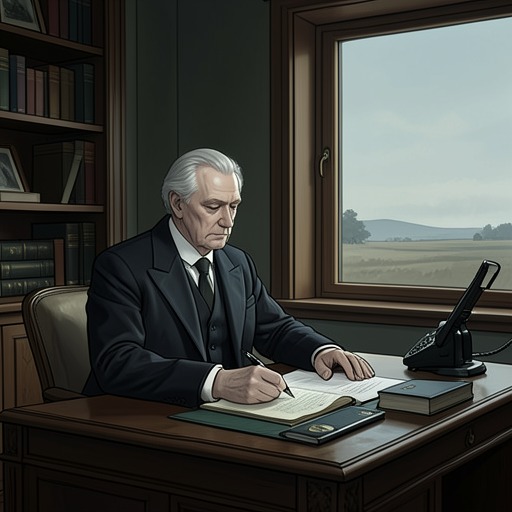
Aschenbach's decision to travel
Death in VeniceAschenbach's decision to travel is the turning point that carries a celebrated but creatively dissatisfied writer out of his established routine and toward Venice. What first feels like an abrupt, almost involuntary longing becomes a practical plan for rest and renewal; the search for somewhere foreign and different then draws him onward when his first destination fails to satisfy him. The journey ultimately places him in the setting of the novel’s central attraction and its later dangers.
The Impulse at the Cemetery
At the beginning of May, after a walk through Munich’s English Gardens, Aschenbach waits for a tram at the North Cemetery. The station and its surroundings are deserted: the roads are empty, the stone-masons’ crosses and memorials make a second burial ground behind their fences, and the Byzantine Funeral Hall stands in the fading light. He amuses himself by reading its inscriptions about the afterlife. Then he notices an unfamiliar traveler in the portico, whose foreign-looking dress and commanding appearance interrupt his reverie.
The encounter is brief, and its cause-and-effect remains uncertain. The stranger meets Aschenbach’s scrutiny with a direct, challenging look; Aschenbach turns away and soon forgets him. Yet he then discovers in himself an intense restlessness and a longing for distant places, so vivid that he stops to examine it. The narration presents the stranger’s appearance as a possible influence, not a definite explanation: the desire may also arise from a new physical or spiritual impulse within Aschenbach.
The longing briefly takes the form of an imagined tropical wilderness, with stagnant water, luxuriant vegetation, unfamiliar birds, and the glint of a tiger’s eyes. The image combines attraction with fear, but it does not become a literal destination. Aschenbach shakes off the vision and resumes his walk. The decisive change is instead inward: travel, previously absent from his immediate plans, has become an urgent possibility.
A Break from Work
The impulse answers a dissatisfaction that has been building in Aschenbach’s working life. He still possesses his craft and continues to produce work that earns national respect, but he feels that technical command is not enough. He fears that his writing lacks the emotional fire and fluctuation that can make literary form a source of enjoyment for both writer and reader. His disciplined habits, once central to his artistic identity, now seem to have left him short of fresh experience and interest.
The prospect of another summer in his familiar country house intensifies that discontent. He imagines being alone there with the servants who provide his meals and the familiar mountain landscape around him, bored and dissatisfied. A change of direction therefore has both practical and artistic stakes: he wants to recover his energy and bring freshness back into his work. The decision is not to pursue the imagined tropics. He settles on a nearer journey, involving a night on the sleeper and three or four weeks at a pleasant, popular southern resort.
As the tram approaches along Ungererstrasse, the intention becomes a plan. Aschenbach decides to spend the evening studying maps and timetables. When he boards, he looks for the man in the straw hat who had shared the cemetery scene, but the stranger is nowhere to be found. That absence leaves the impulse without a further conversation or explanation; Aschenbach proceeds on the strength of the desire already awakened.
Choosing a Destination
Literary and social obligations delay his departure for about two weeks. He arranges for his country house to be ready for occupancy within a month, then takes a night train to Trieste and spends only twenty-four hours there before embarking for Pola. His first choice is an Adriatic island near the Istrian coast, known for rugged cliffs and local inhabitants whose dress and speech strike him as unfamiliar. It offers the foreignness he sought, but not the kind of rest he needs.
Rain, a heavy atmosphere, the hotel’s provincial and exclusively Austrian clientele, and the absence of a soft, sandy beach all frustrate his expectations. Although he has reached a place distinct from his usual surroundings, he does not feel settled there. He studies sailing schedules and looks about for another possibility until his intended destination suddenly seems obvious. He recognizes that he has lost the trail of the journey he wanted to make, gives notice of his mistake, and leaves the island after a week and a half.
In the early-morning mist, a fast motorboat takes Aschenbach and his luggage back to the naval port. He crosses directly to a ship preparing to sail to Venice. The route makes the decision more than a simple escape to a southern resort: when the first attempt does not provide the desired combination of difference and ease, he changes course rather than returning to his familiar life.
Arrival and the Promise of the Journey
The ship is an old, soot-darkened vessel, and its interior and staff do not match an ideal of graceful travel. But the arrival fulfills a different expectation. As the ship passes through the San Marco canal, Aschenbach sees Venice from the water: the palaces, the Bridge of Sighs, the columns bearing the lion and saint, the great church, and the giant clock. He considers arrival by rail an approach from the back of a palace and feels that this city, more unreal than ordinary places, should be entered by sea.
Once ashore, he arranges for a gondola to take him and his luggage toward the small steamers that connect the city with the Lido, explaining that he means to stay near the sea. At the hotel, he takes tea on the terrace facing the ocean and walks along the boardwalk in the direction of the Hotel Excelsior. The international company gathered in the lobby at dinner differs agreeably from the guests at his earlier stop. These details give the journey the restful, cosmopolitan setting he had been seeking, while the sea and beach provide a new daily landscape beyond his habitual workroom.
On the beach, Aschenbach finds pleasure in watching a broad scene of leisure: children wade and swim, people rest on the sand, small boats upset amid laughter, and visitors move among the bathing houses, vendors, and families. The beach is not merely a backdrop but part of the journey’s appeal, bringing him into sustained contact with a social world and forms of recreation unlike his solitary routine. His attention there turns especially to the beautiful Polish boy he has seen among the hotel guests. When the boy’s name is called, Aschenbach listens to its sound and abandons his correspondence to watch the beach again. The travel decision has thus carried him from a wish for general renewal into a particular place and a powerful personal fixation.
Retrospective Significance
The journey begins as a response to creative dissatisfaction, but Aschenbach’s later conduct shows that a change of scene does not simply restore his self-command. When he has an opportunity to approach the boy casually, he fails to speak, and he recognizes that he does not truly want the sobering effect a straightforward acquaintance might have brought. Instead, he cherishes the intoxicating state of longing. The shift makes the original decision consequential in a way its practical terms—a few weeks in the South—could not contain.
The novel’s account of the cholera outbreak in Venice adds a further contrast to the journey’s promise of leisure. The authorities conceal the scale of the epidemic partly to protect tourism, hotels, and commercial prosperity, even as disease spreads and the city’s public life deteriorates. The same tourist economy that offers Aschenbach a welcoming resort experience helps keep visitors uninformed about the risks of remaining there. His arrival has taken him toward the desired foreign setting, but the city’s apparent ease conceals a mounting threat.
Aschenbach’s decision therefore connects a personal crisis of form and energy with the larger movement of the plot. His initial plan is restrained: leave the familiar landscape, rest near the sea, and seek a productive freshness. Yet each stage takes him further from that measured purpose—from the cemetery’s sudden vision, through an unsatisfactory island stay, to Venice and the beach. The journey’s importance lies in this widening gap between the orderly intention that starts it and the emotional surrender that follows.