Dionysian ecstasy
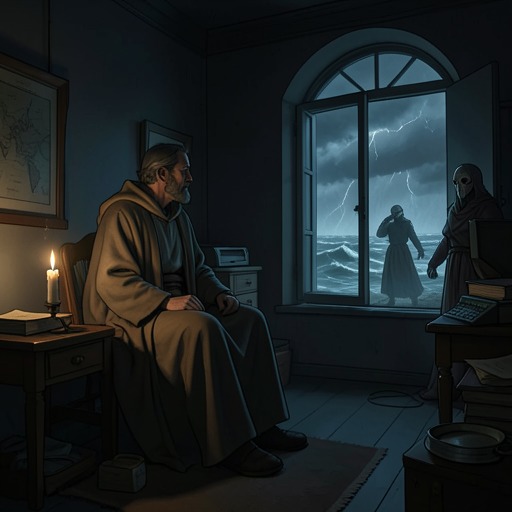
Death in VeniceDionysian ecstasy is the dream-form of the disorder Gustav von Aschenbach has chosen not to resist: a force that overwhelms his cultivated self-command and draws him into an imagined world of collective frenzy. Its decisive significance lies in the contrast between the discipline and moral restraint he has valued and the surrender that follows his decision to keep Venice’s cholera outbreak secret and remain there. The dream does not simply depict a loss of control; it dramatizes how far his desire has already weakened his resistance to chaos.
The Dream’s Invasion
The narrator presents the episode as more than an ordinary dream: it occurs in deep sleep, feels physically real, and seems independent of Aschenbach. He is not a visible participant moving through a scene. Instead, the events take place on the stage of his soul, breaking in from outside and crushing the culture of his lifetime. This framing makes the dream an assault on his inward defenses rather than a deliberate fantasy he can direct or dismiss.
The experience begins with anguish, desire, and frightened curiosity. A mounting confusion of sounds announces something approaching, while a deep flute seems to dominate and entice. Aschenbach recognizes the name of what is coming: “The foreign god!” The vision then takes shape in a landscape resembling the mountains around his summer house, where a crowd pours down through the woods. The familiar setting becomes a stage for a force that is at once remote and disturbingly close to home.
The Collapse of Restraint
The gathering is depicted through movement, noise, and the loss of individual boundaries: a crowd swirls downhill, and its revelry spreads across the hillside. The sound repeatedly intensifies, with the flute’s coaxing presence running through the tumult. Aschenbach initially resists. His fear and revulsion are joined to a determination to defend intellectual poise and dignity against what he experiences as barbaric. But the noise grows, takes the upper hand, and becomes a fury of rapture. The dream thus gives his resistance a clear course and reversal: he begins as a witness struggling against the experience and ends drawn into it.
That reversal is not merely a change of mood. The dreamer ultimately recognizes himself as belonging to the force he had opposed. He is no longer separate from the crowd; he is with them, and they are, in the dream’s logic, himself. The collapse of the boundary between observer and participant gives Dionysian ecstasy its central meaning here: the surrender of the self that had been upheld by culture, discipline, and a claim to moral distance.
Relation to Desire and Disorder
The dream follows Aschenbach’s decision to conceal the outbreak and stay in Venice. He has acknowledged his share in the facts and guilt, yet finds that awareness intoxicating; the diseased city awakens hopes that he regards as beyond reason. His choice to remain gives the dream a concrete narrative context: the surrender staged in sleep develops a course already visible in his waking conduct, where prudence and self-mastery have come to disgust him.
After waking, Aschenbach is unnerved and feels himself under the power of the force the dream has represented. His behavior toward other people changes: he no longer avoids their inquisitive looks and no longer cares whether they suspect him. Meanwhile, the resort is emptying as guests leave, and the city’s concealed danger appears increasingly difficult to hide. Against this dispersal, the continued presence of Tadzio becomes the focus of Aschenbach’s increasingly unchecked desire. He follows the boy through the streets despite the danger, and at such moments imagines that the surrounding obstacles might disappear, leaving him alone with the object of his longing. The dream’s surrender therefore resonates with a waking abandonment of moral limits, without making the dream itself a literal instruction or cause.
Narrative and Thematic Significance
Dionysian ecstasy is set against Aschenbach’s cultivated ideal of intellectual poise and dignity. The dream gives that opposition a dramatic form: first resistance, then the growing force of the experience, and finally the loss of separation from it. Its movement parallels the larger moral change in the supplied episode, where Aschenbach recognizes the guilt of concealment but chooses to remain in the diseased city rather than return to prudence and restraint.
The dream also binds private desire to public disorder. The threatening force is not confined to Aschenbach’s inward life: after he wakes, the cholera crisis is becoming harder to conceal, visitors are departing, and he continues to pursue Tadzio through a city where danger remains hidden. The narrative does not equate the dream with the epidemic, but places them in charged proximity. Ecstasy names the inward surrender through which Aschenbach becomes less willing to resist the disorder around him—and less willing to resist the desires that disorder has helped release.