Eros
Death in VeniceEros is the novel’s name for desire as both an aesthetic power and a destabilizing force: it makes beauty seem like a road from the senses to the spirit, but it also carries Gustav von Aschenbach from artistic discipline toward intoxication and moral compromise. His attraction to Tadzio gives this tension a practical form, inspiring a finely controlled piece of writing while drawing the aging artist into private acts he recognizes as shameful.
Beauty and the Spiritual
Aschenbach interprets Tadzio’s beauty through an inherited philosophical idea: visible beauty can make spiritual perfection perceptible to human beings. Eros, in this account, uses the youthful human form as a tangible representation of an otherwise abstract ideal, much as an instructor makes pure forms graspable through concrete examples. The body is thus not merely an object of sensation; it becomes a possible means by which the mind rises toward what it cannot directly see.
The account also insists on the danger built into that passage. Sunlight, sensual appearance, and immediate circumstance can numb reason and understanding, leaving the soul attached to the beautiful object before it can distinguish the object from the ideal projected upon it. For the noble-minded, the encounter produces trembling and reverence; those unable to recognize beauty’s likeness as a sign of something beyond it may instead respond without reverence. The same bodily beauty can therefore prompt reflection or consume the spectator in fascination.
Aschenbach’s thoughts take the form of an imagined dialogue between Socrates and Phaedrus beneath a plane tree near Athens. In the shaded setting, beside a brook and amid the sound of cicadas, Socrates explains the lover’s distress at encountering a beautiful face or body: the initiate trembles, struggles to look, and honours the beautiful person as if that person were a divine image. Beauty is described as the one form of the spiritual that can be received through the senses; a direct sensory appearance of divinity, reason, virtue, or truth, the dialogue suggests, would overwhelm human beings. Beauty is therefore an access to the spirit, but only a means, not the destination.
The imagined dialogue sharpens that distinction with its paradox about the lover and the beloved: the lover is more divine because the god is in the lover, not in the beloved. Desire’s power lies partly in this reversal. The beloved’s visible form may occasion the experience, but the lover supplies its spiritual intensity and meaning. Aschenbach’s thinking thus elevates his own passion even as it reveals how much of his vision is made by the one who desires.
Artistic Work and Its Conditions
The novel makes Eros productive as well as disruptive. At a point when Aschenbach is absorbed by his passion, the emotional crisis becomes a stimulus to composition. A request circulating in the intellectual world for a public statement on culture and taste gives him an occasion to address a subject familiar from his own experience. He feels an irresistible wish to present it in his own way, and Tadzio’s presence becomes part of the work’s immediate conditions.
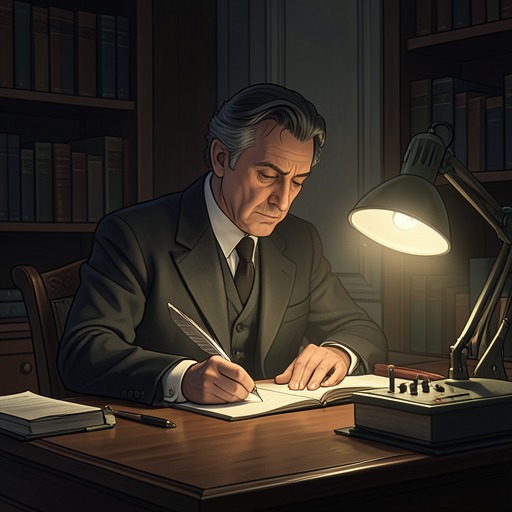
Aschenbach chooses to write in view of the boy, taking the scope of Tadzio’s body as a standard for his prose and allowing his style to follow the lines he perceives in that body. He imagines carrying Tadzio’s beauty over into the spiritual, as an eagle once carried the Trojan youth into the ether. During these hours at a crude table beneath a canopy, with Tadzio before him and the sound of the boy’s voice nearby, the artist finds an unusually sweet pleasure in words. He completes a page and a half of prose that will soon win admiration for its clarity, poise, and vigorous emotional movement.
The scene refuses to separate the polished result from the compromised circumstances that produced it. Aschenbach’s theory of beauty helps him transform physical attraction into artistic form, but the narrative notes that readers usually encounter the beautiful finished work rather than the conditions of its conception. Knowledge of an artist’s sources of inspiration may confuse or alienate the audience and diminish the effect of mastery. The finished prose can command admiration while the desire that helped generate it remains troubling.
Nor does the act of creation resolve the tension. After putting the work away and returning from the beach, Aschenbach feels exhausted, dispersed, and as if his conscience were protesting a transgression. His creative success and his unease are linked: the force that has refreshed his writing has also blurred the boundary between disciplined form and private indulgence.
Desire as Intoxication and Self-Justification
Tadzio’s smile makes the abstract theory immediate and personal. Aschenbach receives it as an overwhelming gift, then hurries away from the terrace and front garden into the darkness of the park. He is shaken enough to collapse onto a bench, breathe in the night air, and whisper his declaration of love. The episode gives Eros a bodily, involuntary intensity: attraction is at once tender and indignant, desired and understood by Aschenbach as impossible, absurd, abject, and yet sacred.
Elsewhere, desire turns from inward speech to furtive proximity. Wanting to pursue Tadzio without interruption, dream of him in his absence, and address even his outline, Aschenbach stops outside the boy’s room after returning late from Venice. He rests his head against the door hinge and remains there for a long time, unable to pull himself away despite the danger of being discovered and embarrassed. This is not the elevated contemplation of beauty at a distance. The lover’s idealizing language accompanies a concrete trespass of boundaries, and his own awareness of the danger does not make him leave at once.
At moments of partial clarity, Aschenbach asks himself where his course is taking him and recalls his ancestors’ rigidity, scrupulous masculinity, and principle. He contrasts their imagined standards with what he calls his own illicit experience and exotic transgressions, then recognizes that his life in art had already diverged from theirs. His reflection does not simply restore restraint. Instead, he recasts his artistic career as a form of service and warfare: the artist, like a soldier, must struggle, practise self-conquest, and endure a hard, sober, unyielding discipline.
That account of discipline becomes a means of defending the passion that is mastering him. Aschenbach invokes ancient warriors who accepted Eros’s yoke and reasons that prostrations, oaths, entreaties, and abasement could be praised when performed for the god, though the same acts might be condemned as cowardice in other circumstances. The argument converts vulnerability into a kind of heroic submission. It protects his respect for himself, but it also shows how readily the language of courage can be turned to justify conduct he knows is compromising.
Artistic Discipline and Moral Ambivalence
Eros does not simply replace discipline with abandon. Aschenbach’s attraction activates the very habits of concentration and formal control that have shaped his art; his desire for Tadzio becomes the measure by which he composes a carefully poised tract. Yet the novel places this achievement beside his exhaustion, guilty feeling, and increasingly compromising pursuit. The artistic form is real, but its clarity does not purify the circumstances from which it emerged.
The concept therefore remains deliberately ambivalent. In its ideal account, desire lets the senses apprehend a beauty that points beyond the body. In Aschenbach’s experience, however, the beloved’s body becomes the focus of a fixation that he spiritualizes, aestheticizes, and uses to defend himself. The distinction between a path toward the spiritual and an end in sensual fascination is stated clearly, but Aschenbach’s conduct shows how easily the path can be mistaken for permission to remain with the object of desire.
Eros also unsettles the conventional opposition between weakness and heroism. Aschenbach’s self-image depends on severity, self-mastery, and the hard-won form of his work, but he now interprets abasement as a possible proof of devotion and the ordeal of desire as a continuation of artistic struggle. That reinterpretation is both compelling and suspect: the language of endurance preserves the image of the disciplined artist even as his actions expose how far discipline has yielded to passion.
By joining creation to transgression, the novel makes Eros neither a simple celebration of inspiration nor merely an external temptation that interrupts art. It is the force that enables Aschenbach to turn emotion into thought and thought into accomplished prose, while simultaneously making his aesthetic ideal a vehicle for self-deception. Beauty can open a passage toward the spirit; the lover’s intoxication can also make that passage indistinguishable from possession, fantasy, and moral evasion.