Tadzio’s smile to Aschenbach
Death in VeniceTadzio’s smile to Aschenbach is the decisive moment when their recurring, wordless exchanges acquire the force of an apparent intimacy for Gustav von Aschenbach. The smile offers no spoken declaration, yet Aschenbach receives it as a personal gift; his startled delight gives way to agitation and a private admission of love.
Background: A Familiarity Without Conversation
By Aschenbach’s fourth week on the Lido, a pattern had formed between him and Tadzio. The boy regularly passed along the front path through the sand, close to Aschenbach’s accustomed place, rather than using the boardwalk on the far side of his family’s bathing house. Aschenbach watched for these approaches. Sometimes he pretended to be occupied; at other times he looked up, and their eyes met.
Those looks remained restrained but charged with attention. Aschenbach’s dignified expression concealed his response, while Tadzio sometimes faltered, looked down, and then glanced up again. The narrator presents this as a familiarity whose meaning Aschenbach hopes is not entirely one-sided, though the encounters themselves establish no spoken understanding between them.
The Evening Encounter
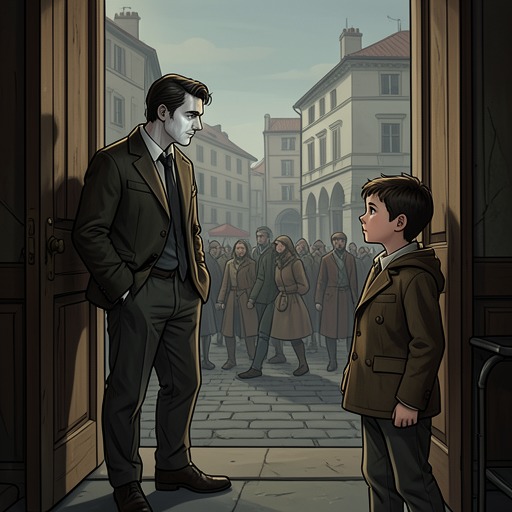
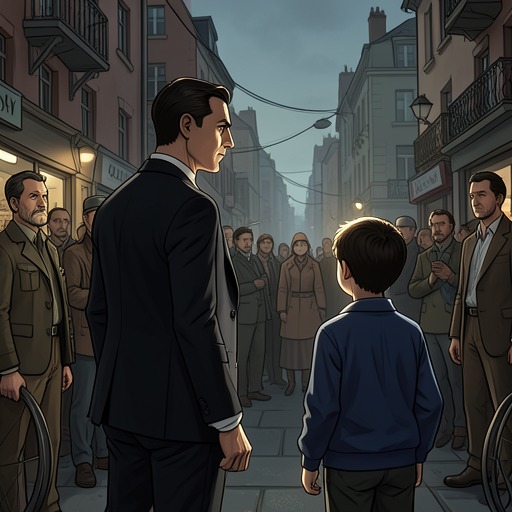
One evening, the Polish children and their governess were absent from dinner in the hotel’s large hall. Aschenbach noticed their absence uneasily and later walked outside in evening dress and a straw hat. Under the arc-lamp at the foot of the terrace, he saw the sisters and governess return, with Tadzio a few steps behind them. They appeared to have come from the steamer pier after dining in the city.
Tadzio wore a dark-blue sailor overcoat fastened with gold buttons and a matching cap. The coolness of the evening and the lamplight made his familiar appearance seem newly vivid to Aschenbach: his skin looked paler, his eyebrows more sharply defined, and his eyes darker. The sight also brought back a recurring artistic frustration. Aschenbach could evaluate beauty in words, he felt, but words could not reproduce the sensuous experience itself.
The Smile and Its Effect
Caught unprepared, Aschenbach could not compose his face into an expression of repose and dignity. Pleasure, surprise, and admiration showed as he met Tadzio’s eyes. At that moment, Tadzio smiled at him openly and familiarly. The smile turns the earlier pattern of passing and exchanged glances into the encounter’s central event: Aschenbach no longer has to wonder whether Tadzio has noticed him, although the smile alone does not establish what Tadzio intends or feels.
Aschenbach interprets the expression through the image of Narcissus smiling at his reflection. That comparison makes the scene’s emotional force inseparable from his own aesthetic imagination: the boy’s smile is presented as beautiful and compelling, while its meaning is filtered through the older man’s desire. The narrator describes it as at once inquisitive and troubled, capable of captivating Aschenbach without resolving the distance between them.
Flight and Confession
Aschenbach experiences the smile as a gift of dangerous force and hurries away from the terrace and front garden into the darkness of the park behind the hotel. He sits on a bench, overwhelmed. In a private admonition, he tells himself that no one should smile in that way to another; then, abandoning admonition for confession, he whispers, "I love you!"
The declaration is addressed neither to Tadzio nor to anyone else: it remains Aschenbach’s solitary recognition of his own feelings. The encounter therefore changes the inward temperature of their relationship without producing a conversation, mutual pledge, or acknowledged relationship. Its narrative significance lies in this contrast between the smile’s apparent intimacy and the silence that continues to surround it.