
The Political Counterattack
Deception PointThis flow follows how NASA funding becomes a campaign weapon, how Sexton is baited into an extreme position, and how the hoax’s collapse reshapes the contest.
increasing Bearing strength in each event
 decreasing
Bearing strength in each eventdecreasingA Campaign Built on NASA

A Campaign Built on NASA
A new political target
Gabrielle Ashe urges Sedgewick Sexton to use NASA’s overruns and failed projects as a symbol of wasteful government spending. The issue catches public attention and helps Sexton gain momentum.
The argument simplifies a complex debate into a sharp contrast between space budgets and domestic needs. It gives Sexton a memorable campaign theme and places NASA at the center of the race.
Political exposure
Sexton’s attacks are useful, but they also make his campaign dependent on continued public skepticism about the agency. A major NASA success could reverse the advantage quickly.
His growing confidence encourages him to mistake a popular line of attack for a secure political position.
Tench Sets the Trap

Tench Sets the Trap
A calculated debate
Marjorie Tench confronts Sexton on CNN and presses him to state what he would do if NASA’s current budget were necessary to explore space. Her question is designed to defeat evasion.
Sexton answers that he would abolish the agency and direct its budget to schools. He has now made his position unmistakable on a live broadcast.
A line that will return
Tench also draws Sexton into dismissing the possibility of extraterrestrial life. His confident promise to eat his hat if he is wrong becomes a ready-made contradiction when Herney announces the fossils.
The debate transforms general criticism into a specific political liability, while Sexton believes he has won the exchange.
The Announcement Lands
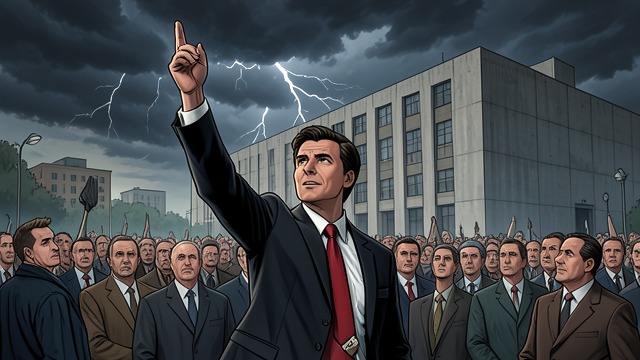
The Announcement Lands
The reversal
Herney presents the fossil-bearing rock to a worldwide audience, supported by NASA officials and civilian scientists. Sexton’s position now appears to reject a discovery that seems to validate NASA’s mission.
The timing makes the news especially damaging: Sexton has just declared that the search for extraterrestrial life is futile and that the space program should be abolished.
A campaign in free fall
His donors abandon him, news coverage turns against his campaign, and the policy issue that helped him rise becomes a source of ridicule.
The political reversal seems complete, although the scientific claims rest on a staged discovery that has not yet been exposed.
A Second Opportunity

A Second Opportunity
A technical doubt
The head of the Space Frontier Foundation shows Sexton footage of Chris Harper’s uneasy announcement about the PODS software repair. The contrast between Harper’s confident bad-news performance and his discomfort over the claimed fix suggests a hidden problem.
Sexton sees a possible route back into the campaign. Rather than accepting defeat, he asks Gabrielle to investigate the anomaly.
A dangerous assignment
Gabrielle has personal reasons to distrust Sexton and has just seen evidence of his questionable ties to private space companies. Nonetheless, she still feels responsible for the campaign’s failure.
Her investigation sends her to NASA Headquarters, where a technical discrepancy leads to a much larger account of deception.
The Scandal Reverses

The Scandal Reverses
A chance to expose fraud
Rachel’s fax gives Sexton proof that the meteorite was planted, and he prepares a dramatic press conference. He believes the revelation will restore his presidential prospects.
Gabrielle discovers that the envelopes he intends to distribute contain intimate photographs of her and the senator instead of Rachel’s evidence. She has substituted material that exposes his personal hypocrisy.
The campaign’s real weakness
Rachel arrives and confronts her father, while Gabrielle reveals that the financial evidence against him is genuine. Sexton’s effort to weaponize the hoax collapses into a public scandal about his own conduct.
The campaign ends not through NASA’s political victory but through Sexton’s willingness to risk his daughter and exploit other people’s trust.
The weeks before the discovery
Early afternoon on announcement day
Eight o’clock that evening
Late night after the announcement
The morning after the address
