
The Ocean as Threat and Teacher
Deception PointThis flow traces how the sea functions first as Rachel’s fear, then as a scientific environment, and finally as the force that tests and transforms the survivors.
increasing Bearing strength in each event
 decreasing
Bearing strength in each eventdecreasingA Childhood Fear
A Childhood Fear
Beneath the ice
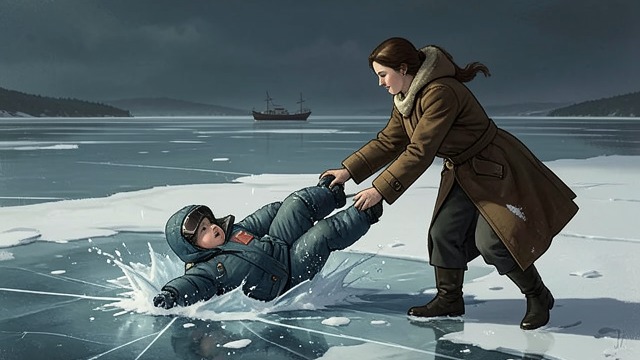
Rachel falls through the ice as a child and nearly drowns. Katherine Wentworth Sexton pulls her to safety and urges her to kick and hold on.
The experience leaves Rachel wary of cold, open water, even as her mother tries to teach her not to let fear dictate her life.
A memory with two meanings
Water becomes associated with danger, helplessness, and maternal rescue. The memory will return when Rachel encounters the Arctic ocean and later becomes trapped underwater.
Her fear is not an irrational flaw; it is a learned response that she must work through rather than simply dismiss.
Tolland’s Marine World
Tolland’s Marine World
Knowledge through immersion
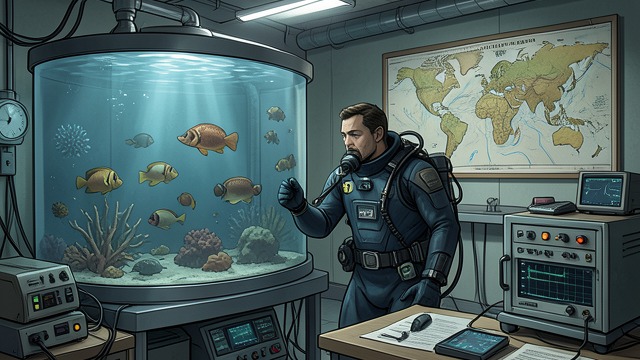
Michael Tolland’s career is built around exploring ocean ecosystems and making their mysteries understandable. He sees the sea as a living environment full of species and processes that remain unknown to most people.
His familiarity with marine life provides the group with an alternative framework for interpreting the fossils and plankton.
A place of competence
On the Goya, Tolland knows the currents, equipment, and risks better than the others. The vessel and its laboratory are extensions of his professional identity.
That competence later becomes essential when the ship turns into a dangerous battlefield.
A Sea Beneath the Ice
A Sea Beneath the Ice
The shelf is not solid land
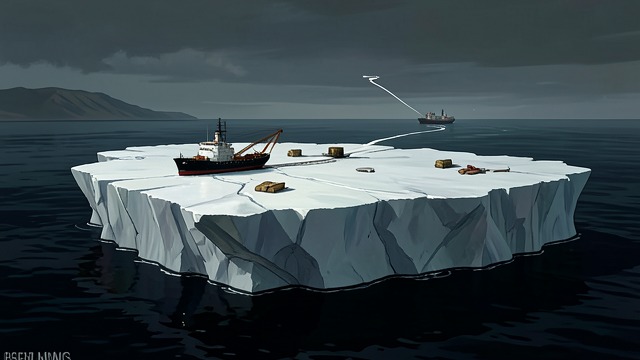
Rachel learns that the Milne Ice Shelf floats above the ocean, despite its appearance of stability. The ice is thick, but it remains part of a dynamic marine environment.
The realization helps explain how ocean organisms could be connected to the extraction pit, though the actual route is artificial.
Landscape misread
The scientists’ remote setting seems separate from the sea until their instruments reveal a connection below the ice. The apparent boundary between glacier and ocean has concealed the relevant evidence.
The shelf becomes a physical metaphor for the novel’s larger problem: what looks sealed may still be connected to forces below the surface.
The Megaplume Grows
The Megaplume Grows
Currents beneath the ship
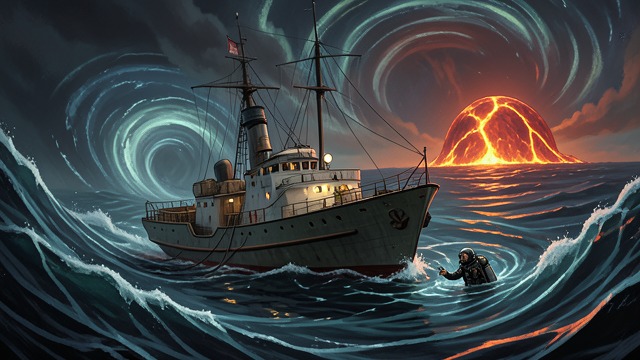
The Goya is anchored over a warm-current vortex created by a magma dome. Tolland explains the phenomenon as a powerful but normally manageable pattern of ocean circulation.
When the Hellfire missiles strike the dome, the underlying conditions become catastrophic. The eruption intensifies the current into a growing surface vortex.
A natural force unleashed
The attackers’ weapons trigger a geological event they cannot control. The ocean that once served as Tolland’s workplace and Rachel’s fear becomes an overwhelming physical force.
The crisis joins human violence to natural systems in a chain of consequences neither political authority nor military technology can command.
Water Reconsidered
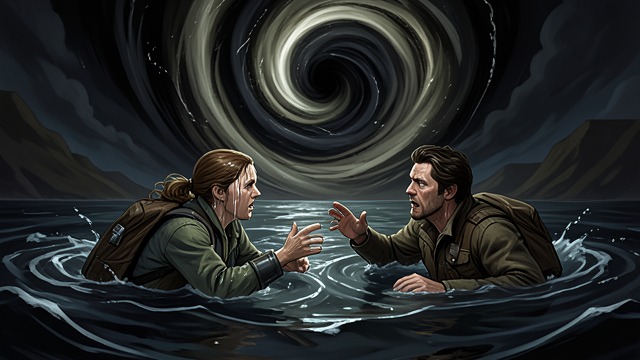
Water Reconsidered
Fear and trust in the dark
After escaping the Triton, Rachel cannot tell which way is up. Tolland reaches her and guides her through the water toward safety, while the eruption and vortex threaten to pull them under.
Rachel must trust his knowledge even when the direction he chooses seems to lead away from the light.
A changed relationship
The sea remains dangerous, and Rachel’s childhood fear is not erased. Yet she survives within it through action, cooperation, and reliance on another person.
The ocean shifts from a symbol of helplessness into a place where Rachel can act and where Tolland’s expertise becomes care.
Rachel’s childhood
Before the Arctic mission
During the Arctic investigation
Before dawn during the attack on the Goya
Near the climax at sea
