Arctic Ocean
Deception PointThe Arctic Ocean is not a distant backdrop to the action on the Milne Ice Shelf but the hidden terrain beneath it: the glacier floats on seawater, and when the ice breaks loose, the ocean becomes an immediate force that submerges and then lifts Rachel Sexton, Michael Tolland, and Corky Marlinson. Its concealed presence first explains the plankton anomaly and later drives the sequence’s near-drowning reversal.
The Ocean Beneath the Ice
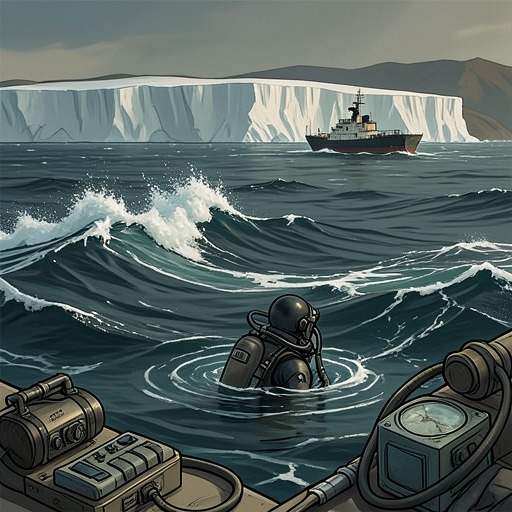
When Rachel wonders how ocean water could have seeped into the shaft, she assumes the coast is miles away. Corky corrects her: the ocean lies directly beneath them. Tolland explains that a glacier can flow beyond land and spread over water; because ice is lighter than water, its outer section floats as an ice shelf. The group is already almost a mile out to sea, though the surface underfoot has looked like solid ground.
That realization changes the meaning of the landscape. The Milne Ice Shelf is at once glacier and raft, a vast slab whose apparent stability conceals open water. The distinction matters immediately: an ice fissure can connect the shaft to the ocean, providing a route for seawater—and the plankton it carries—to enter.
Wind and Exposure
The ocean also sets the scale of the exposed shelf. Outside the habisphere, Tolland faces an eighty-knot katabatic wind rushing down the glacial incline. Unlike the tide- and pressure-driven winds familiar to him at sea, this current of cold air follows the slope with relentless force. The shelf descends toward the ocean two miles away, making the wind and the ice’s grade a combined hazard: Tolland fears that a misstep could send him sliding toward the edge.
The party’s precautions register that danger in concrete terms. Norah Mangor has fitted them with crampons, ice axes, goggles, and belay harnesses, and they descend in a line with ten yards of rope between each person. The ocean is not merely the destination at the bottom of the slope; its proximity shapes how they move across the ice.
Submersion and Reversal
When a massive slab slides down the face of the shelf, it plunges into the Arctic Ocean with Rachel, Tolland, and Corky on top. The impact first leaves Rachel weightless, then drops her hard onto the ice. As the block sinks farther, the ocean surface rises around them; the slab passes below the waterline, seawater pours over its edges, and Rachel is pulled under. She struggles back to the surface, buoyed by the gel in her suit, while the others flounder nearby, tangled in their tethers.
The danger then reverses direction. Tolland warns that the slab is coming back up, and a deep rumble travels through the water as the enormous sheet scrapes its way back up the glacier face. It rises beneath the survivors, carrying them skyward with the churning water. On the newly elevated surface, Rachel finds herself in waist-deep water as it drains away; the current sweeps her toward the slab’s edge. The ocean that swallowed them now raises the ice beneath them, but that rescue-like ascent brings a fresh threat of being swept off.
Narrative Function
The Arctic Ocean turns a mistaken sense of solid ground into a material crisis. Its presence beneath the shelf explains how seawater reaches the shaft, while the slab’s descent and return make the hidden sea an active agent in the survivors’ peril. The landscape does not simply frame their ordeal: its floating ice, submerged depth, and moving water determine the sequence’s reversals and expose how precarious their footing has been all along.