Charles Brophy
Deception PointCharles Brophy is a Canadian geologist whose chance discovery of an apparent meteorite on the Milne Ice Shelf becomes the concealed starting point of NASA’s staged discovery. He reports an ultradense anomaly and requests rescue during a storm; NASA hears his unusually low-frequency transmission and sends help, but finds him dead. The account initially presents his death as a tragic accident. Later, the controller’s recollection reveals that Brophy was deliberately killed to make the planted meteorite appear to have been found independently, establishing him as the first victim in a scheme that soon begins to unravel.
Identity and discovery
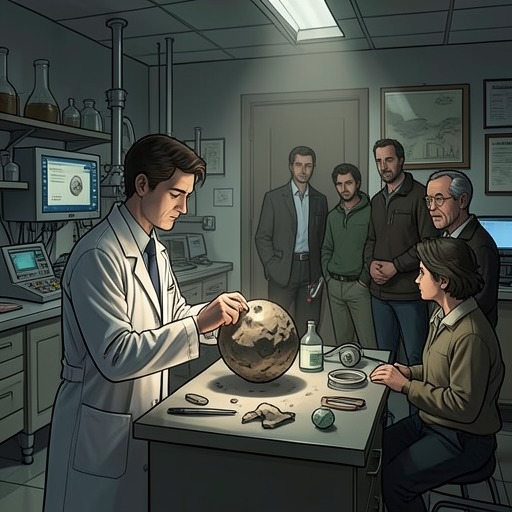
Brophy is identified as a Canadian geologist conducting geologic ice soundings on the Milne Ice Shelf. He is not a NASA employee or a member of the expedition that later investigates the object. According to Chris Harper, Brophy encountered what appeared to be a huge meteorite by chance while carrying out his work. He radioed the discovery, and NASA intercepted the call. His independent discovery matters politically as well as scientifically: it gives NASA a seemingly external route to the object, while Brophy himself cannot later contest the agency’s account or its credit for the find.
Brophy’s message describes an ultradense anomaly buried in the ice, which he suspects is a giant meteorite. While taking measurements, he becomes trapped in a storm. He transmits his coordinates, asks to be rescued, and signs off. His call is not a routine broadcast: he uses an exceptionally low frequency, a method intended to carry a signal over a great distance from an isolated location. Harper explains that the frequency is so low that only NASA’s very-low-frequency receivers could have picked it up. The rescue call thus supplies the path by which NASA learns of the anomaly—and, unbeknownst to the recipients, the means by which the plotters bring their discovery to the agency’s attention.
The rescue and reported death
NASA’s listening post sends a plane from Thule to search for Brophy. The search lasts for hours before rescuers locate him, miles off course, at the bottom of a crevasse with his sled and dogs. The account given to Gabrielle Ashe attributes the outcome to the storm: Brophy apparently tries to outrun it, becomes blinded, loses his way, and falls into the crevasse. His death is therefore first presented as an accidental consequence of dangerous conditions on the ice, not as a crime connected to the meteorite.
The apparent accident also resolves a question about who found the object first. Gabrielle asks whether the Canadian is angry that NASA is taking credit for the discovery. Harper answers that Brophy is dead. That fact removes the living witness who might have challenged NASA’s version of the find, even as it makes the discovery’s origin more suspicious in retrospect. Brophy’s absence is not incidental to the story’s dispute over credit: his testimony could have established that he discovered the anomaly before NASA’s public claim.
The concealed purpose of his death
The later account from the controller changes the meaning of Brophy’s discovery and death. The meteorite had been inserted into the ice months earlier, and the plan depended on the Polar Orbiting Density Scanner (PODS) detecting it so NASA could announce a major find. But the satellite’s anomaly-detection software had failed and was not expected to be repaired before the election. Without its scan, the planted object would remain undetected, threatening the entire plan.
To circumvent the failed software, the controller arranged for NASA to learn about the anomaly through an emergency radio transmission from a Canadian geologist in the vicinity of the insertion. Brophy was made to send that signal, then killed immediately so his death would appear accidental. The narrative’s earlier account of the rescue is thus exposed as a cover for a deliberate killing: the storm, his being found off course, and the apparent fall into a crevasse serve the public explanation, while the controller identifies his death as the necessary first step in alerting NASA without revealing the planting operation.
The controller describes the killing as the beginning of events that have since escaped control. Brophy was the only person the plan expected to die; by the time the controller reflects on the operation, Wailee Ming and Norah Mangor are also dead, and Rachel Sexton, Michael Tolland, and Corky Marlinson are identified as likely future victims. Brophy’s fate therefore marks both the calculated beginning of the scheme and the point from which its supposedly contained deception expands into a widening chain of danger.
Narrative significance
Brophy never appears directly in the supplied scenes; readers learn about him through Harper’s explanation and the controller’s later recollection. That shift in information changes the status of the same events without changing their outward sequence. First, Brophy is the geologist whose independent find reaches NASA through an unusual rescue call. Then his death makes it impossible for him to challenge NASA’s credit. Finally, the controller’s account reveals that the call and the fatal accident were coordinated parts of the deception.
His role is consequently small in physical presence but foundational in the causal structure of the plot. The failed PODS software creates the need for an alternate detection method; Brophy’s transmission provides it; his death protects the false appearance of discovery. The supposed meteorite’s scientific and political story begins, for the characters who investigate it, as an anomalous object in the ice. Brophy’s concealed fate reveals that the story began earlier—with a staged signal, a murdered witness, and an accident designed to pass as chance.