Giant Deep-Sea Warm-Current Vortex
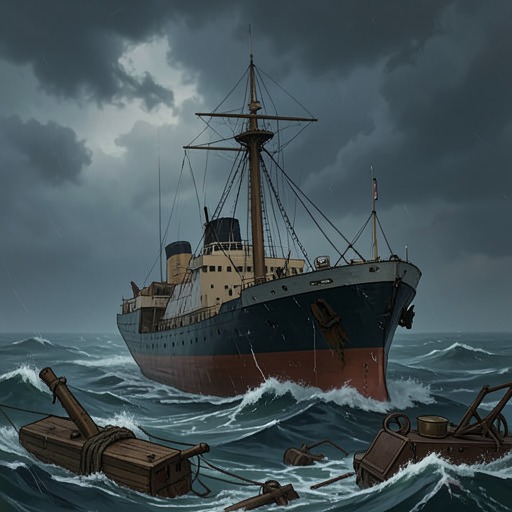
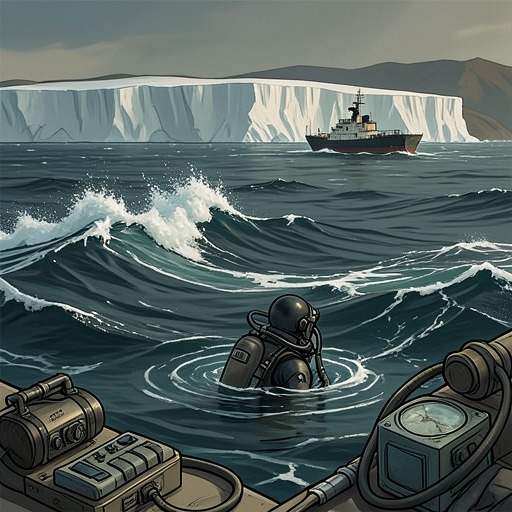
Deception PointThe Giant Deep-Sea Warm-Current Vortex, referred to in the novel as a megaplume, is a large, rotating ocean current driven by a temperature reversal above a magma dome on the seafloor. It is both a scientific phenomenon and a physical hazard: first revealed as a half-mile-wide spiral on a helicopter’s thermal display, it explains the unusual currents around the Goya and later defeats Corky’s attempt to escape by boat. Its calm-looking center, powerful circular flow, and uncertain geological limits make the megaplume a meeting point between exposition and suspense.
Formation and structure
In the explanation given by Michael Tolland, occasional pockets of magma rise beneath the seafloor and heat the water above them. The resulting reverse temperature gradient leaves hot water below cooler surface water. Tolland calls the large spiraling currents formed in this way megaplumes; he says they can spin for a couple of weeks before dissipating. The phenomenon is therefore presented not as an ordinary surface storm, but as a vast circulation created by the interaction between seafloor heat and ocean water.
Tolland later explains the circulation through the difference in water density. Under normal conditions, colder, denser water lies deeper. At the megaplume, heated deep water is lighter and rises, while heavier surface water rushes downward to fill the space it leaves. The opposing movement creates enormous, drain-like currents. The explanation turns the image of an underwater tornado into a causal account: the apparent whirlpool is the visible consequence of water moving in a reversed thermal arrangement.
A dome-shaped mound beneath the vortex supplies the geological source. Tolland identifies it as a magma dome, where lava pushes up under the ocean floor. The mound and the spiral above it are connected but distinct parts of the scene: the dome is the underlying heat source, while the megaplume is the resulting water movement. On the ship’s Acoustic Doppler Current Profiler, their alignment makes this relationship visible as a cross-section of currents and temperature gradients beneath the Goya.
Discovery near the Goya
The megaplume enters the action when a Coast Guard pilot, at Tolland’s direction, activates the helicopter’s thermal lens. The system surveys a three-mile swath of ocean ahead, and its dashboard display resolves into a large, swirling spiral against the dark background. Rachel and Corky see the image, and Rachel compares its appearance to a cyclone. Tolland identifies the pattern as a warm-current cyclone roughly half a mile across.
The pilot says he has seen such currents before, though he had not heard of this one. Tolland says it surfaced the previous week and probably would not persist for more than a few days. The discovery is thus both striking and transient: the screen reveals a large feature that is recent, locally unfamiliar, and expected to disappear soon. The display also changes how the nearby sea is understood. What had been an apparently open stretch of ocean is shown to contain a substantial, organized circulation.
The ship is not merely passing the feature. After checking the coordinates, the pilot realizes that the Goya is parked fairly near the megaplume’s middle. Tolland confirms that the currents are slower near the eye, but specifies that they still run at eighteen knots. He compares anchoring there to anchoring in a fast-moving river and notes that the ship’s chain has been under strain. The center is therefore a relative refuge within the circulation, not an area of still water or freedom from its force.
Explanation and implied danger
Tolland’s account initially stresses the stabilizing conditions that ordinarily limit danger. He says cold water continually circulates over Atlantic magma domes, cooling and hardening the earth’s crust so the magma remains beneath a thick layer of rock. As the lava below cools, the spiral eventually disappears; he characterizes megaplumes as generally not dangerous. This explanation gives the group a natural reason not to treat every visible vortex as an imminent disaster.
That reassurance is qualified by an example and a possibility Tolland does not initially disclose. Recalling a 1986 megaplume event off the Juan de Fuca Ridge, he remembers that thousands of tons of magma at twelve hundred degrees Celsius erupted into the ocean at once, rapidly magnifying the plume and expanding surface currents upward. When Corky asks what might happen if a magma dome ruptured, Tolland first answers that Atlantic domes do not pop. He then acknowledges that a cataclysmic geological event could rupture a dome and allow the vortex to grow large enough to rise to the surface. The contrast between his general reassurance and this exceptional scenario preserves a distinction between ordinary behavior and an extreme hazard; it does not establish that such a rupture occurs in the novel.
A February 1999 issue of Scientific American aboard the Goya, with a cover depicting a tanker being drawn into an ocean funnel and the headline “MEGAPLUMES—GIANT KILLERS FROM THE DEEP?”, gives Corky a visible counterpoint to Tolland’s dismissal. Tolland distinguishes the magazine’s discussion of earthquake zones from the conditions of the Atlantic and calls the article’s account irrelevant to their situation. The exchange leaves the danger bounded but not erased: the group has heard both the usual explanation of a megaplume’s limits and the possibility that an exceptional seafloor event could change them.
Consequences for the escape
The megaplume’s force becomes practical rather than theoretical when Corky leaves in a runaway Crestliner. Looking back, he sees neither the Goya nor the helicopter and briefly hopes he has escaped. The boat’s wake, however, curves instead of extending in a straight line. Following that arc with his eyes, he realizes the Goya is less than half a mile away and that he has doubled back.
The boat has been turning with the megaplume’s circular current. With nobody at the wheel, the Crestliner’s bow repeatedly realigns with the flow, carrying Corky around in a loop rather than away from the ship. The same circulation that Tolland described as slower near its center has therefore become an unseen constraint on escape. Corky’s mistaken impression that he is making distance is reversed by the curved wake: the water has silently returned him toward the Goya.
Corky also knows he remains within the megaplume, where sharks are present, and recalls Tolland’s warning about hammerheads’ ability to detect blood. Because Corky has blood on his hands and leg, he tries to wash it away in the boat’s wake. The episode connects the vortex to danger beyond the current itself: the circular flow prolongs his exposure to the surrounding water and frustrates his attempt to get clear. In the novel’s sequence, the megaplume is not merely a dramatic image or a piece of scientific background; it governs movement, conceals the failure of escape until the wake reveals it, and gives the ocean a force that the boat cannot simply outrun.