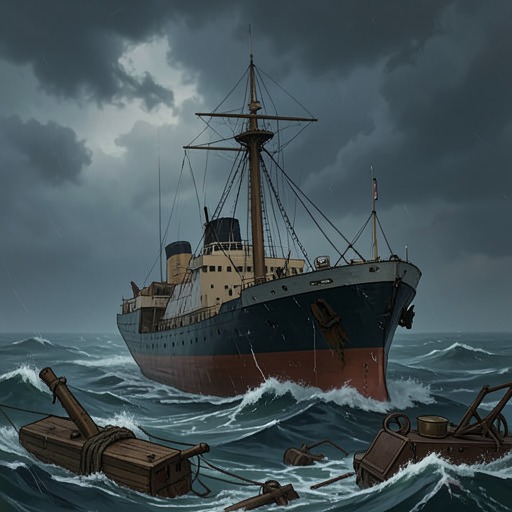
Goya’s Stern Collapses
Deception PointThe collapse of the Goya’s stern is the physical reversal that turns Tolland’s desperate attempt to survive an armed confrontation into a ship-wide crisis. By releasing and then abruptly locking the anchor spool, he jolts the vessel in the current; the damaged structure gives way, tilting the deck and setting the Kiowa gunship sliding toward Rachel inside the Triton.
The Anchor-Spool Maneuver
With a soldier pursuing him and firing, Tolland dives away from the trapdoor and rolls behind the stern anchor spool, a motorized cylinder wound with several thousand feet of steel cable attached to the ship’s anchor. The spool gives him a way to turn the Goya’s equipment against his pursuer: he grabs the anchor lock and yanks it down, releasing cable.
The Goya lurches as the current drives it backward. The sudden movement sends people and objects staggering across the deck, while the anchor cable feeds out faster and faster. Tolland waits until the soldier regains his balance and advances, then braces himself and forces the lever back up. The spool locks; the chain snaps taut, arresting the ship so sharply that the deck shudders and its occupants are thrown off balance.
Structural Failure and the Tilted Deck
The sudden stop exposes the Goya’s damaged stern to a decisive strain. A failing metal strut gives way beneath the ship, and the right stern corner begins to collapse under its own weight. The vessel tips diagonally, like a table losing a leg, while the failing structure and pounding surf overwhelm the scene.
The collapse transforms the deck from a place of pursuit into an unstable incline. The nine-ton Triton swings over the open trapdoor on its cable, and Rachel, enclosed in its cockpit, grips on as the machine sways above the steepening deck. The sea rages below the cockpit’s glass dome; the ship’s structural failure has made the water an immediate presence rather than a distant backdrop.
The People Caught in the Collapse
The shifting deck leaves the armed group and its captives struggling simply to remain aboard. A Delta soldier clamped in the Triton’s claws howls in pain as he bobs above the deck. Pickering scrambles across Rachel’s view and seizes a cleat, while Tolland hangs on near the anchor lever, close to sliding overboard.
Rachel sees another soldier with a machine gun steady himself nearby and calls a warning to Tolland. But Delta-One is looking elsewhere: the gunship helicopter, its rotors still turning, has begun to slide down the tilted deck. Its metal skids behave like skis on a slope, carrying the heavy aircraft directly toward the Triton. The collapse thus leaves Rachel threatened by the drifting machine even as Tolland and Pickering struggle against the ship’s tilt.
Reversal and Consequence
Tolland’s maneuver briefly changes the balance of the confrontation: the Goya’s movement disrupts everyone on deck and knocks the pursuing soldier off balance. Yet stopping the vessel does not restore control. The chain’s sudden tension and the damaged strut’s failure turn Tolland’s improvised tactic into a larger mechanical disaster, with the ship’s instability endangering pursuers and fugitives alike.
The stern collapse also carries the action from armed standoff toward imminent physical catastrophe. Rachel is trapped in the Triton beneath the path of a sliding helicopter; Tolland and Pickering are exposed on the sloping deck; and the trapped Delta soldier remains suspended in the sub’s claws. At this point, the ship’s failing structure has not resolved the confrontation but has made escape, balance, and survival inseparable problems.