Lee Pollock
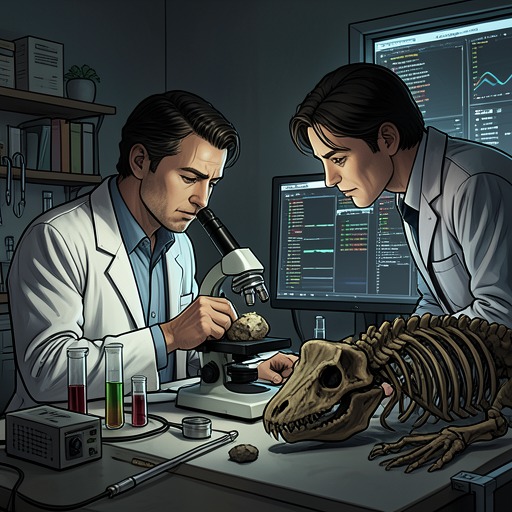
Deception PointLee Pollock is a young geologist at Drew University whose unpublished theory complicates the apparent evidence for a meteorite. After retrieving an unusual rock from the Mariana Trench, he proposed that immense oceanic and tectonic pressures could create chondrulelike features on Earth. His notes offer a terrestrial explanation for structures otherwise treated as signs of extraterrestrial origin, but the rock’s unexpectedly high nickel content keeps the meteorite possibility alive.
Identity and Discovery
Pollock is introduced through the account of Xavia, who describes him as a young geologist working with a new generation of marine robots. During deepwater crust sampling in the Mariana Trench, he brought up a loose rock containing a geological feature he had never encountered. The feature resembled chondrules, the rounded structures associated in the discussion with meteorites, but Pollock named what he saw “plagioclase stress inclusions”: tiny metallic bubbles that, he proposed, had been rehomogenized during deep-ocean pressurization.
The discovery is defined by its uncertain setting as much as by its appearance. The rock came from an ocean floor that was difficult and dangerous to study, and the strange inclusions did not immediately identify their own origin. Pollock was surprised to find metallic bubbles in an ocean rock; rather than treating that surprise as proof of an extraterrestrial source, he developed a geological explanation for how such structures might form under extreme pressure.
The Pressure Hypothesis
Pollock argued that the rock had formed in an ultradeep oceanic environment, where intense pressure metamorphosed pre-existing rock and allowed some of its different metals to fuse. Xavia first recounts the theory to Michael Tolland and Corky Marlinson as an obscure idea she encountered in Pollock’s personal notes while researching fluid-rock interactions for an upcoming megaplume program. It had never been formally published. Its limited circulation matters: it provides a possible explanation, but not one already tested or broadly established in the scientific debate unfolding around the rock.
The proposed mechanism combines two sources of compression. The Mariana Trench lies beneath seven miles of water, and Pollock’s notes describe its crust as subject not only to hydrostatic pressure but also to tectonic forces from nearby subduction zones. In the passage Xavia reads aloud, Pollock reasons that the Pacific and Indian plates move toward one another and collide in the region. He proposes that the combined forces could compress crust into an elastic or semiliquid state, allowing lighter elements to fuse into structures resembling chondrules—features thought to occur only in space.
The idea directly challenges Corky’s objection that chondrules require heat and cannot be produced by water pressure rearranging crystalline rock. Xavia answers with the established geological role of pressure in metamorphism, and Tolland recognizes that much metamorphic change occurs under extreme pressure, even though he remains doubtful that water pressure alone could chemically alter rock. Pollock’s theory is more specific than a simple appeal to the ocean’s depth: it depends on hydrostatic compression acting together with tectonic forces in a remote subduction zone.
An Alternative to the Meteorite Explanation
Corky offers a competing account rather than accepting Pollock’s theory. He suggests that Pollock may have found an actual meteorite that had fallen into the ocean. Years underwater, Corky argues, could have eroded its fusion crust, leaving it visually indistinguishable from an ordinary rock and explaining why Pollock might not have recognized it as extraterrestrial. On this reading, the ocean would conceal the meteorite’s identifying exterior rather than manufacture its chondrulelike structures.
The exchange turns on a testable property: nickel content. Corky asks whether Pollock measured the specimen, anticipating that its nickel level might help distinguish a meteorite from a terrestrial rock. Xavia finds an observation in the notes: Pollock was surprised that the specimen’s nickel content fell within a midrange value not usually associated with terrestrial rocks. That finding does not settle the origin. It undercuts an uncomplicated terrestrial classification while leaving Corky’s eroded-meteorite explanation in play.
Pollock therefore enters the narrative indirectly, through notes read and contested by other characters. He does not appear in person or deliver a final verdict on his specimen. His account instead creates a scientific uncertainty with political and evidentiary consequences: a chondrulelike feature may not be exclusive to space, yet a chemical measurement continues to make the meteorite interpretation plausible. Tolland and Rachel exchange startled looks when they hear the nickel result, marking its force in the immediate conversation without resolving the competing explanations.
Narrative Role and Limits
Pollock’s importance lies in the distinction between resemblance and proof. The specimen looks as though it bears a feature associated with meteorites; his hypothesis proposes a terrestrial process capable of producing a similar structure. The notes turn an apparently decisive visual clue into a question about geological conditions, while the nickel result prevents that alternative from closing the case. Both accounts remain conditional: Pollock’s pressure mechanism is an unpublished theory, and Corky’s explanation depends on the possibility that seawater erased the rock’s fusion crust.
The character is consequently drawn through a single intellectual contribution rather than a broader personal history. The evidence establishes his university affiliation, his use of a marine robot in the Mariana Trench, his observation of metallic inclusions, and his proposed explanation; it supplies no account of his later career or of any further contact with the investigators. Within the debate, however, his obscure notes alter what the others can responsibly infer. They make the ocean not merely the place where a meteorite might have landed, but a geological environment that could imitate some of the signatures used to recognize one.