Marjorie Tench
Deception PointMarjorie Tench is President Zach Herney’s senior adviser and one of Washington’s most formidable political operators. Her keen analytical reputation and icy manner make her an effective strategist, but her role in baiting Sedgewick Sexton, pressuring Gabrielle Ashe, and confronting Rachel Sexton places her at the center of the novel’s collision between political calculation and the truth about NASA’s meteorite discovery. Her eventual murder is not only a consequence of that hidden conflict; William Pickering recognizes that it can also be exploited for political advantage.
Identity and Political Method
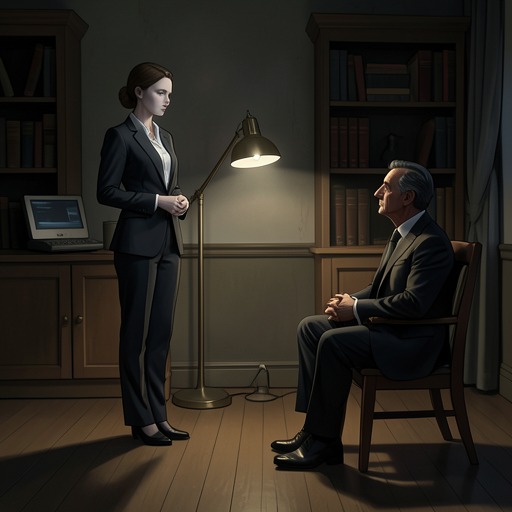
Tench is described as a six-foot, gaunt figure in her early fifties who appears considerably older. Her physical presence is rendered in severe, almost mechanical terms, matching a reputation built on formidable intelligence rather than warmth. Washington regards her as a political authority, and her decade leading the State Department’s Bureau of Intelligence and Research had sharpened the critical mind for which she was known. The President can tolerate her temperament, while few others can endure it for long.
Her manner is concise and purposeful. When she learns that a staff briefing has been scheduled for four that afternoon, she immediately offers to take the speaking position herself. The gesture establishes her as more than a background adviser: she seeks direct control of how the administration addresses an issue, and she is prepared to occupy the public stage when it serves the strategy.
Turning NASA into a Campaign Trap
Tench’s political maneuvering takes shape against Sexton’s sustained attacks on NASA. He has made the agency’s failed missions and large budget overruns central examples in his argument against government spending, despite the political risk of attacking an institution associated with national pride. His political advantage is Gabrielle, whose instincts he trusts. When Sexton asks publicly whether NASA has suffered another failure, the question gives Tench an opening to turn his own attack into a liability.
In the exchange, Tench asks whether Sexton would abolish the space agency if space exploration could not be conducted for less than NASA currently spends. Sexton’s answer gives her the public commitment she needs. She tells him she will remember it, and the first smile attributed to her accompanies the warning that others will remember it too. From the Oval Office, Herney watches the exchange and recognizes that Sexton has taken the bait. The strategy makes the senator’s anti-NASA position vulnerable to the administration’s forthcoming announcement: a claimed scientific triumph will appear especially damaging when set against Sexton’s stated willingness to abolish NASA funding.
The press and campaign consequences confirm the trap’s force. As one analyst later observes, an announcement of NASA’s discovery would benefit the President regardless of Sexton’s position, but Sexton’s public statement makes it a political double blow. Tench’s intervention thus links a carefully framed question to a wider contest over public interpretation: NASA can be presented at once as a disputed expense and as the source of a national achievement.
Pressure on Gabrielle Ashe
Tench also works to detach Gabrielle from Sexton before their association becomes an obstacle to the White House’s political plans. Gabrielle initially fears that an envelope Tench presents contains proof of their sexual relationship. She reasons that, if the White House possessed conclusive evidence, it would already have made it public. Tench then places the relationship inside a larger, long-running political conflict, telling Gabrielle that she is caught in a battle that has been unfolding behind the scenes in Washington since 1996.
Tench’s demand is explicit: Gabrielle should publicly admit to the affair. She sets an 8 p.m. deadline for an affidavit and indicates that the White House is prepared to make the allegations public. Gabrielle first suspects the deadline is meant to force her into a panicked confession or departure from Sexton’s side. Yolanda Cole offers a different reading: photographs of Gabrielle and Sexton would be politically weak if neither acknowledged their authenticity, since Sexton could dismiss them as fabricated. The pressure therefore relies not simply on possessing compromising material but on inducing Gabrielle to validate it herself.
Later, when Gabrielle arrives in the White House Map Room, she recognizes the person who has been sending her email and is startled by the identity of her correspondent. This recognition reinforces how Tench’s political work operates through private channels as well as public exchanges. Her methods bring personal vulnerability into the same campaign struggle in which she has already maneuvered Sexton over NASA.
Rachel Sexton and the Meteorite Evidence
Tench’s dealings with Rachel are marked by the administration’s effort to keep the President’s political opponents unnamed. Rachel notices that Herney speaks of “the opposition” rather than mentioning her father directly. That cautious framing reflects the difficulty of separating official investigation from campaign conflict, particularly while Sexton is attacking NASA and the White House is preparing to announce its discovery.
When Rachel tries to stop the announcement, she tells Tench that the meteorite data are wrong: the object was inserted from beneath the ice shelf, though Rachel does not know who placed it there or why. She warns that the President is about to endorse seriously mistaken information and urges Tench to intervene. Tench’s response is anger and an immediate demand to know what Rachel has told the President. The exchange places her in the path between Rachel’s urgent warning and the administration’s public commitment, without establishing that Tench accepts Rachel’s account or changes the course of the announcement.
The conflict acquires a personal and fatal consequence as the investigation proceeds. After Rachel calls Tench and accuses her of fraud, Pickering concludes that Tench will investigate the accusation relentlessly until she uncovers Rachel’s motives. He believes this is an investigation he cannot allow to continue. Tench’s determination to pursue the matter therefore makes her a threat to the hidden operation, even as her public role has been to protect the administration’s political position.
Death and Political Aftermath
Herney learns that Tench has been murdered, a revelation that reaches him while he is at his Oval Office desk. Pickering regards the death as deeply regrettable but believes it had become inevitable once Rachel’s accusation set Tench investigating. His account makes the causal stakes stark: Tench’s analytical persistence, ordinarily a political asset, now threatens to uncover information that Pickering is concealing.
Pickering also sees a political consequence in her death. Tench had publicly humiliated Sexton on CNN; her violent end could therefore generate sympathy for the White House and cast suspicion on a campaign already under pressure. In this final reversal, the strategist who had turned Sexton’s words into a trap becomes, after her death, another potential instrument in the same struggle. Tench’s character arc is consequently defined by the collision of two forms of political work: shaping what the public believes and pursuing what powerful actors need to keep hidden.