Meteorite Fossils as Evidence of Extraterrestrial Life
Deception PointMeteorite fossils as evidence of extraterrestrial life are the discovery at the center of the novel’s public drama: fossils in an eight-ton rock, announced as unequivocal proof that life exists beyond Earth. The claim is made vivid through a televised image of a giant buglike fossil embedded in charred stone, but its apparent certainty rests on scientific tests, instruments, and institutional assurances that the plot progressively puts in doubt. The fossils first transform a contested NASA program into a triumph; as evidence of tampering accumulates, they become the core of a crisis over what counts as proof and who controls its interpretation.
The claim and its public staging
President Herney presents the discovery as the result of a two-week process of confirmation. In his announcement, NASA has pulled an eight-ton meteorite from Arctic ice, and it contains dozens of fossils of a life-form. He identifies the rock as a fragment of the Jungersol Fall, said to have struck the Arctic Ocean almost three centuries earlier, and dates the fossilized organism to 190 million years ago. The fossil shown behind him is sharply delineated and enormous, its buglike form set inside a charred rock. Herney calls the fossils unequivocal proof of extraterrestrial life.
The announcement makes scientific evidence into a civic spectacle. Herney tells viewers they will hear from NASA and civilian scientists and see a documentary hosted by science celebrity Michael Tolland. He then introduces NASA administrator Lawrence Ekstrom, presenting him as the leader responsible for the achievement. Ekstrom, appearing by satellite from above the Arctic Circle, calls it NASA’s finest hour, and his account moves seamlessly into Tolland’s documentary. The sequence lends the claim the authority of the presidency, the agency, scientific experts, and broadcast images at once; it also reveals how thoroughly the discovery has become entangled with NASA’s public standing.
That spectacle has an immediate political consequence. Senator Sexton, who has been meeting with entrepreneurs, watches the announcement and freezes as his guests react in horror; he then falls to his knees before the television. The fossils’ meaning is not confined to paleontology or astrobiology. Their presentation threatens to overturn the political argument surrounding NASA by making the agency appear to have achieved a historic scientific breakthrough.
The scientific case and its limits
The discovery is initially supported by a chain of observations and tests. Two weeks before the announcement, PODS detected an unusual density anomaly beneath the ice shelf: a hard, roughly ten-foot globule about two hundred feet below the surface. The satellite system had been designed to identify density differences in large regions of ice, especially soft areas and fissures associated with melting. Its detection located an object, but the instrument’s measurement did not by itself establish what the object was or whether it contained fossils. Rachel notes that PODS measures from 120 miles above Earth and was built to distinguish broad categories such as ice from slush or granite from limestone, not necessarily finer differences such as brine ice from fresh ice.
The investigation therefore relies on instruments with different capabilities. Norah Mangor’s Ground Penetrating Radar sends electromagnetic pulses through the ice; variations in the returning reflections can reveal differences in crystal structure. Freshwater ice forms a flatter, shingled lattice, while seawater ice forms a more forked lattice because of its sodium content. The GPR can register sea ice as a shadow and produce a cross-sectional printout. When Tolland examines that printout, he sees the extraction shaft descending two hundred feet and Ming’s body floating in it, but beneath the shaft also sees a dark column of sea ice extending all the way to the open ocean. The column has the same diameter as the shaft. The image suggests that the apparent meteorite shaft continues through the ice shelf rather than ending at a naturally embedded object, making the physical placement of the discovery as important as the rock’s composition.
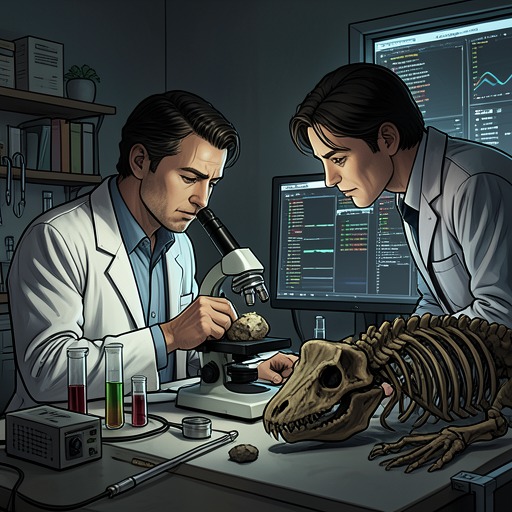
The case for authenticity nevertheless appears formidable to the scientists who examine it. Norah Mangor independently drills cores, runs tests, and confirms NASA’s estimate that the impact occurred in 1716. That year coincides with early explorers’ reported sighting of a fireball over northern Canada, the event associated with the name Jungersol Fall. Corky Marlinson argues that the rock’s chemical scans, spectrograph results, rubidium-strontium dating, and crystalline structure identify it as a genuine meteorite. He points to a flawless fusion crust, chondrules, and a nickel ratio unlike that found in terrestrial rocks. Tolland likewise says that multiple tests date the stone and fossils to 190 million years and that the nickel content is nonterrestrial. Their reasoning makes the central difficulty plain: evidence that the object was inserted under the ice challenges the discovery’s provenance, but does not, on its own, explain away every chemical and chronological result.
Contradiction, re-examination, and the false conclusion
When Rachel and Corky present the problem to William Pickering, he does not dismiss their scientific evidence. He weighs it against NASA’s potential benefit, signs of tampering, and the attack on the investigators, and concludes that a well-executed fraud is the only logical explanation. Corky resists that conclusion because he regards the chemical and crystalline features as too complex to manufacture convincingly. He produces a disc-shaped rock sample and insists that rubidium-strontium dating cannot simply be faked. Tolland initially reinforces Corky’s position: despite having presented the fossils in a persuasive documentary, he says he believes both the rock and fossils are authentic, citing their age, nickel ratios, and the results of multiple tests.
The competing evidence leaves Pickering uncertain. Rachel suggests warning the President about problems in the data, but Pickering replies that the President may already know. He stresses that, apart from the GPR printout showing an insertion shaft, the scientific results appear to support a credible NASA discovery. The apparent strength of the laboratory case and the physical evidence of artificial placement point in opposite directions. The novel makes that conflict consequential: the claim cannot be judged by one spectacular image, nor can the anomaly in the ice automatically invalidate every independent test.
A later measurement overturns the remaining confidence. Xavia arrives with a computer printout showing the titanium-to-zirconium ratios in a sample. She tells Tolland that NASA’s meteorite is an ocean rock. Rachel and Tolland understand the implication without needing it restated: a key line of compositional evidence contradicts the story that the object came from space. The fossil announcement’s certainty has depended on treating several different kinds of evidence as mutually reinforcing; the new result exposes the possibility that their apparent agreement concealed a manufactured discovery.
Rachel gathers the evidence into a physical packet while trapped in the hydrolab and determined that the truth will be told. It includes the GPR printout, images of Bathynomous giganteus, photographs and articles concerning oceanic chondrules, an electron microscan printout, and a brief handwritten note stating that the meteorite is fake. She sends the material by fax to a recipient she chooses from the few numbers she knows by heart. The objects that had supported or complicated the claim are thus converted into evidence for its exposure: a radar cross-section, biological images, geological comparisons, and a microscopic scan travel together as a counter-record to the televised announcement.
Significance of the fossils as proof
The fossils function as more than a proposed answer to whether life exists elsewhere. Their public presentation demonstrates how quickly a scientific claim can become political capital when an institution, a president, and media images converge around it. The same fossil image that makes the discovery instantly legible to viewers also encourages them to experience the conclusion as settled before they can inspect how the object was found, dated, or tested.
The investigation separates questions that the announcement had fused together: whether the fossils look biological, whether their age and composition are consistent with the claim, whether the rock is extraterrestrial, and whether it was naturally embedded in the ice. PODS can detect an anomaly without identifying its origin; GPR can reveal a shaft without determining the full chemical history of the object; dating and composition tests can support authenticity while leaving provenance unresolved. Once the titanium-to-zirconium ratio points to an ocean rock, the claim of extraterrestrial proof collapses not because the televised image changes, but because the chain connecting that image to a trustworthy discovery no longer holds.
That reversal gives the fossils their double role in the novel. At first they appear to move a familiar political fight over NASA into a radically enlarged frame: the agency is no longer merely defending a budget but claiming evidence of life beyond Earth. Later, the same extraordinary claim becomes a test of scientific scrutiny, institutional trust, and the difference between persuasive presentation and reliable proof. The wonder is real as a narrative possibility; the evidence, however, remains answerable to instruments, methods, and the possibility of fraud.