Michael Tolland
Deception PointMichael Tolland is an oceanographer, accomplished seaman, and nationally recognizable science-documentary host whose assignment to authenticate NASA’s meteorite discovery places communication and investigation side by side. Recruited in part for his ability to make science intelligible to the public, he initially helps present the discovery as credible; as questions accumulate, he becomes a careful investigator and a resourceful survivor. His work with Rachel Sexton ultimately exposes the fragility of the assumptions behind the discovery, while their shared ordeal reopens a possibility of love after the death of his wife, Celia.
Identity and Public Role
Tolland is introduced to Rachel at NASA’s Arctic facility as another of President Herney’s civilian recruits. His informal clothes distinguish him from the staff in matching NASA weather gear: a black turtleneck, corduroys, and heavy boat shoes. Rachel does not recognize his name at first, but recognizes him immediately when she sees his face. He greets her with easy warmth and asks her to call him Mike, establishing a relaxed manner that contrasts with the high-stakes surroundings.
His public identity rests on Amazing Seas, a weekly documentary series that brings viewers into contact with oceanic phenomena. The program’s appeal is attributed to his knowledge, enthusiasm, adventurousness, rugged looks, and self-effacing charisma; commentators compare him to Jacques Cousteau and Carl Sagan. Yet the image of a television personality does not capture his practical experience. His callused hands reflect a life as a seaman and hands-on researcher, and his expertise at sea later proves directly useful under pressure.
Tolland is candid with Rachel about why he has been recruited. He suspects his public-relations value matters more than his specific scientific knowledge of meteorites. Herney wants him to make a documentary about the discovery, even though Tolland is an oceanographer rather than a meteorite documentarian. The President’s aim is to lend the find mainstream credibility and include Tolland’s film in the evening’s announcement. The assignment thus makes him both an investigator and part of the machinery presenting the discovery to the public.
The Discovery and Its Presentation
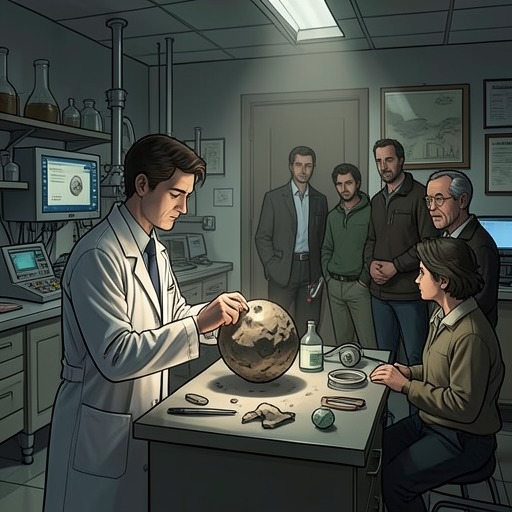
Tolland contributes to the examination of the meteorite alongside Rachel and Corky Marlinson. When Corky confirms the rock’s extraterrestrial origin, Tolland directs Rachel to turn the specimen over. The gesture marks a change in the inquiry: the important question is no longer simply whether the rock came from space, but what the evidence on its other side means. Tolland does not supply the answer for Rachel; he gives her the view that allows her to recognize the problem.
He also works closely with the other scientists in assessing the site. When Rachel praises Norah Mangor’s knowledge of ice, Tolland confirms that her independent dating work supports NASA’s result: Mangor’s estimate of an impact in 1716 matches the year NASA had established before the team arrived. This confirmation strengthens the scientific case at that moment, but the later investigation shows how an apparently corroborating result can coexist with a deeper problem in the assumptions surrounding the meteorite.
At the same time, Tolland turns the investigation into a public-facing film. As the meteorite is extracted from the ice, he edits footage of the operation with interviews of the civilian scientists. The completed documentary runs fifteen minutes and presents the discovery in language accessible to an average American viewer without condescension. Even Ekstrom, initially cynical about Herney’s decision to recruit a television host, is impressed by the result. Tolland’s skill is not merely visibility: he can translate technical material into a clear narrative. That strength also carries a risk, since a compelling explanation can make an unverified premise feel settled.
From Suspicion to Investigation
Tolland’s confidence in the NASA account begins to fracture when the team encounters the glowing water in the extraction pit. Looking into it, he identifies flagellates, and his serious response makes clear that the phenomenon is not a joke to him. The observation becomes one part of the growing conflict between the official story and what the investigators can see for themselves.
Rachel’s later challenge forces him to reconsider the meteorite from first principles. She asks him to set aside everything he has been told about where the sample was found and what it is. Looking at the rock slice again, Tolland recognizes that his reading of its fossils has depended on a single premise: that they were found inside a meteorite. The question does not instantly prove the rock false, but it reveals how the framing of evidence can direct even a trained observer’s analysis. Tolland’s willingness to entertain Rachel’s test makes him a partner in inquiry rather than merely a spokesman for the discovery.
On the flight back toward Washington, he accepts that the evidence remains divided. Corky regards the chondrules as conclusive proof that the rock is a meteorite, and Tolland agrees that the Milne Ice Shelf sample appears authentic despite the suspicions Rachel has raised. He is impressed by her resilience after the ordeal at sea and by her continued effort to determine both whether the meteorite is genuine and who tried to kill them. Their discussions draw him closer to her even before the investigation reaches its answer.
Once aboard the Goya, Tolland asks Xavia to help test the disputed claims. He checks the ship’s stored Project Diversitas database, an offline collection of marine biological data updated whenever the vessel is in port, searching for prehistoric marine fossils that resemble those in the NASA sample. The investigation uses the resources of his own field: rather than treating the meteorite as an isolated object, he compares its supposed contents against the record of oceanic life. Xavia’s challenge to the claim that the rock’s metallic inclusions could form only in space further destabilizes what Tolland had accepted from NASA. His documentary’s authoritative narration now becomes a point of comparison with the evidence, not a substitute for it.
Survival and Leadership
Tolland’s knowledge of the sea also shapes his actions when the investigators are attacked. As the group is forced onto an ice floe, he sees a discarded Mylar weather balloon and at first judges it useless: it is designed to carry a light observational payload and there is no helium tank. A memory of learning spinnaker-flying as a child changes his assessment. He realizes the balloon might serve as a sail, turning a small, specialized object into a desperate means of escape. The plan is a long shot, but remaining where they are means certain death, so he acts on the possibility rather than waiting for a safe solution.
After the group reaches the floating ice, Tolland understands that their survival is temporary. The Arctic current will carry them far from the ice shelf, but distance offers no immediate rescue; without the insulation of their gel-filled Mark IX suits, they would already be dead, and he estimates they have perhaps thirty to forty-five minutes. As exhaustion and cold weaken him, his perspective narrows to the sea and ice around him. The apparent calm and his failing ability to stay conscious make survival a physical limit, not a victory already secured.
Rachel later brings him and Corky before William Pickering aboard the Charlotte and recounts the chain of evidence: the luminous plankton, the insertion shaft beneath the meteorite, and the armed team’s attack. Tolland’s presence in this briefing connects his field observations to the effort to establish what happened. He is not only a witness to the expedition’s danger; he helps carry its findings into the next stage of the investigation.
When the violence reaches the Goya, Tolland again acts under pressure. He pulls the wounded Rachel toward cover and assesses the ship’s layout, rejecting the exposed stairs and glass-walled bridge as unsafe. The Triton submersible offers no simple refuge: it holds only one person, takes time to deploy, and cannot operate properly without charged batteries and compressors. Later, when an armed assailant forces him toward the control panel, Tolland uses the moment to direct Rachel into the open Triton hatch. He then releases the anchor lock, sending cable from the motorized spool and making the vessel lurch in the current. The maneuver disrupts the attack and gives Rachel a chance to escape, though it also sends events beyond his control.
The boat and submersible are soon in danger, but Tolland reaches Rachel again in the water and tries to open the Triton’s hatch before it sinks. When the oceanic vortex forms, Rachel swims toward a light until Tolland catches her ankle and turns her toward another route. She recognizes his hand and follows his direction, trusting his judgment when her own sense of the way out points elsewhere. His practical knowledge of the sea, first displayed as documentary expertise and then as improvisation, becomes the difference between being informed about danger and acting within it.
Relationships, Grief, and Change
Tolland’s relationship with Rachel develops amid their shared work and danger. He first meets her with an easy introduction; later, he takes evident pleasure in talking with her during the flight, and is surprised to miss her when she leaves her seat. Their connection is not separate from the investigation: Rachel’s questions unsettle his assumptions, and his willingness to take those questions seriously supports her effort to re-examine the evidence.
That attachment meets the lasting absence of Celia, his dead wife. The narration records that, in the years after her death, Tolland endured loneliness and periods when he wanted to die, yet chose to continue living alone. Holding Rachel’s hand makes him understand what his friends had been telling him: he does not have to manage life by himself, and another love remains possible. At the same moment, the possibility hurts because the danger around them makes a future uncertain. The memory of Celia’s final request that he find another love gives the moment both tenderness and irony; Tolland senses the emotional armor he has maintained beginning to fall away.
By the end of the supplied arc, Tolland is defined by a movement from public certainty toward hard-won attentiveness. He begins as the recognizable face enlisted to make a national discovery comprehensible, but his strongest contribution comes when he tests the account, listens to Rachel, and adapts to circumstances in which established plans fail. His intimacy with Rachel is likewise a change rather than a simple resolution: after years of grief and self-reliance, he can imagine loving again, while the immediate danger still denies him any assurance about what comes next. His character joins two forms of survival—scientific willingness to revise a conclusion and personal willingness to remain open to life.