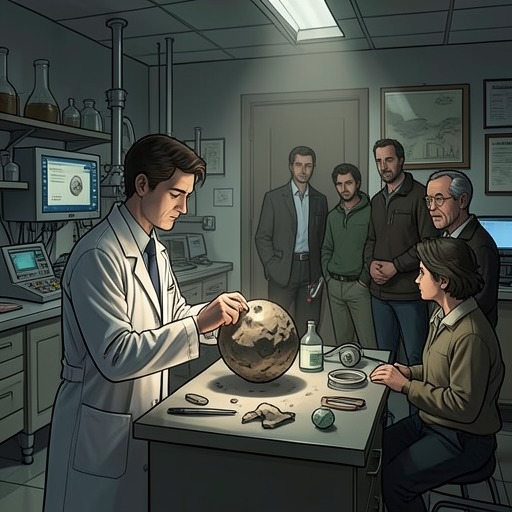
Milne Ice Shelf meteorite
Deception PointThe Milne Ice Shelf meteorite is the story’s central material contradiction: a charred, water-dripping stone hailed as proof of life beyond Earth, then revealed by a scan of the ice beneath it to have been deliberately inserted. Its dramatic emergence appears to confirm NASA’s account of an ancient fall; its hidden route through the shelf overturns the history that made the find persuasive.
Identification and Claimed History
Before the extraction, Norah Mangor’s independently drilled cores and tests had confirmed NASA’s estimate that the meteorite struck in 1716. That date also matched an account by early explorers of a bright fireball over northern Canada. The meteor was known as the Jungersol Fall, named for the expedition’s leader, and the matching core dates and historical record seemed to identify the ice-bound stone as a fragment of that event.
The agreement among independent measurements, historical testimony, and the physical object gave the claim unusual force. The meteorite was not simply an unexplained rock: it appeared to carry its own date, connecting a record of a fireball centuries earlier to a present-day discovery in the ice. The later revelation that it had been planted does not undo those details; it changes what they can establish. The evidence had supported an impact date and a historical connection, but neither could prove that this particular stone had lain in the shelf since 1716.
Extraction and Physical Appearance
As the ice thinned, the meteorite first appeared as an indistinct, oblong shadow, becoming clearer as it emerged. The extraction crew tightened its winches and kept the tension even; the scaffolding creaked as the stone rose. When it broke the surface, it did so with steam, then hung free on its cables above an open shaft of simmering water. The retrieval converted a distant astronomical history into a heavy object before the assembled scientists and technicians.
In the fluorescent light, the wet, rugged surface looked charred and rippled. One end was smooth and rounded, apparently worn by friction during atmospheric entry, while the dark fusion crust made the stone seem to preserve the violence of its passage through the sky. Water ran from the rock as it dangled above the shaft. The image offered a persuasive material narrative: a once-burning object, now captured and suspended, its surface seeming to bear the marks of an ancient descent.
The shaft left by the extraction was about two hundred feet deep and filled with melted water. Its waterline stood roughly four feet below the glacier surface, a difference attributed to the removed meteorite’s mass and to ice shrinking as it melts. Mangor quickly placed SHABA pylons around the opening. The walls were solid ice without footholds, so anyone who slipped in would be unable to climb out unaided. The stone’s recovery therefore left behind a hazardous void as well as an object for examination.
The Discovery’s First Meaning
The extraction initially looked like the culmination of a successful scientific effort. The assembled group watched in silence as the shadow sharpened, then erupted into applause and cheers once the rock was free. Lawrence Ekstrom congratulated Mangor, and Rachel Sexton felt a sudden joy for NASA, whose fortunes had been poor. To her, the meteorite seemed to turn that history around: the rock contained what the group understood as proof that humanity was not alone in the universe.
That response depends on two claims being fused together. The stone’s apparent extraterrestrial origin gave the fossils inside it their extraordinary significance, while its supposed connection to the 1716 Jungersol Fall supplied an account of how it had reached the ice. In the moment of triumph, the extracted object seemed to make both claims visible at once. The suspense of its emergence and the crowd’s celebration register how completely its physical presence seemed to settle the question.
The later evidence separates the claims. The GPR printout showed the extraction shaft descending through the ice and a dark column of sea ice continuing directly beneath it toward the open ocean. That column was the same diameter as the shaft. Norah Mangor concluded that someone had drilled upward from below the shelf and inserted the meteorite. The scan did not, by itself, negate the fossils; it undermined the provenance that had made the discovery appear to be an untouched remnant of an ancient fall.
The Scan and the Reversal
The shift from discovery to suspicion begins with the GPR image in Michael Tolland’s hands. He had just seen Wailee Ming’s floating body in the shaft and was struggling to interpret the printout. Its cross-section placed the body in the extraction hole, but the feature below the shaft mattered more: a massive pillar of sea ice ran down through the shelf toward the ocean. Rachel recognized the implication, and Mangor named it as an intentional insertion. The meteorite’s apparent resting place was connected to a passage from beneath.
Tolland could reconstruct how such a placement might have been accomplished. Because the shelf floated over the ocean, a submersible could approach from below; underwater, the stone would weigh significantly less. Even a small craft comparable to Tolland’s one-person research Triton could carry it in payload arms, drill upward through the ice, and push the meteorite into a prepared shaft with an extending arm or inflatable balloons. Water rising behind the stone would then freeze. Once the shaft had closed enough to hold it, the craft could withdraw, leaving the remaining tunnel to seal naturally and obscure the intervention.
The plankton supplied a further constraint on the timeline. Phosphorescent dinoflagellates could have swum upward into the shaft and become trapped beneath the meteorite as the water froze. When the stone was later heated, the ice below it melted and released them; they swam upward into the habisphere, where they eventually died without saltwater. Mangor argued that the plankton could not have survived in the ice for centuries: the meteorite had been inserted within the previous year. The same natural process that had helped make the shaft difficult to detect thus helped date the deception.
Provenance and Significance
Once the GPR evidence appeared, the 1716 date no longer secured the meteorite’s identity as a piece of the Jungersol Fall. Mangor stated that the object had been inserted recently and was not part of that recorded meteor. Rachel wanted another scan before drawing a conclusion, asking who would believe the charge; Corky Marlinson likewise questioned why NASA would go to the trouble of burying a fossil-bearing meteorite if the fossils were real. Their uncertainty shows how difficult it was to separate the object’s contents from the story built around its location.
The meteorite’s importance lies in that unstable relation between matter and evidence. Its fusion crust, rounded end, fossils, and apparent association with a historic fireball made it legible as a visitor from another world. The GPR column did not make the stone less real; it made its placement newly conspicuous. A rock that had seemed to testify directly to deep time became the center of a dispute about who had put it there, when, and what the discovery could honestly prove.
Its two appearances therefore pull in opposite directions. During extraction, the suspended, dripping stone appears to close the investigation: the hunt is over, and the crowd celebrates what it believes the object proves. After the scan, the same stone becomes evidence that the investigation was manipulated. The reversal is not merely from wonder to doubt; it is a change in the question asked of the object, from what world it came from to what human actions placed it beneath the ice.