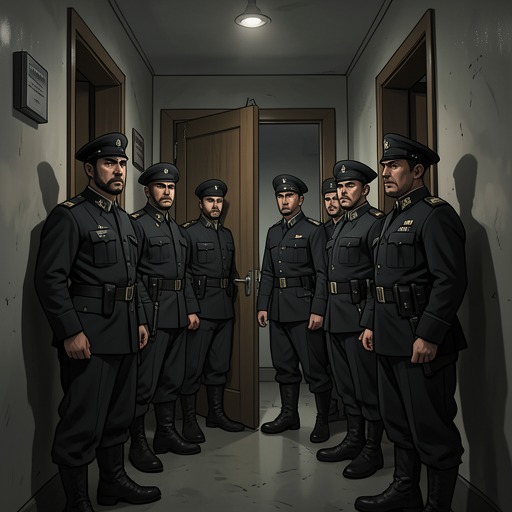
Monocaput management
Deception PointMonocaput management is a command arrangement for exceptionally secret Delta Force missions: instead of relying on the traditional multilayer chain of command, a single controller is given authority to direct the unit as that person sees fit. The rule concentrates operational power while limiting what the soldiers know about the mission and its sponsor, making secrecy a feature of the command structure rather than merely a condition imposed on it.
Definition and Command Structure
The arrangement is presented as an alternative to ordinary military hierarchy. A controller, typically a military or government powerbroker with enough rank or influence to run the operation, holds authority over the team. The controller's identity does not change the mission's classification: Delta Force operations remain classified at the highest level, and their participants are expected to keep silent even after the work is finished.
That silence is expressed in the unit's compact maxim, “Fly. Fight. Forget.” The phrase captures three dimensions of the system: the operators may be sent to act, but afterward they are not to discuss the operation even among themselves or with their Special Operations commanders. In effect, the ordinary channels through which actions might be reviewed or questioned are narrowed by the same secrecy that enables the mission.
Application to the Arctic Surveillance Mission
The Delta team stationed north of the Eighty-second Parallel is assigned to watch a structure rather than immediately attack it. Its instructions are concise: monitor the structure inside and out, and report unexpected developments to the controller. The mission's unusual nature does not prompt Delta-One to challenge the arrangement; he has learned to accept assignments without surprise.
The briefing itself demonstrates how the rule works in practice. It is delivered through secure electronic channels, with every phase explained remotely, and Delta-One has never met the controller. When a message arrives through the CrypTalk device, the operators respond to the alert without knowing who personally stands behind the orders. Centralized authority and restricted knowledge therefore coexist: the team can receive direction without access to the person or broader rationale directing it.
Secrecy, Accountability, and the Novel's Conflicts
The novel sets this covert command model against other institutions where authority and information are also divided. William Pickering objects when the President contacts Rachel Sexton directly for intelligence work while refusing to explain the purpose to him, Rachel's director; Pickering's complaint makes visible the friction between formal oversight and a secret executive request. The broader plot later reveals that Pickering himself has directed a clandestine program, illustrating how concentrated control can place consequential decisions beyond ordinary institutional scrutiny.
In the account of that program, Pickering's concern about protecting the National Reconnaissance Office's deep-sea hydrophones leads to a covert effort that discovers unknown fossils and geological formations in the Mariana Trench. Because the capability and findings are classified, they cannot be publicly shared. The later meteorite deception grows out of efforts to preserve agencies and political support, but Pickering insists that the President and NASA do not know the meteorite is inauthentic. These disclosures distinguish the rule's operational logic from the moral and political choices made under cover of secrecy: a controller can direct a mission, but secrecy does not make its consequences disappear or settle who should answer for them.
Monocaput management thus supplies a mechanism for action without broad disclosure. Its dramatic force lies in the imbalance it creates: operators receive orders but not necessarily context, while the controller can act beyond the ordinary chain of command. The same structure that protects sensitive operations also makes hidden decisions harder to supervise, and the novel's revelations show how that gap can extend from surveillance and intelligence work into deception and lethal consequences.